
Effects of Azolla microphylla and Effective Microorganisms on Rice Production in Cement Pots for Small-Scale Farming
Article Sidebar
Main Article Content
Abstract
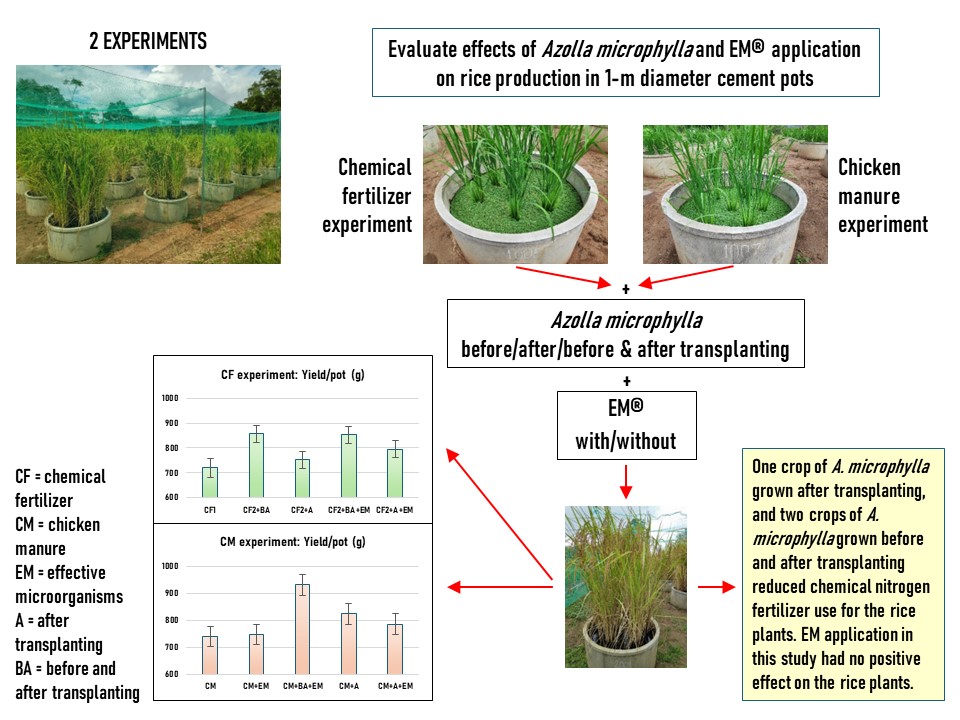
Azolla is a nitrogen-fixing aquatic fern that can potentially reduce the use of synthetic nitrogen fertilizer in rice production, while effective microorganisms (EM) are widely promoted to enhance crop growth. This study evaluated the effects of Azolla microphylla and EM on rice production in 1-m- diameter cement pots under chemical fertilizer (CF) and chicken manure (CM) fertilization systems. Two experiments were conducted using glutinous rice cultivar ‘Sakhon Nakhon’ in Loei Province, Thailand. Treatments included A. microphylla grown before transplanting (BA) or after transplanting (A), with or without EM application. Results showed that A. microphylla grown in BA significantly increased tiller number, plant height, and panicle number in both CF and CM experiments. Grain weight/hill and yield/pot tended to be highest in treatments with A. microphylla grown BA, although differences were not always statistically significant. One crop of A. microphylla grown A and two crops grown BA reduced the requirement for chemical nitrogen fertilizer. EM application to the water showed no positive effects on rice growth or yield. These results indicate that integrating A. microphylla, particularly when grown prior to transplanting, is a practical and beneficial strategy for small-scale rice production in cement pots, whereas EM application under these conditions is not recommended.
Article Details

This work is licensed under a Creative Commons Attribution-NonCommercial-NoDerivatives 4.0 International License.
The content and information in the article published in Journal of Rajamangala University of Technology Srivijaya It is the opinion and responsibility of the author of the article. The editorial journals do not need to agree. Or share any responsibility.
References
Abd El-Mageed, T.A., Rady, M.M., Taha, R.S., Abd El Azeam, S., Simpson, C.R. and Semida, W.M. 2020. Effects of integrated use of residual sulfur-enhanced biochar with effective microorganisms on soil properties, plant growth and shortterm productivity of Capsicum annuum under salt stress. Scientia Horticulturae 261: 108930. DOI: https://doi.org/10.1016/j.scienta.2019.108930
Addeo, N.F., Nocera, F.P., Toscanesi, M., Trifuoggi, M., Bovera, F., Martino, L.D. and Prisco, R.D. 2023. On effect of poultry manure treatment with effective microorganisms with or without zeolite. Environmental Science and Pollution Research 30: 91189-91198. DOI: https://doi.org/10.1007/s11356-023-28793-2
Adhikary, R. and Shrestha, R.K. 2018. Efficacy of Azolla pinnata in rice (Oriza sativa L.) production in Nepal. Advance Research in Agriculture and Veterinary Science 5(1): 4-6.
Adhikari, K., Bhandari, S. and Acharya, S. 2021. An overview of Azolla in rice production: A review. Reviews in Food and Agriculture 2(1): 4-8. DOI: https://doi.org/10.26480/rfna.01.2021.04.08
Alshammari, N.I., Bairum, R.S., Sulieman, A.M.E., Jamal, A., Alamoudi, M., Elamin, H.B. and Veettil, V.N. 2022. Control of tomato wilt disease fungus Fusarium oxysporum f.sp. Lycopersicon by single or combine interaction of mycorrhiza, Trichoderma harzianum, and effective microorganisms (Microbial Blend). Journal of Pure and Applied Microbiology 16(2): 1362-1369. DOI: https://doi.org/10.22207/JPAM.16.2.64
Amaral, E.J., Pereira, L.M.S., Lorençon, E., Poggere, G.C., Agustini, M.A.B. and Edwiges, T. 2025. Valorization of biowastes through pre-composting followed by vermicomposting with the addition of effective microorganisms. International Journal of Environmental Research 19(9): 1-15. DOI: https://doi.org/10.1007/s41742-024-00689-0
Arora, A. and Singh, P.K. 2003. Comparison of biomass productivity and nitrogen fixing potential of Azolla spp. Biomass and Bioenergy 24: 175-178. DOI: https://doi.org/10.1016/S0961-9534(02)00133-2
Bhuvaneshwari, K. and Singh, P.K. 2015. Response of nitrogen-fixing water fern Azolla biofertilization to rice crop. 3 Biotech 5: 523-529. DOI: https://doi.org/10.1007/s13205-014-0251-8
Cui, Q., Xia, J., Yang, H., Liu, J. and Shao, P. 2021. Biochar and effective microorganisms promote Sesbania cannabina growth and soil quality in the coastal saline-alkali soil of the Yellow River Delta, China. Science of The Total Environment 756, 143801. DOI: https://doi.org/10.1016/j.scitotenv.2020.143801
de Macale, M.A.R. and Vlek, P.L.G. 2004. The role of Azolla cover in improving the nitrogen use efficiency of lowland rice. Plant and Soil 263: 311-321. DOI: https://doi.org/10.1023/B:PLSO.0000047742.67467.50
Domenico, P. 2019. Effective microorganisms for germination and root growth in Kalanchoe daigremontiana. World Journal of Advanced Research and Reviews 3(3): 47-53. DOI: https://doi.org/10.30574/wjarr.2019.3.3.0074
El-Hadidy, A.M.A. and El-Ati, A.A.A. 2014. Efficiency of effective microorganisms (EM) to induce resistance against chocolate spot disease and enhance productivity of faba bean under reclaimed soil conditions. Egyptian Journal of Phytopathology 42(1): 117-142. DOI: https://doi.org/10.21608/ejp.2014.96742
Higa, T. and Parr, J.F. 1994. Beneficial and effective microorganisms for a sustainable agriculture and environment. International Nature Farming Research Center, Atami, Japan.
Jusoh, M.L.C., Manaf, L.A. and Latiff, P.A. 2013. Composting of rice straw with effective microorganisms (EM) and its influence on compost quality. Iranian Journal of Environmental Health Sciences & Engineering 10: 17. DOI: https://doi.org/10.1186/1735-2746-10-17
Kanareugsa, C., Swatdee, P., Khonthasuvon, S., Loudhapasittiporn, L. and Suphakumnerd, N. 1984. Azolla for rice production in Thailand. Development in Plant and Soil Sciences 13: 179-187. DOI: https://doi.org/10.1007/978-94-009-6201-9_17
Khair, M.I.M., Azman, E.A., Ismail, R. and Rani, M.N.F.A. 2021. Effect of the biofertilizer (Azolla pinnata) in combination with inorganic fertilizers on growth and yield of rice. Grassroots Journal of Natural Resources 4(4): 59-75. DOI: https://doi.org/10.21203/rs.3.rs-871462/v1
Komboonruang, V., Sanwong, W., Siripanitcharoen, S. and Promnart, P. 1995. Efficiency of effective microorganisms (EM) on increasing rice yield. Thai Agricultural Research Journal 13(2): 110-116. (in Thai)
Kumar, P.A., Chozhan, K., Dhevagi, P., Mahimairaja, S., Prabhu, R. and Poornima, R. 2022. A comparative study of effective microorganisms (EM) and biocompost in the decomposition of coconut waste material. Journal of Applied and Natural Science 14(Suppl. I): 129-137. DOI: https://doi.org/10.31018/jans.v14iSI.3598
Lu, H., Peng, M., Zhang, G., Li, B., and Li, Y. 2019. Brewery wastewater treatment and resource recovery through long term continuous-mode operation in pilot photosynthetic bacteria-membrane bioreactor. Science of The Total Environment 646: 196-205. DOI: https://doi.org/10.1016/j.scitotenv.2018.07.268
Marzouk, S.H., Tindwa, H.J., Amuri, N.A. and Semoka, J.M. 2023. An overview of underutilized benefits derived from Azolla as a promising biofertilizer in lowland rice production. Heliyon 9(1), e13040. DOI: https://doi.org/10.1016/j.heliyon.2023.e13040
Mayer, J., Scheid, S., Widmer, F., Fließbach, A. and Oberholzer, H. 2010. How effective are ‘effective microorganisms® (EM)’? results from a field study in temperate climate. Applied Soil Ecology 46(2): 230-239. DOI: https://doi.org/10.1016/j.apsoil.2010.08.007
Megali, L., Glauser, G. and Rasmann, S. 2014. Fertilization with beneficial microorganisms decreases tomato defenses against insect pests. Agronomy for Sustainable Development 34: 649-656. DOI: https://doi.org/10.1007/s13593-013-0187-0
Meng, L., Rahman, A., Han, S.H., Kim, S.B., Cho, M.S. and Park, B.B. 2018. Growth of Zelkova serrata seedlings in a containerised production system treated with effective microorganisms and biochar. Journal of Tropical Forest Science 30(1): 49-57. DOI: https://doi.org/10.26525/jtfs2018.30.1.4957
Myint, C.C. 1996. Nature farming research in Myanmar: Effect of organic amendments and EM on rice production, pp. 151-162. In Parr, J.F., Hornick, S.B. and Simpson, M.E. eds. Proceedings of the 3rd International Conference on Kyusei Nature Farming. Santa Barbara, CA., USA. 5-7 October 1993.
Namsivayam, S.K.R., Narendrakumar, G. and Kumar, J.A. 2011. Evaluation of effective microorganism (EM) for treatment of domestic sewage. Journal of Experimental Science 2(7): 30-32.
Olle, M. and Williams, I.H. 2013. Effective microorganisms and their influence on vegetable production - A review. Journal of Horticultural Science & Biotechnology 88(4): 380-386. DOI: https://doi.org/10.1080/14620316.2013.11512979
Pszczółkowski, P., Sawicka, B., Barba´s, P., Skiba, D. and Krochmal-Marczak, B. 2023. The use of effective microorganisms as a sustainable alternative to improve the quality of potatoes in food processing. Applied Science 13: 7062. DOI: https://doi.org/10.3390/app13127062
Razavipour, T., Moghaddam, S.S., Doaei, S., Noorhosseini, S.A. and Damalas, C.A. 2018. Azolla (Azolla filiculoides) compost improves grain yield of rice (Oryza sativa L.) under different irrigation regimes. Agricultural Water Management 209: 1-10. DOI: https://doi.org/10.1016/j.agwat.2018.05.020
Renseigné, N. 2006. Foliar application of effective microorganisms on pea as an alternative fertilizer. Agronomy for Sustainable Development 26(4): 257-262. DOI: https://doi.org/10.1051/agro:2006024
Saidia, P.S. and Mrema, J.P. 2017. Effects of farmyard manure and activated effective microorganisms on rain-fed upland rice in Mwanza, Tanzania. Organic Agriculture 7: 83-93. DOI: https://doi.org/10.1007/s13165-016-0154-6
Sanwong, P., Sanitchon, J., Dongsansuk, A. and Jothityangkoon, D. 2023. High temperature alters phenology, seed development and yield in three rice varieties. Plants (Basel) 12(3): 666. DOI: https://doi.org/10.3390/plants12030666
Setiawati, M.R., Prayoga, M.K., Stöber, S., Adinata, K. and Simarmata, T. 2020. Performance of rice paddy varieties under various organic soil fertility strategies. Open Agriculture 5: 509-515. DOI: https://doi.org/10.1515/opag-2020-0050
Singh, D.P. and Singh, P.K. 1986. Relative effects of Azolla pinnata and its combination with chemical nitrogen fertilizer on growth, yield and N uptake of rice. The Journal of Agricultural Science 106(1): 107-112. DOI: https://doi.org/10.1017/S0021859600061803
Suraphonphinit, A., Phakamas, N. and Samart, S. 2023. Rate of Azolla microphylla dry matter on nitrogen use efficiency and yield of Japonica rice. International Journal of Agricultural Technology 19(6): 2681-2692.
Suriyakup, P., Polthanee, A., Pannangpetch, K., Katawatin, R. and Mouret, J.C. 2007. The effects of mungbean residue on growth and yield of direct seeded rice in rice-mungbean mixed cropping in flooded soil. Khon Kaen Agriculture Journal 35(3): 320-327.
Talaat, N.B. 2015. Effective microorganisms improve growth performance and modulate the ROS-scavenging system in common bean (Phaseolus vulgaris L.) plants exposed to salinity stress. Journal of Plant Growth Regulation 34: 35-46. DOI: https://doi.org/10.1007/s00344-014-9440-2
Thapa, P. and Poudel, K. 2021. Azolla: Potential biofertilizer for increasing rice productivity, and government policy for implementation. Journal of Wastes and Biomass Management (JWBM) 3(2): 62-68. DOI: https://doi.org/10.26480/jwbm.02.2021.62.68
Ventura, W. and Watanabe, I. 1993. Green manure production of Azolla microphylla and Sesbania rostrata and their long-term effects on rice yields and soil fertility. Biology and Fertility of Soils 15: 241-248. DOI: https://doi.org/10.1007/BF00337207
Yamuangmorn, S., Rinsinjoy, R., Lordkaew, S., Dell, B. and Prom-u-thai, C. 2020. Responses of grain yield and nutrient content to combined zinc and nitrogen fertilizer in upland and wetland rice varieties grown in waterlogged and well-drained condition. Journal of Soil Science and Plant Nutrition 20: 2112-2122. DOI: https://doi.org/10.1007/s42729-020-00279-x
Yang, G., Ji, H., Liu, H., Feng, Y., Zhang, Y., Chen, L. and Guo, Z. 2021. Nitrogen fertilizer reduction in combination with Azolla cover for reducing ammonia volatilization and improving nitrogen use efficiency of rice. PeerJ 9: e11077. DOI: https://doi.org/10.7717/peerj.11077
Yanrong, W., Shinji, I., Miki, T., Zetian, H., Sanyuan, Z. and Guijin, D. 2006. Effects of effective microorganisms continual application in paddy fields in natural farming. Chinese Journal of Rice Science 20(4): 443-446. (in Chinese)
Yao, Y., Zhang, M., Tian, Y., Zhao, M., Zeng, K., Zhang, B., Zhao, M. and Yin, B. 2018. Azolla biofertilizer for improving low nitrogen use efficiency in an intensive rice cropping system. Field Crops Research 216: 158-164. DOI: https://doi.org/10.1016/j.fcr.2017.11.020
