
Effects of Protein- and Carbohydrate-Based Foaming Agents on Foam Stability and Microstructure in Freeze-Dried Coffee
Article Sidebar
Main Article Content
Abstract
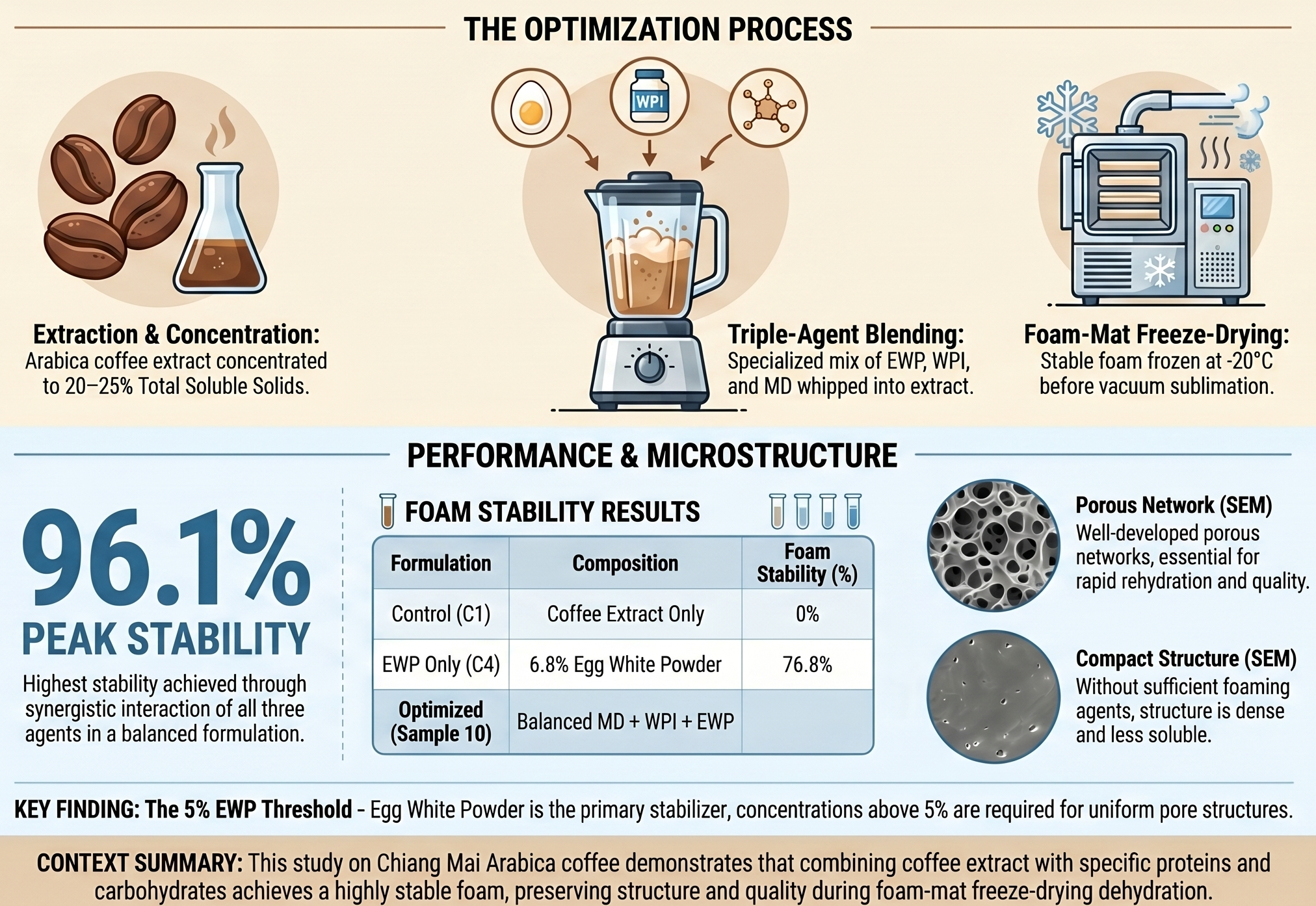
The development of high-quality instant coffee products is essential for increasing market accessibility and economic value for local coffee producers. This study investigates the effect of various foaming agents including maltodextrin, whey protein isolate, and egg white powder on the foam stability and microstructure of coffee extracts processed via foam-mat freeze drying. Coffee extract prepared from roasted Arabica beans sourced from Plang Yai community in Chiang Mai, Thailand, was combined with ten different formulations of foaming agents ranging from 0 – 10% (w/w) and evaluated through foam stability testing and scanning electron microscopy (SEM). The control group consisted of a sole coffee extract without foaming agents added. The results showed that egg white powder was the most effective foaming agent, yielding stable foams and uniform pore structures, particularly at concentrations above 5%. While maltodextrin and whey protein isolate alone did not produce stable foams, they enhanced structural stability when used in combination with egg white powder. SEM imaging further confirmed that the optimal formulations exhibited well-developed porous networks, crucial for drying efficiency and product rehydration. The highest foam stability (96.1%) was achieved with a balanced formulation of all three agents. These findings confirm the synergistic interaction between proteins and carbohydrates in foam stabilization, offering a robust method for producing premium instant coffee. The integration of this approach enables smallholder enterprises to expand product lines while maintaining quality, enhancing the economic sustainability of coffee farming communities.
Article Details

This work is licensed under a Creative Commons Attribution-NonCommercial-NoDerivatives 4.0 International License.
The content and information in the article published in Journal of Rajamangala University of Technology Srivijaya It is the opinion and responsibility of the author of the article. The editorial journals do not need to agree. Or share any responsibility.
References
Anandharamakrishnan, C. 2019. Spray-Freeze-Drying of Coffee. In Caffeinated and Cocoa-Based Beverages. Elsevier, Amsterdam. DOI: https://doi.org/10.1016/B978-0-12-815864-7.00010-6
Bangkok Post. 2024. Coffee market posts healthy growth. Bangkok Post. Available Source: https://www.bangkokpost. com/business/general/2804719/coffee-market-posts-healthy-growth, April 24, 2025.
Bhatta, S., Stevanovic Janezic, T. and Ratti, C. 2020. Freeze-drying of plant-based foods. Foods 9(1): 87. DOI: https://doi.org/10.3390/foods9010087
Campbell, G.M. and Mougeot, E. 1999. Creation and characterisation of aerated food products. Trends in Food Science and Technology 10(9): 283-296. DOI: https://doi.org/10.1016/S0924-2244(00)00008-X
Chen, X. and Zhang, L. 2022. Comparison of freeze-dried and spray-dried coffee: Sensory and physicochemical properties. Food Research International 158: 111577.
Dickinson, E. 2003. Interfacial, emulsifying and foaming properties of milk proteins, pp. 629-692. In Fox, P.F. and McSweeney, P.L.H., eds. Advanced Dairy Chemistry-1 Proteins. 3rd ed. Springer, New York. DOI: https://doi.org/10.1007/978-1-4419-8602-3_33
Ganaie, T.A., Masoodi, F.A., Rather, S.A. and Gani, A. 2021. Exploiting maltodextrin and whey protein isolate macromolecules as carriers for the development of freeze dried honey powder. Carbohydrate Polymer Technologies and Applications 2(1): 100040. DOI: https://doi.org/10.1016/j.carpta.2021.100040
Hamad, A., Mulyadi, A.H., Yulianti, H., Hartanti, D. and Naveed, M. (2024). Foaming agents affect the physicochemical and antioxidants in red dragon fruit powder drinks from foam mat drying. Journal of Applied Science, Engineering, Technology, and Education 3(1), 58–66. DOI: https://doi.org/10.35877/454RI.asci3327
Hossain, M.A., Ahmed, T., Ferdaus, J. and Zzaman, W. 2024. Optimization of the foam-mat drying process to develop high-quality tomato powder: A response surface methodology approach. Heliyon 10(21): e39811. DOI: https://doi.org/10.1016/j.heliyon.2024.e39811
Kaya, Z. and He, J. 2018. Optimization of freeze-drying conditions for coffee extract. Journal of Food Engineering 230: 26-34.
Liu, Y. and Kim, J. 2020. Impact of freeze-drying on the microstructure of coffee particles. Journal of Agricultural and Food Chemistry 68(12): 3409-3418.
Lomakina, K. and Míková, K. 2006. A study of the factors affecting the foaming properties of egg white – A review. Czech Journal of Food Sciences 24: 110–118. DOI: https://doi.org/10.17221/3305-CJFS
Maciel, K.S., Teixeira, L.J.Q., Lucia, S.M.D. and Saraiva, S.H. 2022. Optimization of foam mat drying for instant coffee processing and its effect on drying kinetics and quality characteristics. Drying Technology 40(9): 1866–1880. DOI: https://doi.org/10.1080/07373937.2021.1887210
Michael, M. 2023. Moisture optimization and heating process automation of freeze-dried coffee production: A case study at Jacobs Douwe Egberts Peet's. Master of Science (Industrial Engineering), University of Twente.
Mine, Y. 1995. Competitive adsorption of egg white proteins at the air–water interface: Direct evidence for electrostatic complex formation between lysozyme and other egg proteins at the interface. Journal of Agricultural and Food Chemistry 46(3): 872–876. DOI: https://doi.org/10.1021/jf970722i
Muthukumaran, A., Ratti, C. and Raghavan, V.G.S. 2021. Foam-mat freeze drying of egg white and mathematical modeling Part I: Optimization of egg white foam stability. Journal of Food Engineering 285: 110092.
Ozcelik, M. and Kulozik, U. 2023. The role of maltodextrin concentration in maintaining storage stability of dried fruit foams texturized using plant protein–polysaccharide blends. Foods 12(8): 1673. DOI: https://doi.org/10.3390/foods12081673
Poopan, B., Kasorn, A., Puttarat, N., Kasemwong, K., Pachekrepapol, U. and Taweechotipatr, M. 2024. Freeze drying microencapsulation using whey protein, maltodextrin and corn powder improved survivability of probiotics during storage. Food Science and Biotechnology 34: 959–970. DOI: https://doi.org/10.1007/s10068-024-01706-w
Raikos, V., Dufresne, M. and McClements, D.J. 2007. Effect of protein type on the formation and stability of food foams. Food Hydrocolloids 21(3): 345–354.
Ratti, C. 2001. Hot air and freeze-drying of high-value foods: A review. Journal of Food Engineering 49(4): 311-319. DOI: https://doi.org/10.1016/S0260-8774(00)00228-4
Rizzi, G.P. 2016. Volatile retention in freeze-dried coffee. Food Chemistry 210: 585-591.
This Side Up. 2025. Thailand beanspire. This side up. Available Source: https://thissideup.coffee/beanspire, April 24, 2025.
Waghmare, R.B. and Kumar, M. 2024. Freeze‐Drying: Basic Principles and Processes. Wiley, Hoboken. DOI: https://doi.org/10.1002/9781119982098.ch1
Xiang, J., Liu, F., Wang, B., Chen, L., Liu, W. and Tan, S. 2021. A literature review on Maillard reaction based on milk proteins and carbohydrates in food and pharmaceutical products: Advantages, disadvantages, and avoidance strategies. Foods 10(9): 1998. DOI: https://doi.org/10.3390/foods10091998
