
An Integrated Lean-Visual-Green (LVG) Model for Warehouse Layout Optimization and Carbon Footprint Reduction: A Case Study in the Food Products Industry
Article Sidebar
Main Article Content
Abstract
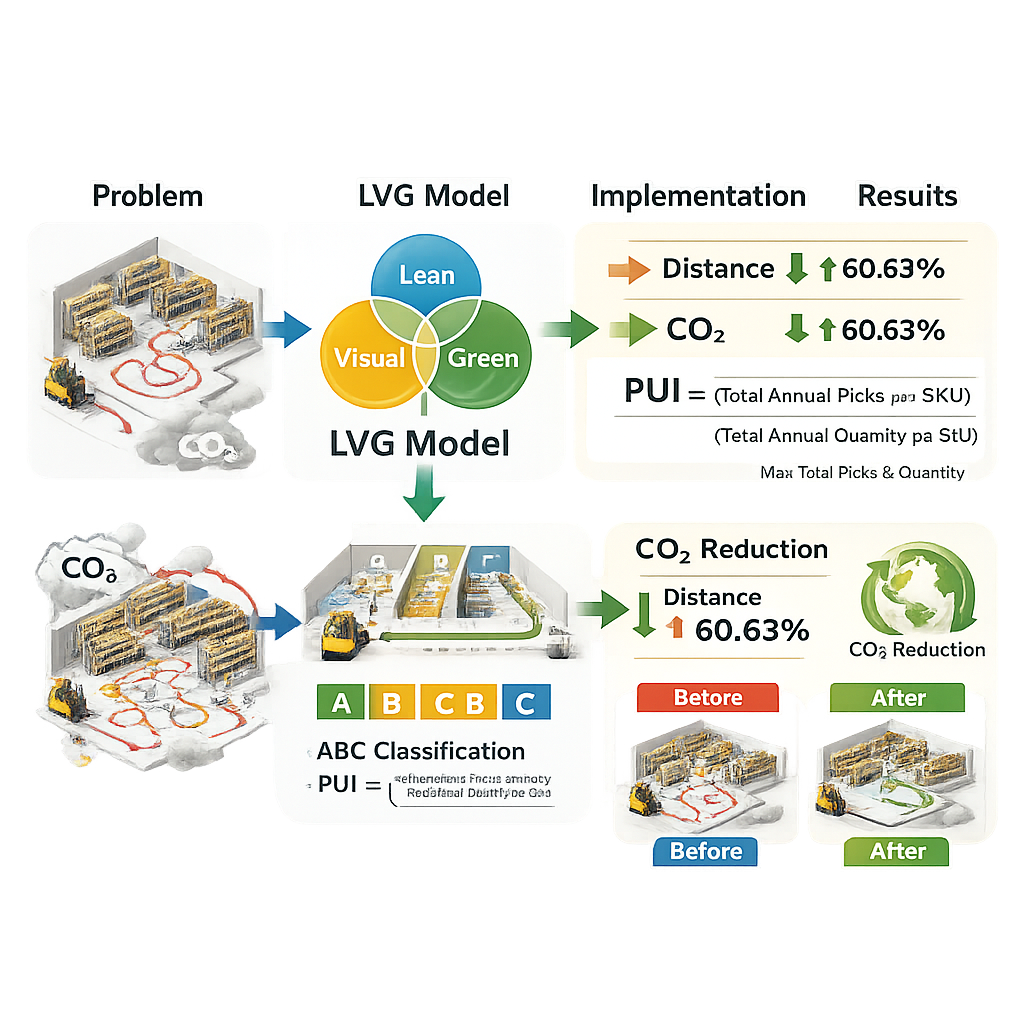
In modern industrial logistics, managing warehouses presents a key challenge-enhancing operational efficiency while minimizing environmental impact. However, existing studies on lean and green warehouse practices often address these dimensions separately, with limited integration into a unified framework applicable in real industrial contexts. This study proposes an integrated Lean–Visual–Green (LVG) model that combines waste reduction, visual control, and environmental impact assessment into a single analytical approach. Unlike conventional lean–green models, the LVG framework incorporates visual management to enhance operational clarity and support layout decision-making. A before–after comparative design was applied in a finished-goods warehouse in the food products industry with 81 stock-keeping units (SKUs). One year of historical data was analyzed to develop a Product Utilization Index (PUI), which was used for ABC classification and warehouse layout redesign. Following implementation, forklift travel distance decreased from 3,519,647.28 to 1,385,685.20 meters per year (-60.63%), with a corresponding reduction in CO2 emissions from 35,372.49 to 13,926.11 kgCO2 per year. The results demonstrated that the LVG model provides a practical and integrative approach for improving warehouse efficiency and reducing environmental impact through data-driven layout optimization.
Article Details

This work is licensed under a Creative Commons Attribution-NonCommercial-NoDerivatives 4.0 International License.
The content and information in the article published in Journal of Rajamangala University of Technology Srivijaya It is the opinion and responsibility of the author of the article. The editorial journals do not need to agree. Or share any responsibility.
References
Abdolazimi, O., Esfandarani, M.S. and Shishebori, D. 2021b. Design of a supply chain network for determining the optimal number of items at the inventory groups based on ABC analysis: A comparison of exact and meta-heuristic methods. Neural Computing and Applications 33(12): 6641–6656. DOI: https://doi.org/10.1007/s00521-020-05428-y
Abdolazimi, O., Shishebori, D., Goodarzian, F., Ghasemi, P. and Appolloni, A. 2021a. Designing a new mathematical model based on ABC analysis for inventory control problem: A real case study. RAIRO - Operations Research 55(4): 2309–2335. DOI: https://doi.org/10.1051/ro/2021104
Accorsi, R., Bortolini, M., Gamberi, M., Manzini, R. and Pilati, F. 2017. Multi-objective warehouse building design to optimize the cycle time, total cost, and carbon footprint. The International Journal of Advanced Manufacturing Technology 92(1–4): 839–854. DOI: https://doi.org/10.1007/s00170-017-0157-9
Agyabeng-Mensah, Y., Ahenkorah, E., Afum, E., Dacosta, E. and Tian, Z. 2020. Green warehousing, logistics optimization, social values and ethics and economic performance: The role of supply chain sustainability. The International Journal of Logistics Management 31(3): 549–574. DOI: https://doi.org/10.1108/IJLM-10-2019-0275
De Assis, T.F., De Abreu, V.H.S., Marujo, L.G. and De Almeida D’Agosto, M. 2024. Best practices applied in logistic intern: From the perspective of reducing the carbon footprint, pp. 313–336. In S.S. Muthu (ed.). Carbon Footprint Assessments. Springer Nature Switzerland. DOI: https://doi.org/10.1007/978-3-031-70262-4_13
Dekker, R., Bloemhof, J. and Mallidis, I. 2012. Operations research for green logistics – An overview of aspects, issues, contributions and challenges. European Journal of Operational Research 219(3): 671–679. DOI: https://doi.org/10.1016/j.ejor.2011.11.010
Domagała, J. 2022. Green warehousing: A state-of-the-art literature review, pp. 43–71. In Domagała, J., Górecka, A. and Roman, M., eds. Sustainable Logistics. Productivity Press, New York. DOI: https://doi.org/10.4324/9781003304364-4
Dües, C.M., Tan, K.H. and Lim, M. 2013. Green as the new lean: How to use lean practices as a catalyst to greening your supply chain. Journal of Cleaner Production 40: 93–100. DOI: https://doi.org/10.1016/j.jclepro.2011.12.023
Fercoq, A., Lamouri, S. and Carbone, V. 2016. Lean/green integration focused on waste reduction techniques. Journal of Cleaner Production 137: 567–578. DOI: https://doi.org/10.1016/j.jclepro.2016.07.107
Füchtenhans, M., Glock, C.H., Grosse, E.H. and Zanoni, S. 2023. Using smart lighting systems to reduce energy costs in warehouses: A simulation study. International Journal of Logistics Research and Applications 26(1): 77-95. DOI: https://doi.org/10.1080/13675567.2021.1937967
Garza-Reyes, J.A. 2015. Lean and green – A systematic review of the state-of-the-art literature. Journal of Cleaner Production 102: 18–29. DOI: https://doi.org/10.1016/j.jclepro.2015.04.064
International Organization for Standardization. 2006. Environmental management-life cycle assessment-principles and Framework. Available Source: https://www.iso.org/standard/37456.html
Jerbi, A., Jribi, H., Aljuaid, A.M., Hachicha, W. and Masmoudi, F. 2022. Design of supply chain transportation pooling strategy for reducing CO2 emissions using a simulation-based methodology: A case study. Sustainability 14(4): 2331. DOI: https://doi.org/10.3390/su14042331
Kaabi, H. 2022. Comparative analysis of multi criteria inventory classification models for ABC analysis. International Journal of Information Technology and Decision Making 21(5): 1617–1646. DOI: https://doi.org/10.1142/S0219622022500262
Kumar, V. and Adil, G.K. 2025. Sustainable warehouse management: A literature review and future research agenda. Management Research Review 48(3): 358-382. DOI: https://doi.org/10.1108/MRR-03-2024-0226
Kumar, V., Das, D. and Bardhan, A.K. 2022. Carbon footprint implications of demand and supply uncertainties in supply chains: A simulation study. International Journal of Modelling and Simulation 42(4): 680-705. DOI: https://doi.org/10.1080/02286203.2021.1965827
Vanesa, L. and Helma, H. 2023. Analysis of raw material inventory control using the ABC analysis method and EOQ method in the Fajar onion crackers business. Mathematical Journal of Modelling and Forecasting 1(1): 1–9. DOI: https://doi.org/10.24036/mjmf.v1i1.7
Luca, C., Sara, P., Alessia, D.C., Behzad, N. and Rinaldi, F. 2025. Sustainable logistics facilities: A simulation-based approach towards warehouse decarbonization within the food and beverage industry. Procedia Computer Science 253: 1545-1554. DOI: https://doi.org/10.1016/j.procs.2025.01.216
Mashud, A.H.M., Roy, D., Chakrabortty, R.K., Tseng, M.L. and Pervin, M. 2022. An optimum balance among the reduction in ordering cost, product deterioration and carbon emissions: A sustainable green warehouse. Environmental Science and Pollution Research 29(51): 78029-78051. DOI: https://doi.org/10.1007/s11356-022-21008-0
Nantee, N. and Sureeyatanapas, P. 2021. The impact of logistics 4.0 on corporate sustainability: A performance assessment of automated warehouse operations. Benchmarking: An International Journal 28(10): 2865–2895. DOI: https://doi.org/10.1108/BIJ-11-2020-0583
Nicoletti, B. and Appolloni, A. 2024. Green warehouse 5.0. The future of industry, pp. 303–320. In Appolloni, A., Kumar, V., Kuzmin, E. and Akberdina, V. eds. Springer Nature Switzerland. Springer, Cham. DOI: https://doi.org/10.1007/978-3-031-66801-2_20
Perotti, S. and Colicchia, C. 2023. Greening warehouses through energy efficiency and environmental impact reduction: A conceptual framework based on a systematic literature review. The International Journal of Logistics Management 34(7): 199–234. DOI: https://doi.org/10.1108/IJLM-02-2022-0086
Priyan, S. 2024. A blockchain-based inventory system with lot size-dependent lead times and uncertain carbon footprints. International Journal of Information Management Data Insights 4(1): 100225. DOI: https://doi.org/10.1016/j.jjimei.2024.100225
Rajković, M., Zrnić, N., Kosanić, N., Borovinšek, M. and Lerher, T.L. 2019. A multi-objective optimization model for minimizing investment expenses, cycle times and CO2 footprint of an automated storage and retrieval systems. Transport 34(3): 275-286. DOI: https://doi.org/10.3846/transport.2019.9686
Ray Silaen, B., Nasution, M. and Muti’ah, R. 2024. Implementation of the ABC analysis to the inventory management. International Journal of Science, Technology and Management 5(4): 816–825. DOI: https://doi.org/10.46729/ijstm.v5i4.1144
Shih-Che Lo. 2022. A particle swarm optimization approach to solve the vehicle routing problem with cross-docking and carbon emissions reduction in logistics management. Logistics 6(3): 62. DOI: https://doi.org/10.3390/logistics6030062
Sousa Jabbour, A.B.L., Jabbour, C.J.C., Godinho Filho, M. and Roubaud, D. 2018. Industry 4.0 and the circular economy: A proposed research agenda and original roadmap for sustainable operations. Annals of Operations Research 270(1–2): 273–286. DOI: https://doi.org/10.1007/s10479-018-2772-8
Thaicarbonlabel. 2025. Carbon label registration review meeting schedule (All labels). Available Source: https://thaicarbonlabel.tgo.or.th/, Mach 31, 2025. (in Thai)
Wang, S., Tao, F. and Shi, Y. 2018. Optimization of location–routing problem for cold chain logistics considering carbon footprint. International Journal of Environmental Research and Public Health 15(1): 86. DOI: https://doi.org/10.3390/ijerph15010086
Yaman, C. 2024. A review on the process of greenhouse gas inventory preparation and proposed mitigation measures for reducing carbon footprint. Gases 4(1): 18-40. DOI: https://doi.org/10.3390/gases4010002
Yasir, K., Shen, J. and Lin, J. 2024. Sustainable logistics: Synergizing passive design and PV–battery systems for carbon footprint reduction. Buildings 14(10): 3257. DOI: https://doi.org/10.3390/buildings14103257
Zheng, P., Zhang, K., Zhang, S., Wang, R. and Wang, H. 2017. The door-to-door recycling scheme of household solid wastes in urban areas: A case study from Nagoya, Japan. Journal of Cleaner Production 163: S366–S373. DOI: https://doi.org/10.1016/j.jclepro.2016.03.106
