
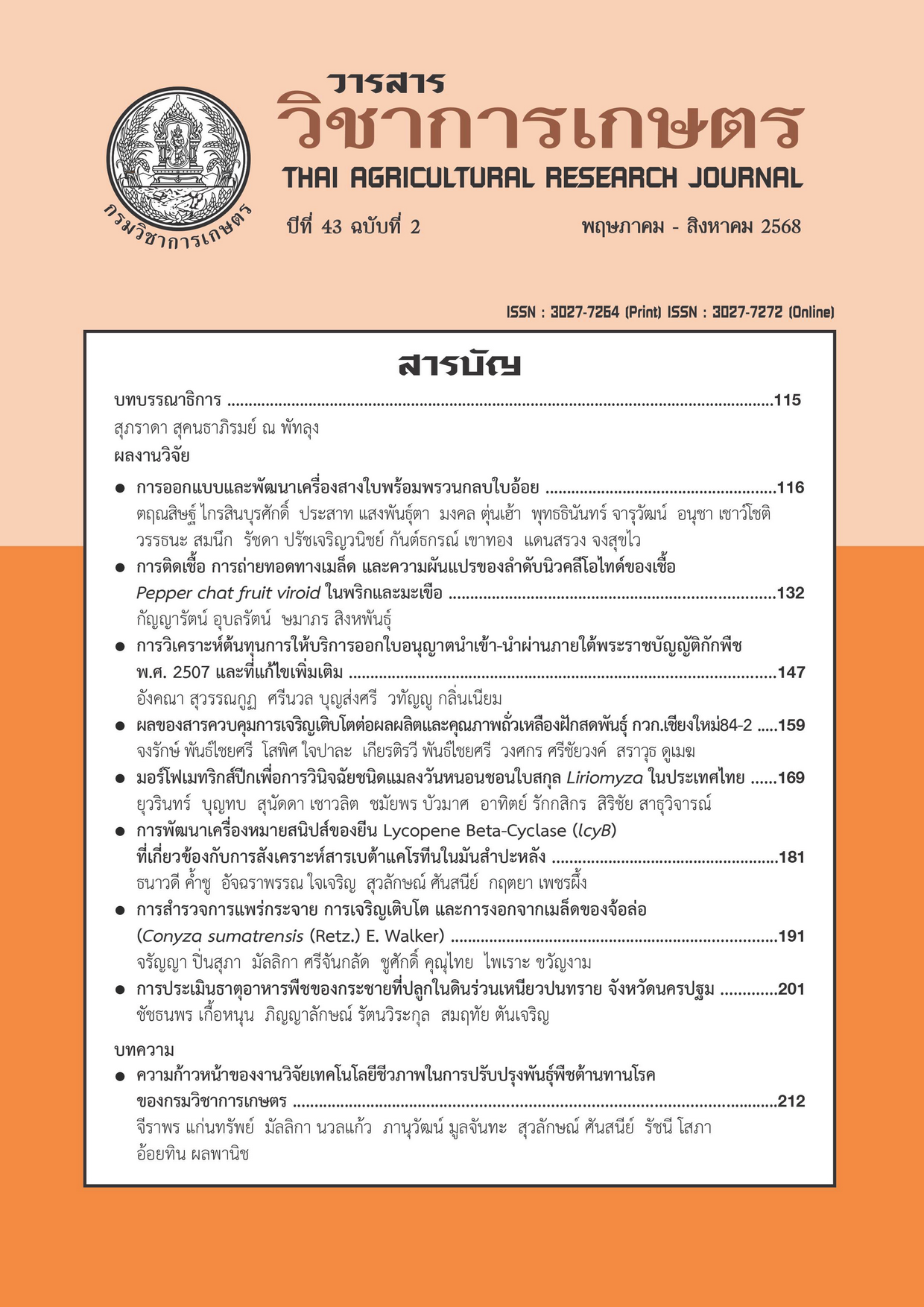
SNPs Marker Development for Lycopene Beta-Cyclase (lcyB) Gene Related to Beta-Carotene Biosynthesis in Cassava
DOI:
https://doi.org/10.14456/thaidoa-agres.2025.15Keywords:
SNPs marker, lycopene beta-cyclase gene, beta-carotene biosynthesis, cassavaAbstract
Single nucleotide polymorphisms (SNPs) molecular markers can be effectively applied to select various traits in plant breeding. The objectives of this study were to develop SNPs markers for the lycopene beta-cyclase (lcyB) gene, which is related to beta-carotene biosynthesis in cassava, to examine the genetic variation of SNPs by using the polymerase chain reaction-restriction fragment length polymorphism technique, and to analyze beta-carotene content in the fresh root. Twenty cassava cultivars/lines (10 cultivars/lines of yellow fresh root and 10 cultivars/lines of white fresh root) were used in the experiments. The results showed that the yellow fresh root group had beta-carotene content ranging from <40.00-172.93 µg/100g, with the MPER297 variety exhibiting the highest beta-carotene content. In contrast, the white fresh root group contained beta-carotene levels below 40.00 µg/100g. A total of 44 SNPs in the lcyB gene were identified, along with 12 restriction enzymes capable of cutting nucleotides at the SNPs positions. Among these 12 SNPs markers of lcyB, 8 SNPs showed polymorphism while 4 SNPs were monomorphism. The polymorphic information contents for these SNPs ranged from 0-0.50, with SNP lcyB g.1673969 having the highest. The accuracy of these markers varied from 0-75%, with SNP lcyB g.1674619 demonstrating an accuracy of 75%. This marker can be used for selecting cassava varieties with high beta-carotene content.
References
จิณณจาร์ หาญเศรษฐสุข ประพิศ วองเทียม อุมาพร รักษาพราหมณ์ จิตติลักษณ์ พลพวก จารุวรรณ บางแวก และจินดา จิตจักร. 2559. การจำแนกและประเมินลักษณะทางคุณภาพของหัวคุณสมบัติทางเคมีฟิสิกส์ของแป้งและคุณภาพของท่อนพันธุ์ในเชื้อพันธุ์มันสำปะหลัง. ใน: รายงานผลงานเรื่องเต็มการทดลองที่สิ้นสุดโครงการวิจัยและพัฒนาพันธุ์มันสำปะหลัง. ศูนย์วิจัยพืชไร่ระยอง สถาบันวิจัยพืชไร่และพืชทดแทนพลังงาน กรมวิชาการเกษตร. 163 หน้า.
Anderson, J.A., G.A. Churchill, J.E. Autrique, S.D. Tanksley and M.E. Sorrells. 1993. Optimizing parental selection for genetic linkage maps. Genome. 36(1): 181-186.
Belalcazar, J., D. Dufour, M.S. Andersson, M. Pizarro, J. Luna, L. Londoño, N. Morante, A.M. Jaramillo, L. Pino, L.A.B. LÓpez-Lavalle, F. Davrieux, E.F. Talsma and H. Ceballos. 2016. High-throughput phenotyping and improvements in breeding cassava for increased carotenoids in the roots. Crop Science. 56(6): 2916-2925.
Bio Basic Inc. 2019. What is “HAP?”. Available at: https://biobasic-asia.com/sevices/oligo-synthesis-2/oligo-synthesis-overview/. Accessed: January 18, 2019.
Carvalho, L.J., M.A. Agustini, J.V. Anderson, E.A Vieira, C.R. de Souza, S. Chen, B.A. Schaal and J.P. Silva. 2016. Natural variation in expression of genes associated with carotenoid biosynthesis and accumulation in cassava (Manihot esculenta Crantz) storage root. BMC Plant Biology. 16: 133.
Codjia, E.D., B. Olasanmi, C.E. Ugoji and I.Y. Rabbi. 2023. SNP-based marker-assisted selection for high provitamin A content in African cassava genetic background. South African Journal of Science. 119: 11-12.
de Albuquerque, H.Y.G, C.D. Carmo, A.C. Brito and E.J. Oliveira. 2018. Genetic diversity of Manihot esculenta Crantz. germplasm based on single-nucleotide polymorphism markers. Annals of Applied Biology. 173(3): 271-284.
Esuma, W., L. Herselman, M.T. Labuschagne, P. Ramu, F. Lun, Y. Baguma, E.S. Buckler and R.S. Kawuki. 2016. Genome-wide association mapping of provitamin A carotenoid content in cassava. Euphytica. 212(1): 97-110.
Kawuki, R.S., M. Ferguson, M. Labuschagne, L. Herselman and D.J. Kim. 2009. Identification, characterisation and application of single nucleotide polymorphisms for diversity assessment in cassava (Manihot esculenta Crantz). Molecular Breeding. 23(4): 669-684.
Luo, X., K.I. Tomlins, L.J.C.B. Carvalho, K. Li and S. Chen. 2018. The analysis of candidate genes and loci involved with carotenoid metabolism in cassava (Manihot esculenta Crantz.) using SLAF-seq. Acta Physiologiae Plantarum. 40(4): 66.
Maziya-Dixon, B.B. and A.G.O. Dixon. 2015. Carotenoids content of yellow-fleshed cassava genotypes grown in four agroecological zones in Nigeria and their retinol activity equivalents (RAE). Journal of Food, Agriculture & Environment. 13(2): 63-69.
Munzuroglu, O., F. Karatas and H. Geckil, 2003. The vitamin and selenium contents of apricot fruit of different varieties cultivated in different geographical regions. Food Chemistry. 83(2): 205-212.
NEBcutter. 2019. NEBcutter V2.0. Available at: https://nc2.neb.com/NEBcutter2/. Accessed: January 18, 2019.
Phytozome. 2019. Gene Manes.09G008200. Available at: https://phytozome.jgi.doe.gov/pz/portal.html. Accessed: January 18, 2019.
Primer3. 2019. Primer3. Available at: https://primer3.org. Accessed: January 18, 2019.
Udoh, L., M. Gedil, E.Y. Parkes, P. Kulakow, A. Adesoye, C. Nwuba and I.Y. Rabbi. 2017. Candidate gene sequencing and validation of SNP markers linked to carotenoid content in cassava (Manihot esculenta Crantz). Molecular Breeding. 37(10): 123.
Welsch, R., J. Arango, C. Bär, B. Salazar, S. Al-Babili, J. Beltrán, P. Chavarriaga, H. Ceballos, J. Tohme and P. Beyer. 2010. Provitamin A accumulation in cassava (Manihot esculenta) roots driven by a single nucleotide polymorphism in a phytoene synthase gene. The Plant Cell. 22(10): 3348-3356.
Downloads
Published
How to Cite
Issue
Section
License
Copyright (c) 2025 Thai Agricultural Research Journal

This work is licensed under a Creative Commons Attribution-NonCommercial-NoDerivatives 4.0 International License.
Thai Agricultural Research Journal

