
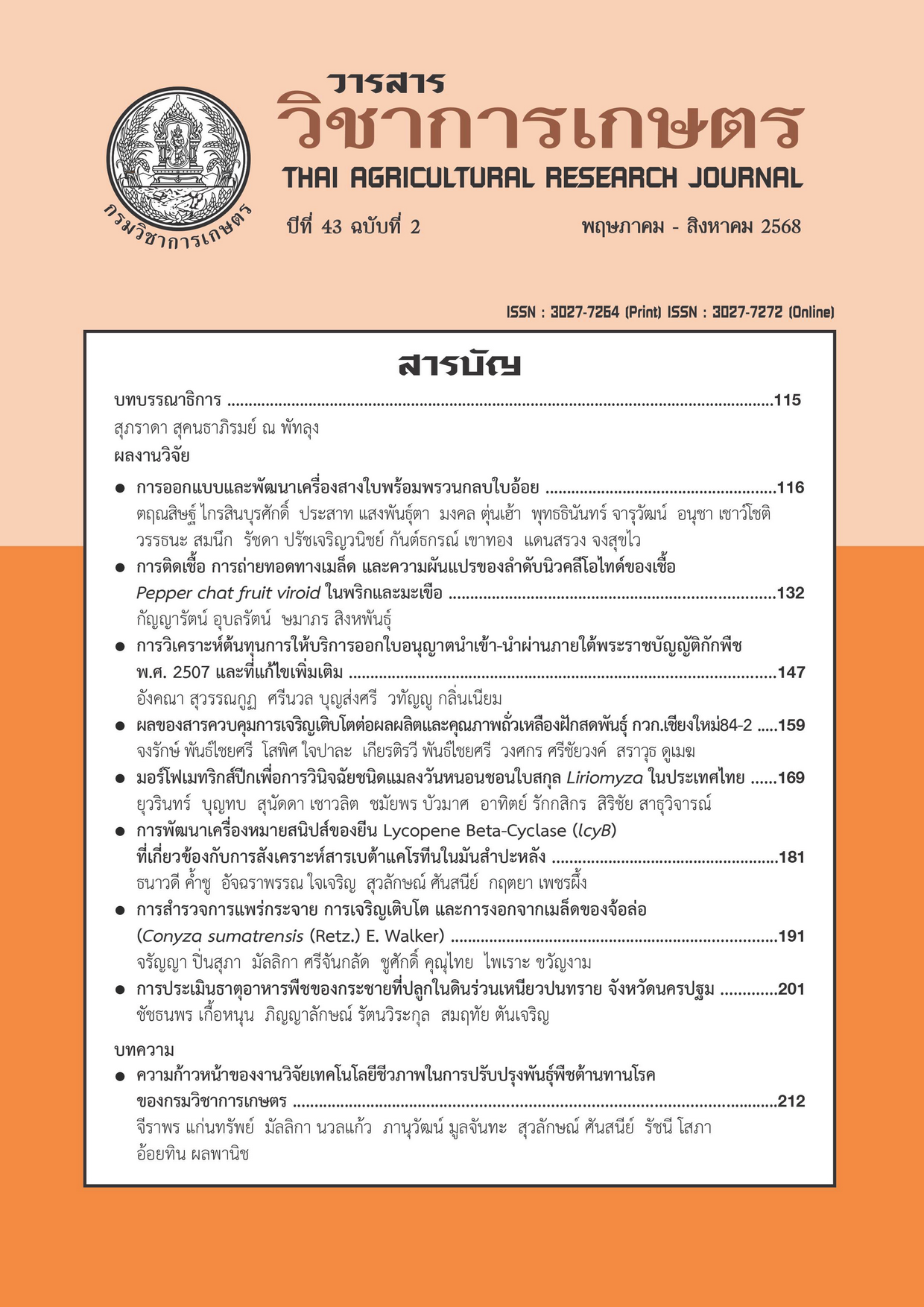
การพัฒนาเครื่องหมายสนิปส์ของยีน Lycopene Beta-Cyclase (lcyB) ที่เกี่ยวข้องกับการสังเคราะห์สารเบต้าแคโรทีนในมันสำปะหลัง
DOI:
https://doi.org/10.14456/thaidoa-agres.2025.15คำสำคัญ:
เครื่องหมายสนิปส์, ยีน lycopene beta-cyclase, การสังเคราะห์สารเบต้าแคโรทีน, มันสำปะหลังบทคัดย่อ
เครื่องหมายโมเลกุล single nucleotide polymorphisms (SNPs) สามารถนำมาประยุกต์ใช้ในการคัดเลือกลักษณะต่าง ๆ ในงานปรับปรุงพันธุ์พืชได้อย่างมีประสิทธิภาพ จึงพัฒนาเครื่องหมาย SNPs ของยีน lycopene beta-cyclase (lcyB) ซึ่งเกี่ยวข้องกับการสังเคราะห์สารเบต้าแคโรทีนในมันสำปะหลัง ศึกษาความผันแปรทางพันธุกรรมของตำแหน่ง SNPs โดยใช้เทคนิค polymerase chain reaction-restriction fragment length polymorphism และวิเคราะห์ปริมาณสารเบต้าแคโรทีนในหัวสดมันสำปะหลัง 20 พันธุ์/สายพันธุ์ (กลุ่มสีเนื้อหัวสดสีเหลือง 10 พันธุ์/สายพันธุ์ และกลุ่มสีเนื้อหัวสดสีขาว 10 พันธุ์/สายพันธุ์) พบว่า กลุ่มสีเนื้อหัวสดสีเหลืองมีปริมาณสารเบต้าแคโรทีนในหัวสด <40.00-172.93 ไมโครกรัม/100 ก. ซึ่งพันธุ์ MPER297 มีปริมาณสารเบต้าแคโรทีนสูงสุด และกลุ่มสีเนื้อหัวสดสีขาวปริมาณสารเบต้าแคโรทีนในหัวสด <40.00 ไมโครกรัม/100 ก. สำหรับความผันแปรทางพันธุกรรมของตำแหน่ง SNPs ของยีน lcyB พบทั้งหมด 44 ตำแหน่ง และค้นหาเอนไซม์ตัดจำเพาะเพื่อใช้ตัดนิวคลีโอไทด์ที่ตำแหน่ง SNPs ได้ทั้งหมด 12 SNPs เมื่อตรวจสอบความผันแปรทางพันธุกรรมตำแหน่ง SNPs พบว่า มี 8 ตำแหน่ง แสดงลักษณะ polymorphism และมี 4 ตำแหน่ง แสดงลักษณะ monomorphism ซึ่งมีค่า polymorphic information contents 0-0.5 โดย SNP lcyB g.1673969 มีค่าสูงสุด ส่วนความแม่นยำมีค่า 0-75% ซึ่ง SNP lcyB g.1674619 มีค่าสูงสุด 75% เครื่องหมายนี้สามารถนำมาใช้ตรวจคัดเลือกพันธุ์มันสำปะหลังที่มีปริมาณสารเบต้าแคโรทีนในหัวสดได้
เอกสารอ้างอิง
จิณณจาร์ หาญเศรษฐสุข ประพิศ วองเทียม อุมาพร รักษาพราหมณ์ จิตติลักษณ์ พลพวก จารุวรรณ บางแวก และจินดา จิตจักร. 2559. การจำแนกและประเมินลักษณะทางคุณภาพของหัวคุณสมบัติทางเคมีฟิสิกส์ของแป้งและคุณภาพของท่อนพันธุ์ในเชื้อพันธุ์มันสำปะหลัง. ใน: รายงานผลงานเรื่องเต็มการทดลองที่สิ้นสุดโครงการวิจัยและพัฒนาพันธุ์มันสำปะหลัง. ศูนย์วิจัยพืชไร่ระยอง สถาบันวิจัยพืชไร่และพืชทดแทนพลังงาน กรมวิชาการเกษตร. 163 หน้า.
Anderson, J.A., G.A. Churchill, J.E. Autrique, S.D. Tanksley and M.E. Sorrells. 1993. Optimizing parental selection for genetic linkage maps. Genome. 36(1): 181-186.
Belalcazar, J., D. Dufour, M.S. Andersson, M. Pizarro, J. Luna, L. Londoño, N. Morante, A.M. Jaramillo, L. Pino, L.A.B. LÓpez-Lavalle, F. Davrieux, E.F. Talsma and H. Ceballos. 2016. High-throughput phenotyping and improvements in breeding cassava for increased carotenoids in the roots. Crop Science. 56(6): 2916-2925.
Bio Basic Inc. 2019. What is “HAP?”. Available at: https://biobasic-asia.com/sevices/oligo-synthesis-2/oligo-synthesis-overview/. Accessed: January 18, 2019.
Carvalho, L.J., M.A. Agustini, J.V. Anderson, E.A Vieira, C.R. de Souza, S. Chen, B.A. Schaal and J.P. Silva. 2016. Natural variation in expression of genes associated with carotenoid biosynthesis and accumulation in cassava (Manihot esculenta Crantz) storage root. BMC Plant Biology. 16: 133.
Codjia, E.D., B. Olasanmi, C.E. Ugoji and I.Y. Rabbi. 2023. SNP-based marker-assisted selection for high provitamin A content in African cassava genetic background. South African Journal of Science. 119: 11-12.
de Albuquerque, H.Y.G, C.D. Carmo, A.C. Brito and E.J. Oliveira. 2018. Genetic diversity of Manihot esculenta Crantz. germplasm based on single-nucleotide polymorphism markers. Annals of Applied Biology. 173(3): 271-284.
Esuma, W., L. Herselman, M.T. Labuschagne, P. Ramu, F. Lun, Y. Baguma, E.S. Buckler and R.S. Kawuki. 2016. Genome-wide association mapping of provitamin A carotenoid content in cassava. Euphytica. 212(1): 97-110.
Kawuki, R.S., M. Ferguson, M. Labuschagne, L. Herselman and D.J. Kim. 2009. Identification, characterisation and application of single nucleotide polymorphisms for diversity assessment in cassava (Manihot esculenta Crantz). Molecular Breeding. 23(4): 669-684.
Luo, X., K.I. Tomlins, L.J.C.B. Carvalho, K. Li and S. Chen. 2018. The analysis of candidate genes and loci involved with carotenoid metabolism in cassava (Manihot esculenta Crantz.) using SLAF-seq. Acta Physiologiae Plantarum. 40(4): 66.
Maziya-Dixon, B.B. and A.G.O. Dixon. 2015. Carotenoids content of yellow-fleshed cassava genotypes grown in four agroecological zones in Nigeria and their retinol activity equivalents (RAE). Journal of Food, Agriculture & Environment. 13(2): 63-69.
Munzuroglu, O., F. Karatas and H. Geckil, 2003. The vitamin and selenium contents of apricot fruit of different varieties cultivated in different geographical regions. Food Chemistry. 83(2): 205-212.
NEBcutter. 2019. NEBcutter V2.0. Available at: https://nc2.neb.com/NEBcutter2/. Accessed: January 18, 2019.
Phytozome. 2019. Gene Manes.09G008200. Available at: https://phytozome.jgi.doe.gov/pz/portal.html. Accessed: January 18, 2019.
Primer3. 2019. Primer3. Available at: https://primer3.org. Accessed: January 18, 2019.
Udoh, L., M. Gedil, E.Y. Parkes, P. Kulakow, A. Adesoye, C. Nwuba and I.Y. Rabbi. 2017. Candidate gene sequencing and validation of SNP markers linked to carotenoid content in cassava (Manihot esculenta Crantz). Molecular Breeding. 37(10): 123.
Welsch, R., J. Arango, C. Bär, B. Salazar, S. Al-Babili, J. Beltrán, P. Chavarriaga, H. Ceballos, J. Tohme and P. Beyer. 2010. Provitamin A accumulation in cassava (Manihot esculenta) roots driven by a single nucleotide polymorphism in a phytoene synthase gene. The Plant Cell. 22(10): 3348-3356.
ดาวน์โหลด
เผยแพร่แล้ว
รูปแบบการอ้างอิง
ฉบับ
ประเภทบทความ
สัญญาอนุญาต
ลิขสิทธิ์ (c) 2025 วารสารวิชาการเกษตร

อนุญาตภายใต้เงื่อนไข Creative Commons Attribution-NonCommercial-NoDerivatives 4.0 International License.
วารสารวิชาการเกษตร

