ผลของการฟื้นฟูป่าชายเลนต่อการเติบโตของปูดำ (Scylla olivacea) ในจังหวัดปัตตานี
Article Sidebar
Main Article Content
บทคัดย่อ
ป่าชายเลนเป็นทรัพยากรที่มีความสำคัญในการช่วยรักษาความสมดุลของระบบนิเวศ ตลอดจนเป็นแหล่งอาหารของประชาชน ในอดีตป่าชายเลนเคยมีความอุดมสมบูรณ์ หากแต่ในปัจจุบันพื้นที่ป่าชายเลนกลับลดลงอย่างต่อเนื่อง ปริมาณสัตว์น้ำตามธรรมชาติจึงลดลงตามไปด้วย การศึกษาในครั้งนี้จึงมีวัตถุประสงค์ เพื่อศึกษาชนิดไม้ การเติบโต และปริมาณมวลชีวภาพของไม้ป่าชายเลน ภายหลังการปลูกฟื้นฟู ในพื้นที่แปลงสาธิต ตำบลบางปู อำเภอยะหริ่ง จังหวัดปัตตานี และเปรียบเทียบอัตราการเติบโตของปูดำ (Scylla olivacea) ที่เลี้ยงในพื้นที่แปลงสาธิต ตำบลบางปู อำเภอยะหริ่ง และพื้นที่นากุ้งร้าง ตำบลบางเขา อำเภอหนองจิก จังหวัดปัตตานี รวมถึงศึกษาปัจจัยแวดล้อมบางประการในพื้นที่ดังกล่าว โดยทำการศึกษาเป็นเวลา 7 เดือน (กรกฎาคม 2566 – กุมภาพันธ์ 2567)
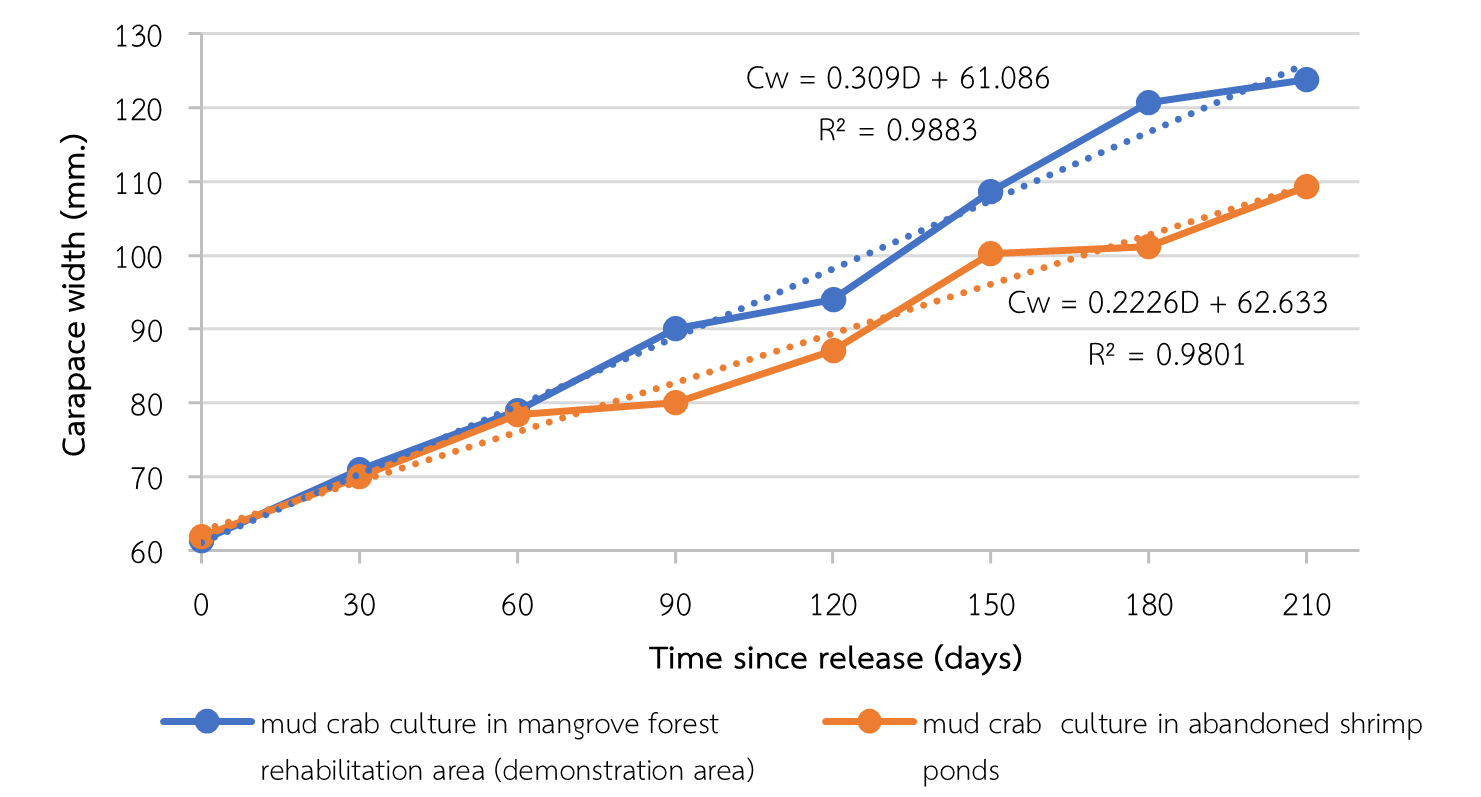
ผลการศึกษาพบว่า ในพื้นที่แปลงสาธิตพบชนิดไม้ทั้งสิ้น 5 ชนิด ได้แก่ โกงกางใบเล็ก โกงกางใบใหญ่ ถั่วขาว แสมขาว และลำแพน มีมวลชีวภาพรวม 13.21 ตัน/ไร่ (82.56 ตัน/เฮกตาร์) เป็นมวลชีวภาพเหนือพื้นดิน 9.97 ตัน/ไร่ (62.31 ตัน/เฮกตาร์) และมวลชีวภาพใต้พื้นดิน 3.24 ตัน/ไร่ (20.25 ตัน/เฮกตาร์) จากการศึกษาอัตราการเติบโตของปูดำ พบว่า ปูดำที่เลี้ยงในพื้นที่แปลงสาธิต และปูดำที่เลี้ยงในพื้นที่นากุ้งร้าง มีอัตราการเติบโตของกระดองเฉลี่ย 0.31 และ 0.22 มิลลิเมตร/วัน ตามลำดับ โดยปูดำที่เลี้ยงในพื้นที่แปลงสาธิต มีอัตราการรอดตายร้อยละ 52.5 และปูดำที่เลี้ยงในพื้นที่นากุ้งร้าง มีอัตราการรอดตายร้อยละ 42.0 และเมื่อพิจารณาปัจจัยด้านสิ่งแวดล้อมบางประการ พบว่า สมบัติทางเคมีของน้ำในพื้นที่แปลงสาธิตอยู่ในเกณฑ์ที่เหมาะสมตามมาตรฐานคุณภาพน้ำเพื่อการเพาะเลี้ยงสัตว์น้ำชายฝั่ง หากแต่ในบริเวณพื้นที่นากุ้งร้าง มีสมบัติทางเคมีของน้ำบางประการที่สูงเกินค่ามาตรฐานคุณภาพน้ำเพื่อการเพาะเลี้ยงสัตว์น้ำชายฝั่ง ได้แก่ แอมโมเนีย และไนเตรท อันเนื่องมาจาก อาหารสดที่ใช้เลี้ยงปูดำตกค้างในบ่อ จึงทำให้น้ำเกิดการเน่าเสีย
Downloads
Article Details

อนุญาตภายใต้เงื่อนไข Creative Commons Attribution-NonCommercial-NoDerivatives 4.0 International License.
ข้าพเจ้าและผู้เขียนร่วม (ถ้ามี) ขอรับรองว่า ต้นฉบับที่เสนอมานี้ยังไม่เคยได้รับการตีพิมพ์และไม่ได้อยู่ในระหว่างกระบวนการพิจารณาตีพิมพ์ลงในวารสารหรือสิ่งตีพิมพ์อื่นใด ข้าพเจ้าและผู้เขียนร่วม (ถ้ามี) ยอมรับหลักเกณฑ์และเงื่อนไขการพิจารณาต้นฉบับ ทั้งยินยอมให้กองบรรณาธิการมีสิทธิ์พิจารณาและตรวจแก้ต้นฉบับได้ตามที่เห็นสมควร พร้อมนี้ขอมอบลิขสิทธิ์ผลงานที่ได้รับการตีพิมพ์ให้แก่วารสารวนศาสตร์ คณะวนศาสตร์ มหาวิทยาลัยเกษตรศาสตร์ กรณีมีการฟ้องร้องเรื่องการละเมิดลิขสิทธิ์เกี่ยวกับภาพ กราฟ ข้อความส่วนใดส่วนหนึ่ง หรือ ข้อคิดเห็นที่ปรากฏในผลงาน ให้เป็นความรับผิดชอบของข้าพเจ้าและผู้เขียนร่วม (ถ้ามี) แต่เพียงฝ่ายเดียว และหากข้าพเจ้าและผู้เขียนร่วม (ถ้ามี) ประสงค์ถอนบทความในระหว่างกระบวนการพิจารณาของทางวารสาร ข้าพเจ้าและผู้เขียนร่วม (ถ้ามี) ยินดีรับผิดชอบค่าใช้จ่ายทั้งหมดที่เกิดขึ้นในกระบวนการพิจารณาบทความนั้น”
เอกสารอ้างอิง
Aksornkaew, S. 1998. Mangroves Ecology and Management, 2nd. Kasetsart University, Bangkok. Thailand. (in Thai)
Boyd, C.E. 1982. Water Quality Management for Pond Fish Culture. Elsevier Sci. Pulb.CO., Amsterdam, Netherlands.
Department of Marine and Coastal Resources. 2008. Biodiversity in the Mangrove Forests of the Upper Southern Region. The Agricultural Cooperative Federation of Thailand Ltd., Bangkok, Thailand. (in Thai)
Department of Marine and Coastal Resources. 2013. Surveying Forest Structure and Biodiversity in Mangrove Forest Handbook. The Agricultural Cooperative Federation of Thailand Ltd., Bangkok, Thailand. (in Thai)
Department of Marine and Coastal Resources. 2021. The Knowledge of Mangrove Handbook. Ployjean Media Inc., Bangkok, Thailand. (in Thai)
Department of Fisheries. n.d. Culture of Mud Crab. Fisheries Promotion bureau, Bangkok, Thailand. (in Thai)
Department of Fisheries. 2017. Water Quality for Culture Coastal aquatic. https://www4.fisheries.go.th/local/pic_activities/201705180947181_pic.pdf, 20 May 2025.
Department of Fisheries. 2021. Breeding and Culture of Mud Crab, Scylla spp. Coastal Aquaculture, Bangkok, Thailand. (in Thai)
Faculty of Forestry. 2011.Potential of Tree Species Guide for Promotion under the Clean Development Mechanism Project in Forestry Sector. Aksorn Siam Ltd., Bangkok, Thailand. (in Thai)
Gordon, M., Brown, M. 1957. Physiological Genetics of Fishes, 2nd ed. Academic Press Inc. New York, NY, USA.
Havanont, V., Praipanapong, S. 2003. Effect of Salinity on Growth and Survival of Mud Crab (Scylla Olivacea Herbst, 1796). Department of Fisheries, Bangkok, Thailand. (in Thai)
Heamasaton, T., Pisuttharachai, D. 2017. Productivity improvement of mud crabs Scylla sarrata (Forskal) in cage–pond using different sheltering materials. Thaksin Journal, 20(3): 1–7. (in Thai)
IPCC. 2006. IPCC Guidelines for National Greenhouse Gas Inventories: Chapter 4 Forestland. National Greenhouse Gas Inventories Programme. IGES, Japan.
Meekaew, N., Suwannakij, P., Sookdara, A., Arkronrat, W. 2021. Effect of salinity levels on specific growth rate and feed intake of mud crab (Scylla paramamosain). Science and Technology Journal Ubon Ratchathani University, 23(2): 58–64. (in Thai)
Paibulkichakul, C., Tarapun, S., Chemplee, S., Paibulkichakul, B. 2016. Some biological aspects of mud crab Scylla olivacea at Ban Bang Sa Kao Coast, Chanthaburi province. Khon Kaen Agriculture Journal, 44(1): 717–722. (in Thai)
Paphavasit, N., 1996. Effects of mangrove forest rehabilitation on coastal aquatic resources in Klong Ngao Mangrove forests, Ranong province. In: Proceedings of Seminar and training on Mangrove Forest Rehabilitation, Nakhon Si Thammarat Province. National Research Council of Thailand, Bangkok, Thailand, pp. 35 – 51. (in Thai)
Phongsuksawat, P. 2002. Determination of Tree Biomass in the Mangrove Habitat Study Area, Phang Nga Province. M.S. Thesis, Kasetsart University, Bangkok, Thailand. (in Thai)
Pollution Control Department. 2006. Marine Water Quality Standards. Water Quality Management Bureau, Bangkok, Thailand. (in Thai)
Royal Forest Department. 2014. Thai Plant Names. Funny Publishing Inc., Bangkok, Thailand. (in Thai)
Sookwong, S., Kaonoona, R. 2004. The Mono–Sex Culture of Mud Crab (Scylla sp.) Maintained in Cages in Earthen Pond. Department of Fisheries, Bangkok, Thailand. (in Thai)
Thongdon–A, R., 2013. Study on Diseases and Parasites in Cage–cultured Red Hybrid Tilapia (Oreochromis sp.). Ph.D. Thesis, Kasetsart University, Bangkok, Thailand. (in Thai)
