สมบัติเชิงกลและความต้านทานปลวกของไม้กระถินลูกผสมอายุ 5 ปี สวนป่าลาดกระทิง จังหวัดฉะเชิงเทรา
Article Sidebar
Main Article Content
บทคัดย่อ
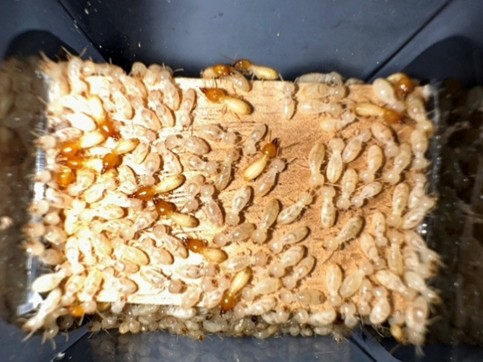
ไม้กระถินสกุล Acacia มีการนามาปลูกเป็นไม้เศรษฐกิจมากขึ้น โดยเฉพาะไม้กระถินลูกผสมที่สามารถเจริญเติบโตทนโรคได้ดี งานวิจัยนี้เป็นการศึกษาคุณสมบัติเชิงกลของไม้กระถินลูกผสม (Acacia HybridHybrid) จากสวนป่าลาดกระทิง จังหวัดฉะเชิงเทรา มีวัตถุประสงค์เพื่อทดสอบค่ามอดุลัสแตกร้าวและค่ามอดุลัสยืดหยุ่น (Modulus of Rupture (MOR) and Modulus of Elasticity (MOE) in Static Bending) หลังจากการเข้าทาลายของปลวกใต้ดิน โดยเลือกศึกษาสายต้น KK4 และสายต้น KK19 อายุ 5 ปี สุ่มเลือกสายต้นละ 3 ต้น แบ่งเป็น 3 ส่วน คือ โคนต้น กลางต้น และปลายต้น ผลการศึกษาพบว่าสายต้น KK4 มีค่า MOR เฉลี่ยเท่ากับ 111.97 MPa และ MOE เฉลี่ยเท่ากับ 10 625.52 MPa และสายต้น KK19 มีค่า MOR เฉลี่ยเท่ากับ 102.73 MPa และ MOE เฉลี่ยเท่ากับ 9,625.20 MPa จากหนังสือคุณลักษณะของไม้ไทย กล่าวว่าเนื้อไม้ที่มี MOR สูงกว่า 95 MPa จัดเป็นไม้ที่มีความแข็งแรงสูงได้ ซึ่งไม้กระถินลูกผสมสายต้น KK4 และ สายต้น KK19 มี MOR มากกว่า 95 MPa สามารถจัดเป็นไม้เนื้อแข็งแรงสูงได้ และ MOE ของสายต้น KK4 มีค่ามากกว่า สายต้น KK19 แสดงให้เห็นว่าเนื้อไม้ของสายต้นที่ KK4 มีความยืดหยุ่นมากกว่าสายต้นที่ KK19 เนื่องจากมีค่า MOE มากกว่า 10,000 MPa ขึ้นไป ส่วนการทดสอบคุณสมบัติเชิงกลหลังถูกปลวกใต้ดินเข้าทาลายในระยะเวลา 21 วัน ตามมาตรฐาน JIS K 1571 : 2010 พบว่าไม้กระถินลูกผสมสายต้น KK4 หลังถูกปลวกใต้ดินเข้าทาลายมี MOR เฉลี่ยเท่ากับ 94.92 ซึ่งมีอัตราลดลงร้อยละ 17.97 MOE เฉลี่ยเท่ากับ 10 062.67 MPa และ สายต้น K19 มี MO R เฉลี่ยเท่ากับ 89.46 MPa ซึ่งมีอัตราลดลงร้อยละ 14.84 และ MOE เฉลี่ยเท่ากับ 8,388.12 MPa
Downloads
Article Details

อนุญาตภายใต้เงื่อนไข Creative Commons Attribution-NonCommercial-NoDerivatives 4.0 International License.
ข้าพเจ้าและผู้เขียนร่วม (ถ้ามี) ขอรับรองว่า ต้นฉบับที่เสนอมานี้ยังไม่เคยได้รับการตีพิมพ์และไม่ได้อยู่ในระหว่างกระบวนการพิจารณาตีพิมพ์ลงในวารสารหรือสิ่งตีพิมพ์อื่นใด ข้าพเจ้าและผู้เขียนร่วม (ถ้ามี) ยอมรับหลักเกณฑ์และเงื่อนไขการพิจารณาต้นฉบับ ทั้งยินยอมให้กองบรรณาธิการมีสิทธิ์พิจารณาและตรวจแก้ต้นฉบับได้ตามที่เห็นสมควร พร้อมนี้ขอมอบลิขสิทธิ์ผลงานที่ได้รับการตีพิมพ์ให้แก่วารสารวนศาสตร์ คณะวนศาสตร์ มหาวิทยาลัยเกษตรศาสตร์ กรณีมีการฟ้องร้องเรื่องการละเมิดลิขสิทธิ์เกี่ยวกับภาพ กราฟ ข้อความส่วนใดส่วนหนึ่ง หรือ ข้อคิดเห็นที่ปรากฏในผลงาน ให้เป็นความรับผิดชอบของข้าพเจ้าและผู้เขียนร่วม (ถ้ามี) แต่เพียงฝ่ายเดียว และหากข้าพเจ้าและผู้เขียนร่วม (ถ้ามี) ประสงค์ถอนบทความในระหว่างกระบวนการพิจารณาของทางวารสาร ข้าพเจ้าและผู้เขียนร่วม (ถ้ามี) ยินดีรับผิดชอบค่าใช้จ่ายทั้งหมดที่เกิดขึ้นในกระบวนการพิจารณาบทความนั้น”
เอกสารอ้างอิง
Arango, R. A., Green, F., Hintz, K., Lebow, P. K., Miller, R. B. 2006. Natural durability of tropical and native wood species against termite damage. Wood and Fi ber Science Science, 38(4), 662 662–667.
ASTM D143-20 .2020 Standard Test Methods for Small Clear Specimens of Timber , ASTM
InternationalInternational.
Banik, R. L., Nurul Islam, S. A. M. 1996. In vitroclonal propagation of hybrid Acacia ( A. mangium × A. auriculiformisauriculiformis). Bangladesh Journal of Forest Science, 25 (1 –2), 121 121–129.
Boonnum, M. D. 1999. Mechanical testing of wood (1st ed.). Forestry knowledge dissemination project project, Kasetsart University, Bangkok. (in Thai)
Boonnum R., Tangmitcharoen S., Sahunalu S, P. 2008 . Physical and mechanical properties of hybrid Acacia ( Acacia mangium × A. auriculiformis auriculiformis). Kasetsart Journal (Natural Science) Science), 42, 261 261–267.
Charoenkrung, K., Pengyam, W., Jakpong, N. 2017 The Efficacy on wood of Eucalyptus urophylla to the attack of subterranean termites and value added Royal Forest Department. (in thai)
Forest Research and Development Bureau. 2011. Research report on the development of Acacia species for industrial utilizationutilization. Royal Forest Department, Bangkok, Thailand. (in Thai)
Forest Products Laboratory. 2010. Wood handbook: Wood as an engineering
material (General Technical Report FPL FPL- GTRGTR-190). U.S. Department of Agriculture, Forest Service.
Jacob, M., Samuel, O., Dauda, I. 2013. Effect of density on the natural resistance of ten selected Nigerian
wood species to subterranean termites. Pro Ligno, 9(1), 32 – 40.
JWPAS. 1981. Qualitative standards for termiticide, preservative termiticides and soil -poisoning.
Worapan Kaewmanee, Somchai Santiwattanakul, Nikhom Laemsak, Songklod Jarusombuti. 2009. Mechanical strength of hybrid Acacia planted in the northeastern region of Thailand. Department of Forest Biology, Faculty of Forestry, Kasetsar t University, Bangkok. (in Thai)
Nguyen, V. T., Zhu, S., Kojima, T. 2008. Variation in wood properties of six natural acacia hybrid clones in northern Vietnam. Journal of Wood Science, 54, 436–442.
Office of Wood Utilization Promotion. 2006. Properties of Thai Wood. Bangkok: War Veterans Organization of Thailand Printing Office. (in Thai)
Panshin, A. J., de Zeeuw, C. 1980. Textbook of Wood Technology. McGraw McGraw-Hill.
Phipatsiri, S. 2023. Physical and mechanical properties of (Acacia auriculiformis × A. mangium) hybrid Acacia from Lad Krating plantationplantation. Forest Industry Organization, Thailand. (in Thai)
Wongkhaluang, J. 1986. Animals and Insects that destroy wood and prevention and elimination.Training documents for the course on prevention and elimination of wood -destroying pests pests. Royal Forest
Department, Bangkok. (in Thai)
Wongkhaluang. J., 1996. Termites. In Seminar on BiodiversityBiodiversity-UtilizationUtilization-ConservationConservation- Research (pp. 417 –429). Kasetsart University, Bangkok. (in Thai)
Jusoh, I., Abu Zaharin, F., Adam, N. S. 2014. Acacia sp. wood qualities qualities. BioResources , 9(1),
–160.
Royal Forest Department. 2014. Research project plan on the potential of Eucalyptus urophylla for commercial use (p. 9). Forest Research and Development Bureau. (in Thai)
Yahya, R., S ugiyama , J., Silsia, Gril, J. 2010. Some anatomical features of an Acacia hybrid, A. mangium and A. auriculiformis grown in Indonesia with consideration of pulp yield and paper
Yeesoonsee, S., Maelim, S., Suanpaga, W., Panrod, N. 2023. A clonal test of Acacia hybrid at Lad Krating plantation, Chachoengsao province. Thai Journal of
Forestry, 42(2), 189 –198. (in thai)
Yue, K., Li, X., Liu, L., Ma, L. 2014. Wood properties of Acacia auriculiformis × A.
mangium hybrid clones in relation to growth rate. Journal of Wood Science, 60, 169–176.
