
Effect of Sodium Hypochlorite in Culture Medium on Shoot Proliferation and Root Induction of Curcuma longa L.
Article Sidebar
Main Article Content
Abstract
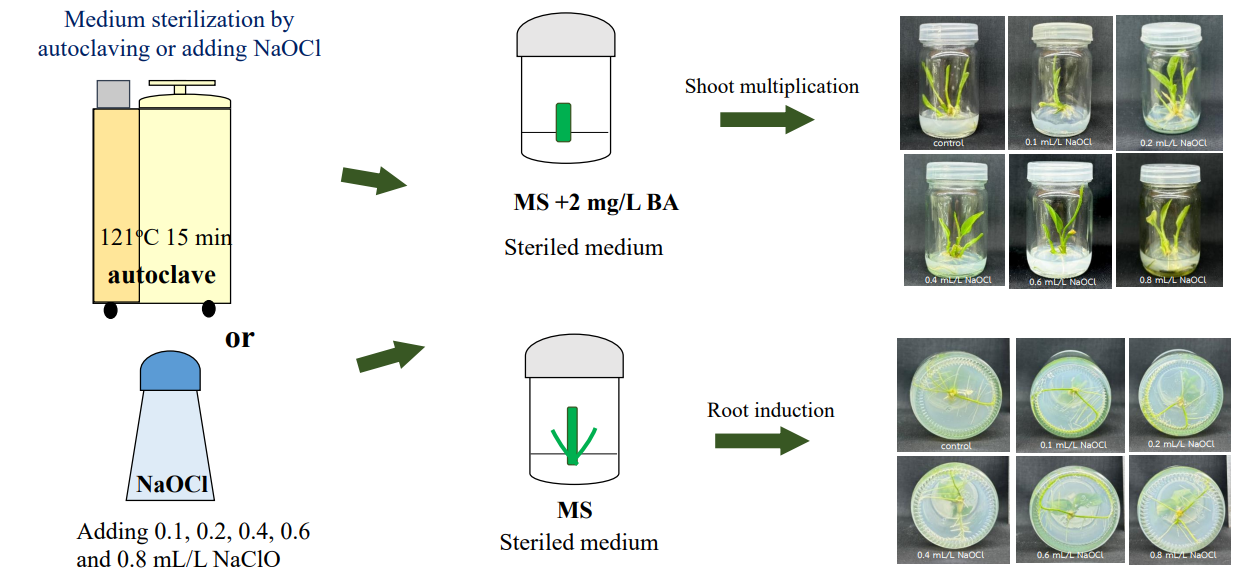
The propagationof Curcuma longa L., a medicinal herb known for its therapeutic properties, including alleviating stomach discomfort and expelling gas, can be effectively supported through plant tissue culture to ensure an adequate supply for cultivation. However, the cost of autoclaving for media sterilization is high. The addition of sodium hypochlorite (NaOCl) to the medium can achievesterility and reduce cost, but it may also affect plant growth in vitro. Therefore, this study aimed to investigate the effect of various concentrations of NaOCl intheculture medium on shoot multiplication and root induction of C. longa under aseptic conditions. The in vitro shoots were cultured on Murashige and Skoog (MS) medium supplemented with 2 mg/L benzyladenine (BA) to induce shoot formation and on MS medium without plant growth regulators to induce root development. The culture medium was sterilized either by autoclaving (control) or by adding NaOCl at concentrations of 0.1, 0.2, 0.4, 0.6, and 0.8 mL/L. The results showed that all treatments effectively sterilized the culture medium. There were no significant differences among treatments in shoot and root induction percentage, number of shoots and roots, or shoot and root length. The survival rate after transplantation was 100%. Thus, NaOCl at a concentration of 0.1 mL/L can be effectively used for media sterilization in the micropropagation of C. longa.
Article Details
References
Dada Khalandar, S., Adithya, T. N., Basha, S. J., Koshma, M., Subbareddy, U. V. and Reddy, V. J. S., 2018, A current review on Curcuma longa Linn, Plant. Int. J. Pharma. Chem. Biol. Sci. 8: 68-73.
Jain , S., Shrivastava, S., Nayak, S. and Sumbhate, S., 2007, Recent trends in Curcuma longa Linn, Pharmacog. Rev. 1: 119-128.
Trade Policy and Strategy Office, 2022, Trade Opportunities for Thai Herbal Products, Case Study: Turmeric, Ministry of Commerce, Available Source:https://uploads.tpso.go.th/2022-09-11_raayngaankhminchbabyaaw_final.pdf, Dec 18, 2024. (in Thai)
Dolase, P. and Chaudhari, V., 2024, Review on cultivation practices of Haridra (Curcuma longa Linn.), Int. J. Ayurveda Pharma. Res. 12: 56-61.
Prathanturarug, S., Soonthornchareonnon N., Chuakul, W., Phaidee Y. and Saralamp, P., 2005, Rapid micropropagation of Curcuma longa using bud explants pre-cultured in thidiazuron - supplemented liquid medium, Plant Cell Tiss. Org. Cult. 80: 347-351.
Hashemy, T., Maki, H., Yamada, Y., Kaneko, T. S. and Syono, K., 2009, Effects of light and cytokinin on in vitro micropropagation and microrhizome production in turmeric (Curcuma longaL.), Plant Biotechnology 26: 237-242.
Koarapatchaikol, K., 2015, Micropr- opagation of Turmeric (Curcuma longa L.) via shoot tip culture from juvenile rhizome, SWU Sci. J. 3: 175-188. (in Thai)
Marchant, M. J., Molina, P., Montecinos, M., Guzmán, L., Balada, C., Fassio, C. and Castro, M., 2021, In vitro propagation of easter island Curcuma longa from rhizome explants using temporary immersion system, Agronomy 11: 2121.
Wamaedeesa, R., Ali, B., Chedao, N. and Kanjanawattanawong, S., 2021, Chemical sterilization in MS culture medium for in vitro culture of Philodendron sp. “Ruaysap”, PNUJR. 13: 377-387. (inThai)
Duan, Y., Zhang, H., Sun, M., Zhao, F., Xue, T. and Xue, J., 2019, Use of chlorine dioxide to sterilize medium for tissue culture of potato, Sci. Rep. 9: 10232.
Phuangphachong, S., Thamanantada, W., Rithichai, P. and Jirakiattikul, Y., 2024, Effects of chlorine dioxide and sodium hypochlorite in culture medium on micropropagation of pineapple (Ananas comosus) cv. Phulae, Thai Sci. Technol. J. 32: 67-76. (in Thai)
Carrillo, A., Puente, M. E. and Bashan, Y., 1996, Application of diluted chlorine dioxide to radish and lettuce nurseries insignificantly reduced plant development, Ecotoxicol. Environ. Saf. 35: 57-66.
Russell, A. D., 2003, Similarities and differences in the responses of microorganisms to biocides, J. Antimicrob. Chemother. 52: 750-763.
Matsumoto, K., Coelho, M. C. F., Monte, D. C. and Teixeira, J.B., 2009, Sterilization of non-autoclavable vessels and culture media by sodium hypochlorite for in vitro culture, Acta Hortic. 839: 329-336.
Pais, A., Sliva, A., Souza, C., Teixeira, S., Ribeiro, J., Peixoto, A. and Paz, D., 2016, Sodium hypochlorite sterilization of culture medium in micropropagation of Gerbera hybridacv. Essandre, Academic. Rep. 15: 36.
Laksana, C., Pengsa, Y. and Sophipan, O., 2023, Study of the effectiveness of preservatives and sodium hypochlorite for eradiation of microorganism in plant tissue culture medium for Bucephalandra aquatic plant, RMUTSB Acad. J.11:57-66. (in Thai)
Cardoso, J. C. and Imthurn, A. C.P., 2018, Easy and efficient chemical sterilization of theculture medium for in vitro growth of gerbera using chlorine dioxide (ClO2), Ornam. Hortic. 24: 218-224.
