
Effect of Butterfly Pea Flower Extract on Quality of Kefir Beverage
Article Sidebar
Main Article Content
Abstract
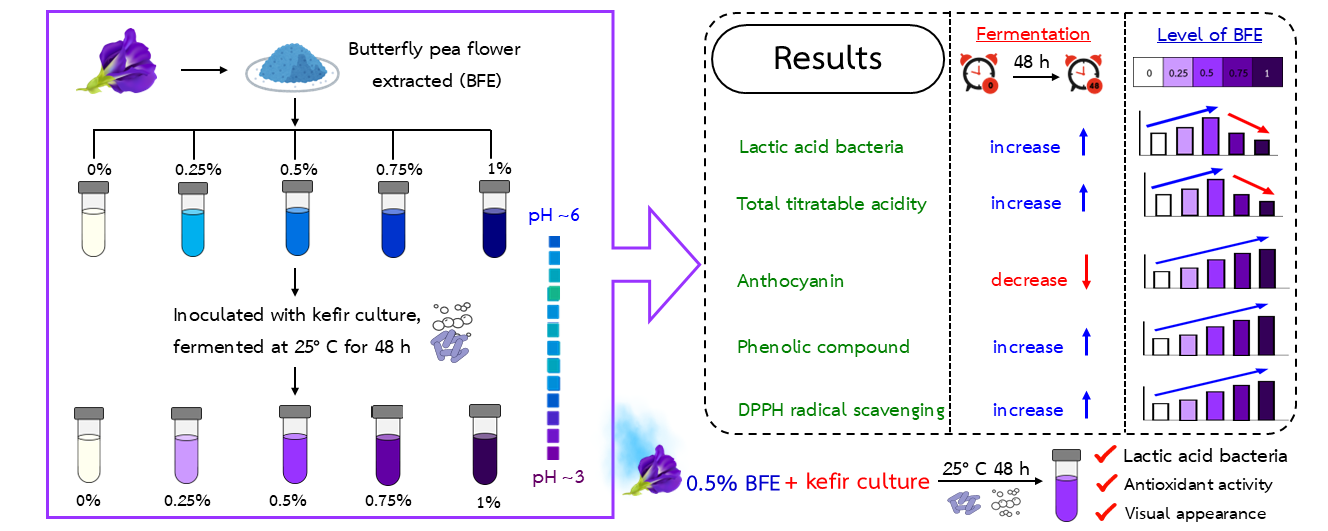
Butterfly pea flower extract (BFE) was used in this study as an alternate substrate for kefir beverage production.The interaction between different BFE concentrations (0, 0.25, 0.5, 0.75, and 1%) and kefir culture fermentation (beforeand after) was investigated.The results showed that anthocyanin content, total phenolic compounds, and DPPH radical scavenging activity in the samples increased with higher BFE concentrations, both before and after fermentation. The additionof 0.25% and 0.5% BFE increased the growth of lactic acid bacteria, whereas 0.75% and 1% BFE reduced bacterial growthand acid production compared with the control. Furthermore, the anthocyanin content of the butterfly pea beverage decreased after fermentation, while the total phenolic compound content and DPPH radical scavenging activity increased relative to prefermentation levels. Regarding color characteristics, the L* value decreased with increasing BFE concentration, while the a* and b* values increased. After fermentation, the L* values werehigher, and the a* and b* values werelower compared with pre-fermentation measurements. Overall, the results suggest that the additionof 0.5% BFE combined with kefir culture fermentation improved the beverage’s health-promoting properties, particularly by enhancing lactic acid bacteria counts, total phenolic compound content, and DPPH radical scavenging activity.
Article Details
References
Otbes, S. and Cagindi, O., 2003, Kefir: A probiotic dairy-composition, nutritional and therapeutic aspects, Pak. J. Nutr. 2(2):54-59.
Codex Alimentarius International Food Standards, Standard for Fermented Milks (CODEX STAN 243-2003), Available Source:
https://alimentosargentinos.magyp.gob.ar/contenido/marco/codex_Alimentarius/normativa/codex/stan/CODEX_STAN_243.asp, December 27, 2022.
Heenan, C.N., Adams, M.C., Hosken, R.W. and Fleet, G.H., 2004, Survival and sensory acceptability of probiotic microorganisms in a nonfermented frozen vegetarian dessert, Lebensm.- Wiss. Technol. 37: 461-466.
Laureys, D. and De Vuyst, L., 2017, The water kefir grain inoculum determines the characteristics of the resulting water kefir fermentation process, J. Appl. Microbiol. 122: 719-732.
Escher, G.B., Wen, M., Zhang, L., Rosso, N.D. and Granato, D., 2020, Phenolic composition by UHPLC-Q-TOF-MS/MS and stability of anthocyanins from Clitoria ternatea L. (butterfly pea) blue petals, Food Chem. 331: 127341.
Alves-Santos, A. M., Sugizaki, C.S.A., Lima, G.C. and Naves, M.M.V., 2020, Prebiotic effect of dietary polyphenols: A systematic review, J. Funct. Foods. 74:104169.
Zhang,Y., Liu, W., Wei, Z., Yin, B., Man, C. and Jiang, Y., 2021, Enhancement of functional characteristics of blueberry juice fermented by Lactobacillus plantarum, LWT-Food Sci.Technol. 139:110590.
Kabakcia, S.A.,Turkyılmaz, M. and Ozkan, M., 2020, Changes in the quality of kefir fortified with anthocyanin-rich juices during storage, Food Chem. 326:126977.
Aksornsri, T., Chaturapornchai, N., Jitsayen, N., Rojjanapaitoontip, P. and Peanparkdee, M., 2023, Development of kombucha-like beverage using butterfly pea flower extract with the addition of tender coconut water, Int. J. Gastron. Food Sci. 4: 100825.
Gamage, G.C.V., Goh, J.K. and Choo, W.S., 2024, Application of anthocyanins from black goji berry infermented dairy model food systems: an alternate natural purple color, LWT - Food Sci. Technol. 198:115975.
Corona, O., Randazzo, W., Miceli, A., Guarcello, R., Francesca, N., Erten, H., Moschetti, G. and Settanni, L., 2016, Characterization of kefir like beverages produced from vegetable juices, LWT - Food Sci. Technol. 66: 572-581.
Association of Official Analysis Chemists (AOAC), 2000, Official Methods of Analysis of the Association of Official Analytical Chemists, 17th Ed., AOAC International, Inc., Virginia, 2,200 p.
Qiu, L., Zhang, M. and Chang, L., 2002, Effects of lactic acid bacteria fermentation on the phytochemicals content, taste and aroma of blended edible rose and shiitake beverage, Food Chem. 405:134722.
Lee, J., Durst, R.W. and Wrolstad, R.E., 2005, Determination of total monomeric anthocyanin pigment content of fruit juices, beverages, natural colorants, and wines by the pH differential method: Collaborative study, J. AOAC Int. 88:1269-1278.
Kwaw, E., Ma, Y., Tchabo, W., Apaliya, M.T., Wu, M., Sackey, A.S., Xiao, L. and Tahir, H.E., 2018, Effect of lactobacillus strains on phenolic profile, color attributes and antioxidant activities of lactic-acid-fermented mulberry juice, Food Chem. 250: 148-154.
Food and Agriculture Organization of the United Nations/World Health Organization (FAO/WHO), 2006, Probiotics in Food: Health and Nutritional Properties and Guidelines for Evaluation, Report, Food and Agriculture Organization of the United Nations, Rome, 50 p.
Molan, A.L, Lila, MA., Mawson, J. and De, S., 2009, In vitro and in vivo evaluation of the prebiotic activityof water-soluble blueberry extracts, World J. Microbiol. Biotechnol. 25: 1243-1249.
Zhang, P., Zhang, M., He, S., Cao, X., Sun, H., Chen, X., Xie,Y.,Lou, Q., Wang, X.and Ye, Y., 2016, Extraction and probiotic properties of new anthocyanins form purple sweet potato (Solanum tuberosum), Curr.Top. Nutraceutical Res. 14(2): 153-160.
Lin, S., Zhang, X., Wang, J., Li,T. and Wang, L., 2024, Effect of lactic acid bacteria fermentation on bioactive components of black rice bran (Oryza sativa L.) with different milling fractions, Food Biosci. 58: 103684.
Sevindik, O., Guclu, G., Agirman, B., Selli, S., Kadiroglu, P., Bordiga, M., Capanoglu, E. and Kelebek, H., 2022, Impacts of selected lactic acid bacteria strains on the aroma and bioactive compositions of fermented gilaburu (Viburnum opulus) juices, Food Chem. 378: 132079.
Hasanah, N.N., Mohamad Azman, E., Rozzamri, A., Zainal Abedin, N.H. and Ismail-Fitry, M.R., 2023, A systematic review of butterfly pea flower (Clitoria ternatea L.): extraction and application as a food freshness pH-indicator for polymer-based intelligent packaging, Polymers. 15: 2541
