
A Comparative Analysis of the Break-Even Point for Rooftop Solar Panel Installation: A Case Study of C-Dormitory, Chiangrai College
Article Sidebar
Main Article Content
Abstract
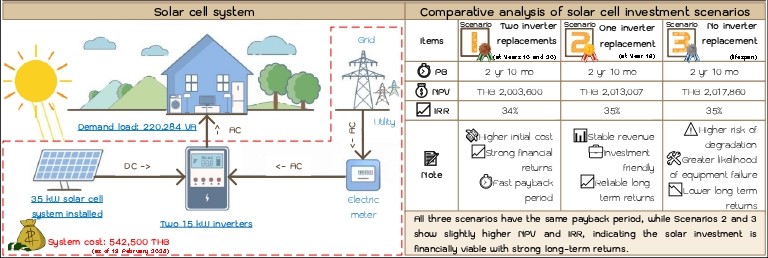
This study investigates the feasibility and economic viability of installing solar photovoltaic (PV) systems to enhance energy efficiency and sustainability. The analysis focuses on electricity generation potential and investment evaluation using a case study of the C-Dormitory at Chiang Rai College, which offers optimal rooftop conditions for solar exposure and efficient energy production. Building electricity consumption data were used to design a system capacity aligned with actual demand, followed by a financial assessment using key indicators: payback period (PB), net present value (NPV), and internal rate of return (IRR). The results show promising financial returns across three scenarios. Scenario 1 yields an IRR of 34% and an NPV of 2,003,600 THB; Scenario 2 yields an IRR of 35% and an NPV of 2,013,007 THB; and Scenario 3 yields an IRR of 35% and an NPV of 2,017,860 THB. All scenarios share a similar payback period of 2 years and 10 months. Cash flow and cumulative income analyses reveal that Scenario 2 offers the highest stability, while Scenario 3 provides slightly higher total returns. Although Scenario 1 has the lowest IRR, it still ensures rapid payback and consistent income. This comparison highlights the importance of both cash flow consistency and revenue potential in investment decision-making.
Article Details
References
Chansela, W. and Ingkarojrit, V., 2020, Feasibility assessment of solar rooftop systems for gymnasium: case study of Chulalongkorn University, J. Econ. Dev. 7(2): 1–25. (in Thai)
Wongrat, O., Rattanaboontawee, P., Madee, S. and Thongchuay, A., 2020, Calculation of break-even point for solar panel installation for public buildings Bangkhen subdistrict, Mueang district, Nonthaburi province, Ind. Technol. Phranakhon Rajabhat Univ. 3(1): 31–38. (in Thai)
Tantisattayakul, T., 2020, Comparative economic assessment of solar rooftop system between being system owner and private power purchase agreement: a case study of Thammasat University, Rangsit centre, Thai Sci. Technol. J. 28(8): 1502–1515. (in Thai)
Muangchuen, S. and Wongsata, D., 2023, Potential and cost-effectiveness evaluation of solar rooftop system: case study of Chaloem-Phra-Kiat education building, Chiangrai College, Sci. Technol. Nakhon Sawan Rajabhat Univ. J. 15(22): 145–158. (in Thai)
Nassar, Y., Abdunnabi, M., Sbeta, M., Hafez, A., Amer, K., Ahmed, A. and Belgasim, B., 2021, Dynamic analysis and sizing optimization of a pumped hydroelectric storage-integrated hybrid PV/wind system: a case study, Energy Convers. Manag. 229: 113744–113759.
Bhayo, B., Al-Kayiem, H. and Gilani, S., 2019, Assessment of standalone solar PV-battery system for electricity generation and utilization of excess power for water pumping, Int. Solar Energy Soc. 194: 766–776.
Said, M., El-Shimy, M. and Abdelraheem, M., 2015, Photovoltaics energy: Improved modeling and analysis of the levelized cost of energy (LCOE) and grid parity – Egypt case study, Sustain. energy technol. assessments. 9: 37–48.
Gaisma, Solar Radiation Data for Chiangrai, Available Source: https://www.gaisma.com/en/location/chiang-rai.html, September 9, 2025.
Pholnak, C., Waewsak, J., Cheewamongkolkarn, S. and Nutongkaew, P., 2017, Efficiency evaluation of 3 kW photovoltaic rooftop and grid connected system by using PVsyst programmed modeling simulation, Thaksin J. 20(3): 261–268. (in Thai)
Ma, W., Fan, J., Fang, S. and Liu, G., 2019, Techno-economic potential evaluation of small-scale grid-connected renewable power systems in China, Energy Convers. Manag. 196: 430–442.
Ma, W., Xue, X., Liu, G. and Zhou, R., 2018, Techno-economic evaluation of a community-based hybrid renewable energy system considering site-specific nature, Energy Convers. Manag. 171: 1737–1748.
Kong, J., Kim, S., Kang, B. and Jung, J., 2019, Determining the size of energy storage system to maximize the economic profit for photovoltaic and wind turbine generators in South Korea, Renew. Sustain. Energy Rev. 116: 109467–109482.
Zhang, Y., Ma, T., Campana, P., Yamaguchi, Y. and Dai, Y., 2020, A techno-economic sizing method for grid-connected household photovoltaic battery systems, Appl. Energy. 269: 115106–115116.
Panprayun, G., 2017, 8 kWp rooftop PV system and feasibility of system expansion, J. Prof. Routine Res. 4: 79–86. (in Thai)
Inthamat, P., Chaisakulniyom, M., Suksing, P., Boonraksa, T. and Boonraksa, P., 2022, Technical analysis and cost-effectiveness of installation of residential rooftop PV generation systems, Rajabhat J. Sci. Technol. 4(3): 47–56. (in Thai)
Axaopoulos, P. and Fylladitakis, E., 2013, Energy and economic comparative study of a tracking vs a fixed photovoltaic system in the Northern Hemisphere, Int. J. Energy Environ. Econ. 21: 1–20.
