
Effect of Calcium Sulfate and Magnesium Sulfate on Physical Properties of Gluten-Free Instant Noodle Made from Mixed Flours and Pea Protein
Article Sidebar
Main Article Content
Abstract
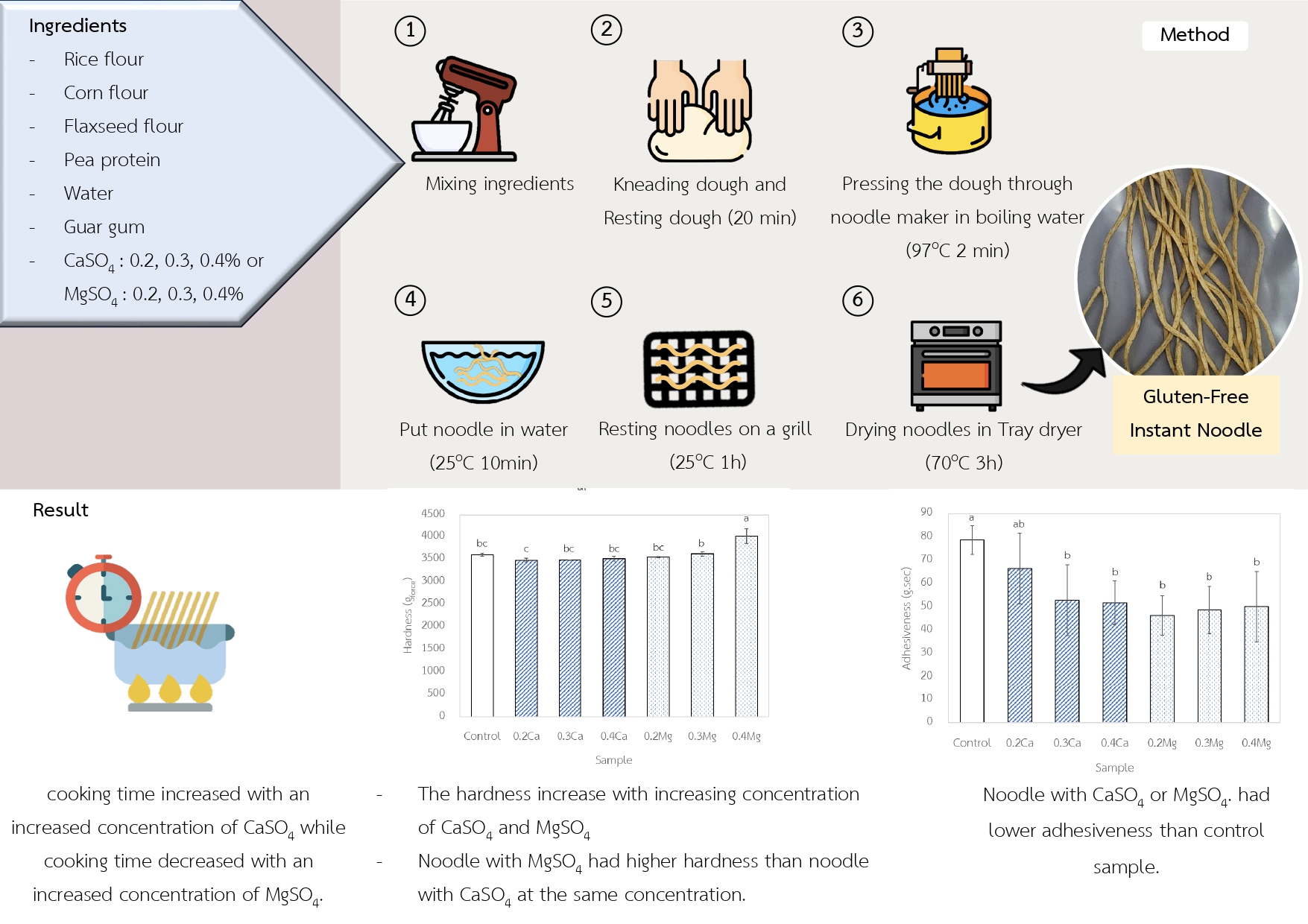
The objective of this study was to investigate the effect of calcium and magnesium salts on the physical properties of gluten-free instant noodles made from a mixture of rice flour, corn flour, flaxseed flour, and pea protein. Calcium sulfate and magnesium sulfate were added at concentrations of 0-0.4% (w/w). The ingredients were mixed, and the resulting dough was kneaded and pressed through a noodle maker into boiling water at 97 oC for 2 minutes. The obtained noodles were allowed to rest for 1 hour before being dried in a tray dryer at 70 oC for 3 hours. The results showed that the water activity of the treatment ranged from 0.25-0.32. Noodles containing 0.4% calcium sulfate had the highest water activity (p≤0.05). Cooking time increased with increasing concentration of calcium sulfate, whereas it decreased with increasing concentration of magnesium sulfate. The hardness of noodles increased with increasing concentration of calcium sulfate or magnesium sulfate, with noodles containing 0.4% magnesium sulfate exhibiting the highest hardness (p≤0.05). The addition of calcium sulfate or magnesium sulfate significantly decreased noodle adhesiveness (p≤0.05). The brightness of the noodles containing magnesium sulfate was lower than that of the control (p≤0.05).
Article Details
References
Gujral, N., Freeman, H.J. and Thomson, A.B., 2012, Celiac disease: Prevalence, diagnosis, pathogenesis and treatment, World J. Gastroenterol. 18(42): 60366059.
National Celiac Association 2024, What is Celiac Disease, Available Source: https://nationalceliac.org/resources/what-isceliac-disease, December 25, 2024.
Qin, W., Lin, Z., Wang, A., Chen, Z., He, Y., Wang, L., Liu, L., Wang, F. and Tong, L.T., 2021, Influence of particle size on the properties of rice flour and quality of gluten-free rice bread, Food Sci. Technol. 151: 112236.
Najjingo, E., Byakika, S. and Mukisa, I.M., 2024, Physical properties, nutritional profile, and consumer acceptability of gluten-free breakfast flakes from cassava flour, Appl. Food Res. 4(2): 100541.
Ferreira, S.M.R., De Mello, A.P., De Caldas Rosa, M., Kruger, C.C.H., Azoubel, P.M. and De Oliveira Alves, M.A., 2016, Utilization of sorghum, rice, corn flours with potato starch for the preparation of gluten-free pasta, Food Chem. 191: 147-151.
Halim, MD.A., Alharbi, S.A., Alarfaj, A.A, Almansour, M.I., Ansari, M.J., Nessa, M.J., Kabir, F.N.A. and Khatun, A.A., 2024, Improvement and quality evaluation of gluten-free cake supplemented with sweet potato flour and carrot powder, Appl. Food Res. 4: 100543.
Beyond Celiac 2025, The Gluten-Free Diet, Available Source: https://www.beyondceliac.org/gluten-free-diet/whatis-gluten/, April 24, 2025.
Zhao, F., Li, Y., Li, C., Ban, X., Cheng, L., Hong, Y., Gu, Z. and Li, Z., 2022, Insight into the regulations of rice protein on the gluten-free bread matrix properties, Food Hydrocoll. 131: 107796.
Dilrukshi, H.N., Torrico, D.D., Brennan, M.A. and Brennan, C.S., 2022, Effects of extrusion processing on the bioactive constituents, in vitro digestibility, amino acid composition, and antioxidant potential of novel gluten-free extruded snacks fortified with cowpea and whey protein concentrate, Food Chem. 389: 33107.
Silva, P.G., Kalschne, D.L., Salvati, D., Bona, E. and Rodrigues, A.C., 2022, Aquafaba powder, lentil protein and citric acid as egg replacer in gluten-free cake: A model approach, Appl. Food Res. 2(2): 100188.
Rolandelli, G., Shan, S. and Campanella, O.H., 2024, Effects of alkalinization and addition of pea protein as a co-protein to zein for the development of gluten free doughs, Food Hydrocoll. 146: 109313.
Shukla, V., Martinez, A.C., Li, Y.O. and Pardo, G.D., 2023, Optimization of glutenfree pasta formulation enriched with pulse protein isolates, J. Culin. Sci. Technol. 21(1): 99-117.
Rachman, A., Brennan, M.A., Morton, J., Torrico, D. and Brennan, C.S., 2023, In Vitro digestibility, protein digestibility corrected amino acid, and sensory properties of banana-cassava gluten-free pasta with soy protein isolate and egg white protein addition, Food Sci. Hum. Wellness 12(2): 520-527.
Pinel, P., Robert, M., Putois, A., Claudel, J., Barron, C., Menard, O., Micard, V. and Lacanal, C.B., 2025, In Vitro protein digestibility of gluten-free climate-smart cowpea-based pasta, Food Res. Int. 208: 116100.
Roger, R.A., Laohakunjit, N., Uthairatanakij, A., Vongsawasdi, P., Kaisangsri, N. and Selamassakul, O., 2025, Unveiling the effects of psyllium husk, mung bean protein, and transglutaminase on the quality characteristics of heat moisture treated gluten-free rice pasta, Int. J. Food Sci. Technol. 60(1): vvae090.
Sofi, S.A., Singh, J., Chhikara, N., Panghal, A. and Gat, Y., 2020, Quality characterization of gluten free noodles enriched with chickpea protein isolate, Food Biosci. 36: 100626.
Detchewa, P., Thongngam, M., Jane, J.L. and Naivikul, O., 2016, Preparation of gluten-free rice spaghetti with soy protein isolate using twin-screw extrusion, J. Food Sci. Technol. 53: 3485-3494.
Wang, W., Shen, M., Liu, S., Jiang, L., Song, Q. and Xie, J., 2018, Gel properties and interactions of Mesona blumes polysaccharide-soy protein isolates mixed gel: The effect of salt addition, Carbohydr. Polym. 192: 193-201.
Chu, L., Yang, L., Li, J., Lin, L. and Zheng, G., 2019, Effect of Smilax china L. starch on the gel properties and interactions of calcium sulfate-induced soy protein isolate gel, Int. J. Biol. Macromol. 135: 127-132.
Li, Y., Wan, Y., Mamu, Y., Xu, J. and Guo, S., 2023, Aggregation and gelation of soymilk protein after alkaline heat treatment: Effect of coagulants and their addition sequences, Food Hydrocoll. 135: 108178.
Kao,F.J., Su, N.W. and Lee, M.H., 2003, Effect of calcium sulfate concentration in soymilk on the microstructure of firm tofu and the protein constitutions in tofu whey, J. Agric. Food Chem. 51: 6211- 6216.
Zhu, Q., Wu, F., Saito, M., Tatsumi, E. and Yin, L., 2016, Effect of magnesium salt concentration in water-in-oil emulsions on the Physical properties and microstructure of tofu, Food Chem. 201: 197-204.
Cacace, M.G., Landau, E.M. and Ramsden, J.J., 1997, The hofmeister series: salt and solvent effects on interfacial phenomena,Q. Rev. Biophys. 30(3): 241-277.
Wang, Y., Yang, X. and Li, L., 2020, A new style of fermented tofu by Lactobacillus casei combined with salt coagulant, 3 Biotech. 10(2): 81.
Lu, Z.X., He, J.F., Zhang, Y.C. and Bing, D.J., 2020, Composition, Physicochemical properties of pea protein and its application in functional foods, Crit. Rev. Food Sci. Nutr. 60(15): 2593-2605.
Gwiazda, S., Rutkowski, A. and Kocon, J., 1979, Some functional properties of pea and soy bean protein preparations, Nahrung. 23(7): 681-686.
Oomah, B.D., Mazza, G. and Kenaschuk, E.O., 1992, Cyanogenic compounds in flaxseed, J. Agric. Food Chem. 40(8): 1346-1348.
AACC, 2000, Approved Methods of the American Association of Cereal Chemists, 10th Ed., American Association of Cereal Chemists, Inc., St. Paul, Minnesota, 1200 p.
Choy, A.L., Morrison, P.D., Hughes, J.G., Marriott, P.J. and Small, D.M., 2013, Quality and antioxidant properties of instant noodles enhanced with common buckwheat flour, J. Cereal Sci. 57: 281-287.
Zhao, Y., Dai, X., Mackon, E., Ma, Y. and Liu, P., 2022, Impacts of protein from high-protein rice on gelatinization and retrogradation properties in high and low-amylose reconstituted rice flour, Agronomy (Basel, Switz.). 12(6): 1431.
Lyu, Z., Sala, G. and Scholten, E., 2022, Water distribution in maize starch-pea protein gels as determined by a novel confocal laser scanning microscopy image analysis method and its effect on structural and mechanical properties of composite gels, Food Hydrocoll. 133(5): 107942.
Koh, W.Y., Matanjun, P., Lim, X.X. and Kobun, R., 2022, Sensory, Physicochemical, and cooking qualities of instant noodles incorporated with red seaweed (Eucheuma denticulatum), Foods. 11(17): 2669.
Gan, J., Kong, X., Xiao, Z., Chen, Y., Du, M., Wang, Y., Wang, Z., Cheng, Y. and Xu, B., 2022, Calcium binding mechanism of soybean peptide with histidine alteration by molecular docking analysis and spectroscopic methods, Foods. 11(20): 3290.
Lu, W., Zhang, Y., Zhang, C., Chen, D. and Xiao, C., 2023, Influence of calcium sulfate incorporated with gluconolactone coagulant on the quality of whole soybean flour tofu, Food Chem.:X. 17(7): 100527.
Chung, H.J., Cho, A. and Lim, S.T., 2012, Effect of heat-moisture treatment for utilization of germinated brown rice in wheat noodle, Food Sci. Technol. 47(2): 342-347.
Liang, Y., Qu, Z., Liu, M., Wang, J., Zhu, M., Liu, Z., Li, J., Zhan, X. and Jia, F., 2020, Effect of curdlan on the quality of frozen cooked noodles during frozen storage, J. Cereal Sci. 95(3): 103019.
Bolarinwa, I.F. and Oyesiji, O.O., 2021, Gluten free rice-soy pasta: Proximate composition, textural properties and sensory attributes, Heliyon. 7(1): e06052.
Limroongreungrat, K., Suksomboon, A. and Sangnark, A., 2015, Development of Functional Rice Pasta Supplemented With Pulse Flour, Research Report, Burapha University, Chonburi, 92 p. (in Thai)
Doan, C.D. and Ghosh, S., 2019, Formation and stability of pea proteins nanoparticles using ethanol-induced desolvation, Nanomaterials. 9(7): 949.
Lan, Y., Ohm, J.B., Chen, B. and Rao, J., 2020, Physicochemical properties and aroma profiles of flaxseed proteins extracted from whole flaxseed and flaxseed meal, Food Hydrocoll. 104(4): 105731.
Shin, F.F. and Daigle, K., 1997, Use of enzymes for the separation of protein from rice flour, Cereal Chem. 74(4): 437-441.
Wu, Y., Du, J., Zhang, J., Li, Y. and Gao, Z., 2023, pH effect on the structure, Rheology, and electrospinning of maize zein, Foods. 12(7): 1395.
Yang, X., Wang, Y., Hao, M. and Li, L., 2020, Synergistic effect of the lactic acid bacteria and salt coagulant in improvement of quality characteristics and storage stability of tofu, J. Oleo Sci. 69(11): 1455-1465.
Ding, X., Li, X., Cai, Q., Ma, Z., Ren, T. and Hu, X., 2023, Effect of calcium hydroxide on Physicochemical and In Vitro digestibility properties of Tartary buckwheat starch-rutin complex prepared by pre gelatinization and cogelatinization methods, Foods. 12(5): 951.
Tian, X., Huang, J., Li, H., Zhang, C., Li, T. and Pan, Y., 2025, Effects of calcium citrate on the stabilit of rice starch in a level 3 liquid system, Food Hydrocoll. 167(2): 111420.
Yang, Q., Zhang, X., Gu, C., Li, M., Hu, X., Gao, Y., Min, Z., Zhang, W. and Wu, W., 2024, The mediation mechanism of calcium ions on black bean type 3 resistant starch: metabolomics, structure characteristics and digestibility, Food Chem. 446: 138883.
Haixia, Z., Zhiguang, C., Junrong, H. and Huayin, P., 2022, Exploration of the process and mechanism of magnesium chloride induced starch gelatinization, Int. J. Biol. Macromol. 205: 118-127.
Szczesniak, A.S., 2002, Texture is a sensory property, Food Qual. Prefer. 13(4): 215-225.
Bresciani, A., Vaglia, V., Saitta, F., Fessas, D., Casiraghi, M.C., Erba, D., Pagani, M.A., Lee, J.Y., Kang, J.W., Ko, J.M., Bocchi, S., Cho, J.H. and Marti, A., 2022, High amylose and Tongil type Korean rice varieties: Physical properties, cooking behaviour and starch digestibility, Food Sci. Biotechnol. 31(6): 681-690.
Nilsson, K., Johansson, M., Sandstrom, C., Eriksson Rohnish, H., Hedenqvist, M.S. and Langton, M., 2023, Pasting and gelation of faba bean starch-protein mixtures, Food Hydrocoll. 138: 108494.
Thirathumthavorn, D., Sintongtanaput, A., Wongpracharat, S., Chai-Uea, P. and Udomrati, S., 2022, Physicochemical properties of instant fried gluten-free noodles incorporating defatted rice berry bran and soy protein isolate, Braz. J. Food Technol. 25: e2022045.
Oakenfull, D., Pearce, J. and Burley, R.W., 1997, Protein Gelation, pp. 111-142, In Damodaran, S. and Paraf, A. (Ed.), Food Proteins and Their Applications, Marcel Dekker, Inc., New York.
