
Genotoxicity Evaluation of Zanthoxylum myriacanthum Wall. Ex Hook.f. Extract Using in vitro Micronucleus Assay
Article Sidebar
Main Article Content
Abstract
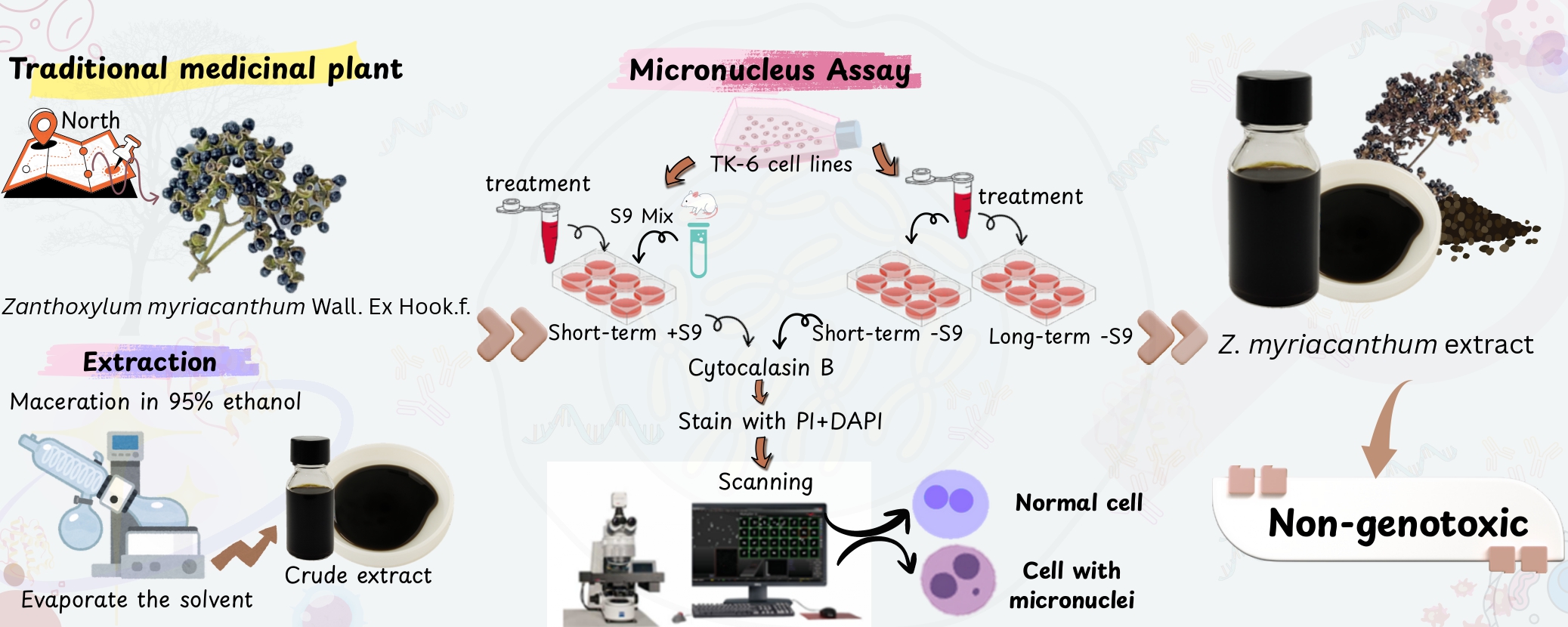
Zanthoxylum myriacanthum, commonly known as Ma-Khwan, is a traditional medicinal plant predominantly found in the northern part of Thailand. Its fruits are extensively used in culinary practices and traditional medicine. However, comprehensive safety and toxicity data on its extracts remain limited. This study aimed to evaluate the genotoxic potential of Z. myriacanthum fruit extract using the in vitro micronucleus assay in human TK-6 lymphoblastoid cells, following the OECD Test Guideline No. 487. The extract was tested under three exposure conditions: short-term treatment with and without metabolic activation (S9 mix) for 4 hours, and long-term treatment without S9 mix for 24 hours. The results indicated that the extract did not induce a statistically significant increase in micronucleus frequency compared with the concurrent negative controls at any tested concentration. These findings suggested that the fruit extract of Z. myriacanthum does not exhibit genotoxicity under the specified experimental conditions. The study was conducted in accordance with OECD Good Laboratory Practice (GLP) standards and aligned with the Thai Food and Drug Administration guidelines for herbal product development. Nonetheless, further in vivo toxicity assessments are required to fully substantiate its safety profile, support consumer confidence, and facilitate its potential application in commercial product registration.
Article Details
References
Vainio, H., Magee, P.N., McGregor, D.B. and McMichael, A.J. (Eds.), 1992, Mechanisms of Carcinogenesis in Risk Identification, IARC Scientific Publication No. 116, International Agency for Research on Cancer, Lyon.
Fenech, M., 2000, The in vitro micronucleus technique, Mutation Research. 455(1–2): 81–95.
Plants of the World Online 2025, Facilitated by the Royal Botanic Gardens Kew, Available Source: https://powo.science.kew.org/, May 13, 2025.
Dai, W., Zhang, L., Dai, L., Tian, Y., Ye, X., Wang, S. and Wang, Q., 2023, Comparative analysis of chemical composition of Zanthoxylum myriacanthum branches and leaves by GC-MS and UPLC-Q-Orbitrap HRMS, and evaluation of their antioxidant activities, Molecules. 28: 5631.
Department of Agricultural Extension, 2020, Final Research Report on the Completed Experiment, Research Report, Department of Agricultural Extension, Bangkok, 45 p. (in Thai).
Li, R., Yang, J.J., Shi, Y.X., Zhao, M., Ji, K.L., Zhang, P., Xu Y.K. and Hu, H.B., 2014, Chemical composition, antimicrobial and anti-inflammatory activities of the essential oil from Maqian (Zanthoxylum myriacanthum var. pubescens) in Xishuangbanna, SW China, J. Ethnopharmacol. 158: 43-48.
Zhang, H.L., Gan, X.Q., Fan, Q.F., Yang, J.J., Zhang, P., Hu, H.B. and Song, Q.S., 2017, Chemical constituents and anti-inflammatory activities of Maqian (Zanthoxylum myriacanthum var. pubescens) bark extracts, Sci. Rep. 7: 45805.
Lu, Q., Luo, S., Shi, Z., Yu, M., Guo, W. and Li, C., 2022, Nitidine chloride, a benzophenanthridine alkaloid from Zanthoxylum nitidum (Roxb.) DC., exerts multiple beneficial properties, especially in tumors and inflammation-related diseases, Front. Pharmacol. 13: 1046402.
Chaisakul, P. and Boonprong, S., 2016, Nutritional composition and antioxidant activity of Zanthoxylum limonella essential oil, J. Med. Plants Res. 10: 135-141.
Yang, J., Zhao, L., Li, R., Yan, Y., Yin, J., Dai, Q., Guo, X., Li, W., Li, Y., Liu, M., Ren, X., Yang, X., Hu, H., Zhong, W., Cao, R. and Li, S., 2022, In vitro and in vivo antiviral activity of Maqian (Zanthoxylum myriacanthum var. pubescens) essential oil and its major constituents against strains of influenza virus, Ind. Crops Prod. 177: 114524.
Okagu, I.U., Ndefo, J.C., Aham, E.C. and Udenigwe, C.C., 2021, Zanthoxylum species: A comprehensive review of traditional uses, phytochemistry, pharmacological and nutraceutical applications, Molecules. 26: 4023.
Posawang, S., Sornsuparb, B., Intachub, P. and Tongkhaw, K., 2019, Research on Species Diversity and Identification of Indigenous Plants Genus Zanthozylum (Rutaceae), Department of Agriculture, pp. 1-14 (in Thai)
Barkatullah, U., Ibrar, M. and Muhammad, N., 2011, Evaluation of Zanthoxylum armatum DC for in-vitro and in-vivo biological activities, Afr. J. Pharm. Pharmacol. 5: 1170-1178.
Laovitthayanggoon, S., Potduang, B., Ketmanee, N. and Banchonglikitkul, C., 2013, Cytotoxic evaluation of a fruit extract from Zanthoxylum limonella in human dermal fibroblast cell line using MTT assay, Thai J. Pharm. Sci. 38: 103-105.
Shu, L., Zhang, S., Qiu, H., Yao, Y., Liu, S., Qian, J., Chen, S., Zhao, Q. and Li, Y., 2024, Rapid classification and identification of chemical components in three different Zanthoxylum species by ultra-high-performance-liquid chromatography quadrupole-orbitrap-mass spectrometry, J. Sep. Sci. 47: e2300670.
In Vitro Mammalian Cell Micronucleus Test No.487 2025, OECD Guideline for Testing of Chemicals. Available Source:https://www.oecd.org/content/dam/oecd/en/publications/reports/2023/07/test-no-487-in-vitro-mammalian-cell-micronucleus-test_g1g6fb2a/9789264264861-en.pdf, May 2, 2025.
Rushendran, R. and Chitra, V., 2024, Antimigraine activity of Asarinin by OPRM1 pathway with multifaceted impacts through network analysis, Sci. Rep. 14(1): 20207.
Kasai, F., Hirayama, N., and Kohara, A., 2020, TK6 genome profile compared with WIL2-NS: Reference data to improve the reproducibility of genotoxicity studies, Mutat. Res. Genet. Toxicol. Environ. Mutagen. 858: 503236.
Verma, J. R., Rees, B. J., Wilde, E. C., Thornton, C. A., Jenkins, G. J. S., Doak, S. H. and Johnson, G. E. 2017, Evaluation of the automated MicroFlow® and Metafer™ platforms for high-throughput micronucleus scoring and dose response analysis in human lymphoblastoid TK6 cells, Arch. Toxicol. 91(7): 2689–2698.
Meta Systems: Innovative Solutions for Automated Imaging, Available Source: https://metasystems-international.com/, May 15, 2025
Wipoosanapan, P., Kangsadalampai, K. and Tongyonk, L., 2019, Antiformation and antimutagenic activities of extracts from pericarp and seed of Zanthoxylum limonella (Dennst.) Alston, Thai J. Pharm. Sci.43(2): 90–95.
Sudhong, W., Aunkat, S., Sirinanthananon, P., Suppajariyawat, P., Sincharoenpokai, P., Radapong, S., and Onthong, S., 2025, Mutagenicity Study of Zanthoxylum myriacanthum Wall. Ex Hook.f. Extract Using the Ames Test, SCI J CRU. 35(2):8-17. (in Thai).
Pattanawongsa, A., Klongsiriwet, C., Thaina, P., Prammano, A., Maneechai, N., Saengphrom, P. Yusakul, G. and Utsintong, M., 2021, In vitro and in vivo effects of Zanthoxylum limonella (Dennst.) Alston. crude extracts and volatile oil on blood glucose reduction, Thai J. Pharm. Sci. 45(6): 433-441.
