
Physicochemical Properties of Various Starches and Flours and the Effect of Quinoa Flour on Composite Gel Texture
Article Sidebar
Main Article Content
Abstract
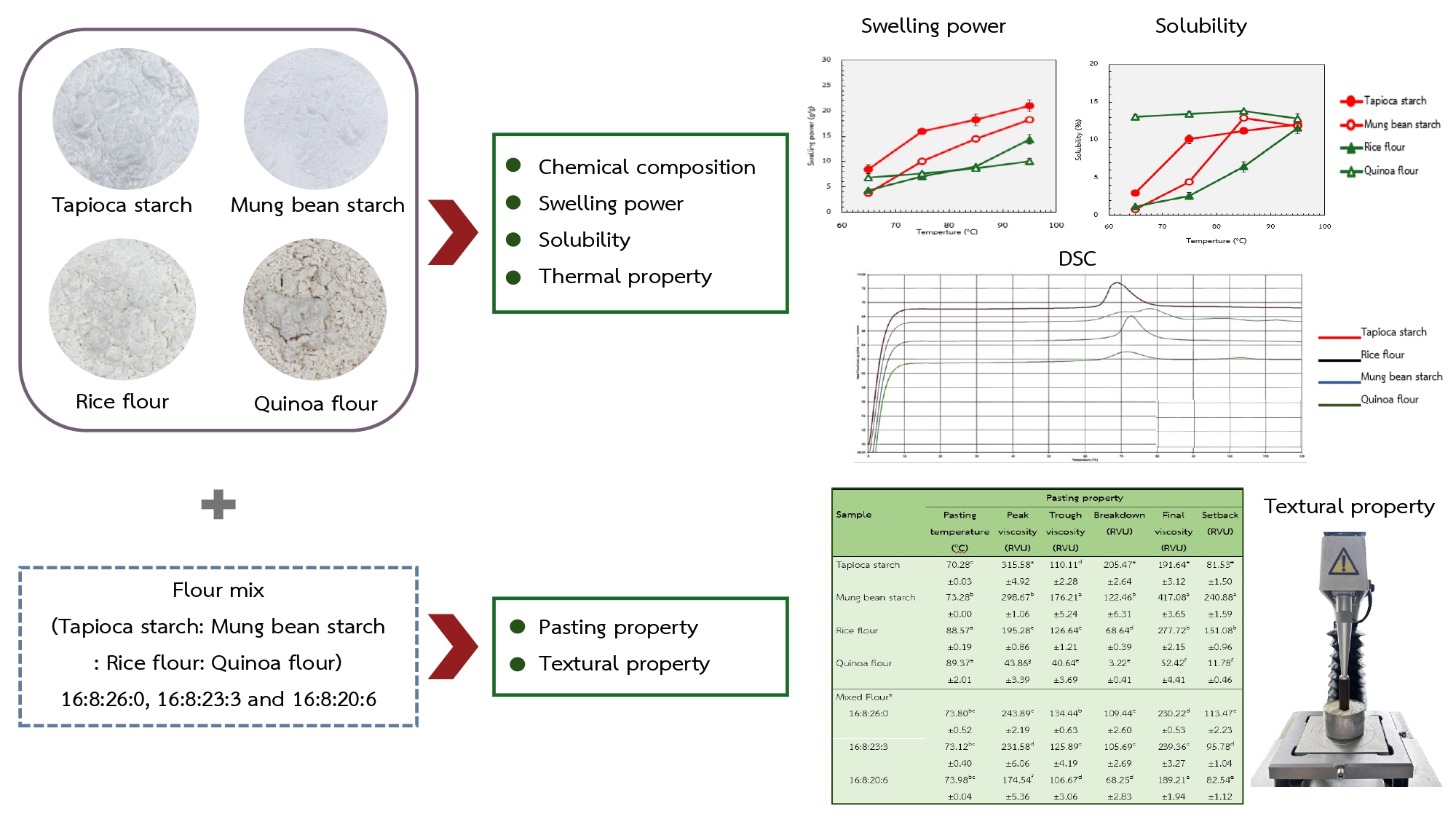
This research aimed to investigate the chemical composition and physicochemical properties of tapioca starch, mung bean starch, rice flour, and quinoa flour, as well as the textural characteristics of quinoa composite flour gels prepared from these four ingredients. The flour mixtures studied had weight ratios of 16:8:26:0, 16:8:23:3 and 16:8:20:6, respectively. The results showed that quinoa flour had the highest protein and fat contents at 21.86% and 9.17%, respectively. Mung bean starch exhibited the highest amylose content at 33.76%, whereas quinoa flour had the lowest amylose content at 13.75%. Increasing temperature resulted in higher swelling power and solubility for all starches and flours. Tapioca starch and mung bean starch showed greater swelling power than rice flour and quinoa flour in the temperature range of 75–95°C, while quinoa flour exhibited the highest solubility. Rice flour had the highest gelatinization temperature (Tp), whereas quinoa flour required the lowest gelatinization enthalpy (∆H). Regarding pasting properties, quinoa flour had the lowest breakdown and setback value, at 3.22 RVU and 11.78 RVU, respectively. Among the individual starch and flour gels, tapioca starch gel had the lowest hardness. The analysis of the physical properties of gel prepared from composite flour revealed that replacing rice flour with quinoa flour tended to decrease gel hardness.
Article Details
References
Graziano, S., Agrimonti, C., Marmiroli, N. and Gullì, M., 2022, Utilisation and limitations ofpseudocereals (quinoa, amaranth, and buckwheat) in food production: A review, Trends Food Sci. Technol. 125: 154-165.
Li, S., Zhang, Y., Wei, Y., Zhang, W. and Zhang, B., 2014, Thermal, pasting and gel textural properties of commercial starches from different botanical sources, J. Bioprocess. Biotech. 4(4): 1000161.
Ren,Y., Yuan, T.Z., Chigwedere, C.M. and Ai, Y., 2021, A current review of structure, functional properties, and industrial applications of pulse starches for value added utilization, Compr. Rev. Food Sci. Food Saf. 20(3): 3061-3092.
Waterschoot, J., Gomand, S.V., Willebrords, J.K., Fierens, E. and Delcour, J.A., 2014, Pasting properties of blends of potato, rice and maize starches, Food Hydrocoll. 41: 298-308.
Srirat, K. and Piyachomkwan, K., 2007, Technology of Flour, Kasetsart University, Bangkok, 303 p. (in Thai)
Udomrati, S., 2021, Determination of phase transition using differential scanning calorimetry, Food J. 51(2): 14-22. (in Thai)
Seetapan, N., Limparyoon, N., Gamonpilas, C., Methacanon, P. and Fuongfuchat, A., 2015, Effect of cryogenic freezing on textural properties and microstructure of rice flour/tapioca starch blend gel, J. Food Eng. 151: 51-59.
Wu, F., Meng, Y., Yang, N., Tao, H. and Xu, X., 2015, Effects of mung bean starch on quality of rice noodles made by direct dry flour extrusion, LWT-Food Sci. Technol. 63(2): 1199-1205.
Sahagún, M., Bravo-Núñez, Á., Báscones, G. and Gómez, M., 2018, Influence of protein source on the characteristics of gluten-free layer cakes, LWT. 94: 50-56.
Tirkey, I.A. and Paul, V., 2023, Research article recognition of quinoa as complete protein: Essential amino acid content of quinoa, Int. J. Adv. Multidiscip. Res. 10(8): 8645-8647.
Araujo-Farro, P.C., do Amaral Sobral, J.P. and Menegalli, F.C., 2005, Comparison of Starch Pasting and Retrogradation Properties of Quinoa (Chenopodium quinoa Willd.), Rice, Potato, Cassava, Wheat and Corn Starches, In Proceedings of the 2nd Mercosur Congress on Chemical Engineering and 4th Mercosur Congress on Process Systems Engineering. pp. 14-18.
Feng, Y., Zhu, Y., Wang, Z. and Li, X., 2023, Effects of whole quinoa flour addition on the pasting property, dough rheology, and steam bread textural propertyof wheat flour, Int. Food Res. J. 30: 1212-1220.
AOAC, 2012, Official Method of Analysis of Association of Official Analysis Chemists, 19th Ed., Washington D.C. Takeda,Y. and Hizukuri, S., 1987, Structures of rice amylopectins with low and high affinities for iodine, Carbohydr. Res. 168(1): 79-88.
Gibson, T.S., Solah, V.A. and McClearyt, B.V., 1997, A procedure to measure amylose in cereal starches and flours with Concanavalin A., J. Cereal Sci. 25(2): 111-119.
Li, J. and Corke, H., 1999, Physicochemical properties of normal and waxy Job’s tears (Coix lachrymal-jobi L.) starch, Cereal Chem. 76(3): 413-416.
Kim, Y.S., Wiesenborn, D.P., Orr, P.H. and Grant, L.A., 1995, Screening potato starch for novel properties using differential scanning calorimetry, J. Food Sci. 60(5): 1060-1065.
Byars, J.A. and Singh, M., 2016, Rheological and textural properties of pulse starch gels, Starch-Stärke. 68(7-8): 778-784.
Yang, C., Zhu, X., Liu, W., Huang, J., Xie, Z., Yang, F. and Wei, Y., 2024, Quantitative analysis of the phenolic compounds and antioxidant activities of six quinoa seed grains with different colors, LWT-Food Sci. Technol. 203: 116384.
Dong, J., Huang, L., Chen, W., Zhu, Y., Dun, B. and Shen, R., 2021, Effect of heat moisture treatments on digestibility and physicochemical property of whole quinoa flour, Foods. 10(12): 3042.
Jia, R., Cui, C., Gao, L., Qin, Y., Ji, N., Dai, L. and Sun, Q., 2023, A review of starch swelling behavior: Its mechanism, determination methods, influencing factors, and influence on food quality, Carbohydr. Polym. 321: 121260.
Photinam, R., Moongngarm, A. and Paseephol, T., 2016, Process optimization to increase resistant starch in vermicelli prepared from mung bean and cowpea starch, Emir. J. Food Agric. 28: 449-458.
Phrukwiwattanakul, P., Wichienchotand, S. and Sirivongpaisal, P., 2014, Comparative studies on physico-chemical properties of starches from jackfruit seed and mung bean, Int. J. Food Prop. 17(9): 1965-1976.
Mishra, S. and Rai, T., 2006, Morphology and functional properties of corn, potato and tapioca starches, Food Hydrocoll. 20(5): 557-566.
Noosuk, P., Hill, S.E., Pradipasena, P. and Mitchell, J.R., 2003, Structure-viscosity relationships for Thai rice starches, Starch Stärke. 55(8): 337-344.
Velásquez-Barreto, F.F., Miñano, H.A., Alvarez-Ramirez, J. and Bello-Pérez, L.A., 2021, Structural, functional and chemical properties of small starch granules: Andean quinoa and kiwicha, Food Hydrocoll. 120(1): 106883.
Wattanachant, S., Muhammad, S.K.S., Hashim, D.M. and Rahman, R.A., 2002, Suitability of sago starch as a base for dual-modification, Songklanakarin J. Sci. Technol. 24(3): 431-438.
Singh, N., Kaur, L., K.S. Sandhu, K.S., Kaur, J. and Nishinar, K., 2006, Relationships between physicochemical, morphological, thermal, rheological properties of rice starches, Food Hydrocoll. 20(4): 534-542.
Yu, S., Ma, Y., Menager, L. and Sun, D.W., 2012, Physicochemical properties of starch and flour from different ricecultivars, Food Bioprocess Technol. 5(2): 626-637.
Tester, R.F. and Morrison, W.R., 1990, Swelling and gelatinization of cereal starches. I. Effects of amylopectin, amylose, and lipids, Cereal Chem. 67(6): 551-557.
Contreras-Jiménez, B., Torres-Vargas, O.L. and Rodríguez-García, M.E., 2019, Physicochemical characterization of quinoa (Chenopodium quinoa) flour and isolated starch, Food chem. 298(1): 124982.
Ahamed, N.T., Singhal, R.S., Kulkarni, P.R. and Pal, M., 1996, Physicochemical and functional properties of Chenopodium quinoa starch, Carbohydr. Polym. 31: 99-103
Jiao, A., Yang, Y., Li, Y., Chen, Y., Xu, X. and Jin, Z., 2020, Structural properties of rice flour as affected by the addition of pea starch and its effects on textural properties of extruded rice noodles, Int. J. Food Prop. 23(1): 809-819.
Lamothe, L.M., Srichuwong, S., Reuhs, B.L. and Hamaker, B.R., 2015, Quinoa (Chenopodium quinoa W.) and amaranth (Amaranthus caudatus L.) provide dietary fibres high in pectic substances and xyloglucans, Food chem. 167(1): 490-6.
Ratnayake, W.S. and Jackson, D.S., 2007, A new insight into the gelatinization process of native starches, Carbohydr. Polym. 67(4): 511-529.
Li, W., Shu, C., Zhang, P. and Shen, Q., 2011, Properties of starch separated from ten mung bean varieties and seeds processing characteristics, Food Bioprocess Technol. 4(5): 814-821.
Singh, N., Singh, J., Kaur, L., Sodhi, N.S. and Gill, B.S., 2003, Morphological, thermal and rheological properties of starches from different botanical sources, Food Chem. 81(2): 219-231.
Chung, H.J. and Liu, Q., 2010, Molecular structure and physicochemical properties of potato and bean starches as affected by gamma-irradiation, Int. J. Biol. Macromol. 47(2): 214-222.
Huang, C.C., 2009, Physicochemical, pasting and thermal properties of tuber starches as modified by guar gum and locust bean gum, Int. J. Food Sci. Technol. 44(1): 50-57.
Ragaee, S. and Abdel-Aal, E.S.M, 2006, Pasting properties of starch and protein in selected cereal and quality of their food products, Food Chem. 95(1): 9-18.
Gupta, M., Bawa, A.S. and Semwal, A.D., 2009, Morphological, thermal, pasting, and rheological properties of barley starch and their blends, Int. J. Food Prop. 12(3): 587-604.
León, A.E., Barrera, G.N., Pérez, G.T., Ribotta, P. D. and Rosell, C.M., 2006, Effect of damaged starch levels on flourthermal behaviour and bread staling, Eur. Food Res. Technol. 224(2): 187-192.
Chanapamokkhot, H. and Thongngam, M., 2007, The chemical and physico chemical properties of sorghum starch and flour, Agr. Nat. Resour. 41(5): 343-349.
Sciarini, L.S., Ribotta, P.D., León, A.E. and Pérez, G.T., 2010, Influence of gluten-free flours and their mixtures on batter properties and bread quality, Food Bioprocess Technol. 3(4): 577-585.
Aphichachan, U. and Jiamyangyuen, S., 2006, Production and utilization of pregelatinized rice flour and its application in reduced-fat donut cake, Univ. Thai Chamb. Commer. J. (UTCC). 26(3): 32-45. (in Thai)
Sandhu, K.S. and Singh, N., 2007, Some properties of corn starches II: Physicochemical, gelatinization, retrogradation, pasting and gel textural properties, Food Chem. 101(4): 14991507.
De Bock, P., Daelemans, L., Selis, L., Raes, K., Vermeir, P., Eeckhout, M. and Van Bockstaele, F., 2021, Comparison of the chemical and technological characteristics of wholemeal flours obtained from amaranth (Amaranthus sp.), quinoa (Chenopodium quinoa w.) and buckwheat (Fagopyrum sp.) seeds, Foods. 10(3): 651.
