
องค์ประกอบทางเคมีและฤทธิ์ทางชีวภาพของสารสกัดใบพลู (Piper betle L.) ตกเกรด
Article Sidebar
Main Article Content
บทคัดย่อ
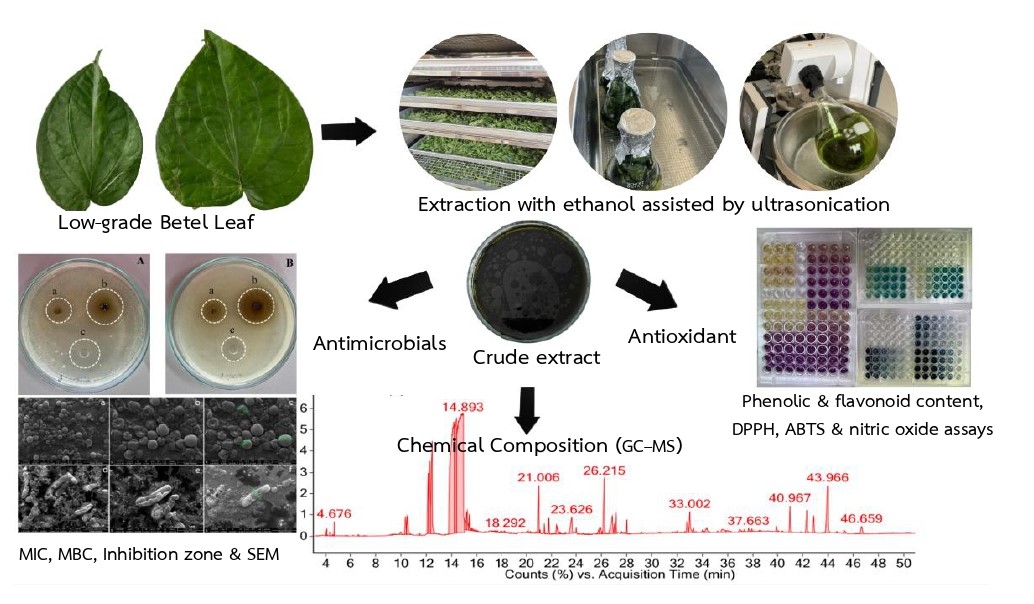
พลู (Piper betle L.) เป็นพืชเศรษฐกิจของจังหวัดพัทลุง หลังการคัดเกรดเพื่อส่งออกทำให้มีใบพลูตกเกรดเหลือทิ้งกว่า 1 ตันต่อวัน การศึกษานี้มีวัตถุประสงค์เพื่อสกัดสารสำคัญ วิเคราะห์องค์ประกอบทางเคมี และประเมินฤทธิ์ทางชีวภาพของสารสกัดใบพลูตกเกรด โดยใช้วิธีการสกัดด้วยเอทานอลร้อยละ 95 ร่วมกับการใช้คลื่นเสียงความถี่สูง จากการวิเคราะห์องค์ประกอบทางเคมีของสารสกัดด้วยเทคนิคแก๊สโครมาโทกราฟี–แมสสเปกโทรเมทรี (GC–MS) พบสารสำคัญทั้งหมด 10 ชนิด โดยมี Phytol, Neophytadiene และ Tolycaine เป็นองค์ประกอบหลัก และพบ Phenol, 2-methoxy-4-(1-propenyl)-, Eugenol, และ Ergost-5-en-3-ol เป็นองค์ประกอบรอง สารสกัดมีปริมาณสารประกอบฟีนอลิกทั้งหมด 559.66 mg GAE/g และฟลาโวนอยด์ทั้งหมด 48.36 mg QE/g มีฤทธิ์ต้านอนุมูลอิสระ DPPH (IC50=35.53 µg/mL) และ ABTS (IC50=95.63 µg/mL) และมีฤทธิ์ยับยั้งการสร้างไนตริกออกไซด์ (IC50=1,075.75 µg/mL) ซึ่งสัมพันธ์กับการอักเสบ เมื่อทดสอบฤทธิ์ต้านจุลินทรีย์ พบว่าสารสกัดสามารถยับยั้งและฆ่าเชื้อ Staphylococcus aureus และ Escherichia coli ได้ ผลการวิเคราะห์ด้วยกล้องจุลทรรศน์อิเล็กตรอนแบบส่องกราดยืนยันถึงความเสียหายของผนังและเยื่อหุ้มเซลล์ของแบคทีเรีย ดังนั้นสารสกัดใบพลูตกเกรดมีฤทธิ์ต้านอนุมูลอิสระ ต้านจุลชีพ และต้านการอักเสบ ซึ่งอาจมีศักยภาพในการเป็นวัตถุดิบสำหรับผลิตภัณฑ์สุขภาพและเวชสำอางในอนาคต และช่วยเพิ่มมูลค่าให้วัสดุเศษเหลือจากการคัดเกรดเพื่อการส่งออก
Article Details
เอกสารอ้างอิง
Umar, A., Imam, G., Amina, M. and Sadiya, A., 2018, Antibacterial activity of methanolic extract of Piper betle against selected bacterial strains, J. Med. Plants Res. 12(3): 56–62.
Rugthaworn, P., Innok, P. and Wanachantararak, P., 2010, Antimicrobial activity of Piper betle Linn. extracts against pathogenic bacteria, Thai J. Pharm. Sci. 34(2): 71–78.
Gogoi, R., Loying, R. and Sarma, D., 2014, Chemical composition and antimicrobial activity of essential oil of Piper betle L., Int. J. Pharm. Pharm. Sci. 6(5): 199–202.
Arambewela, L.S.R. Arawwawala, L.D.A.M., and Ratnasooriya, W.D., 2005, Antidiabetic activities of Piper betle leaves, J. Ethnopharmacol. 102(2): 239–245.
Gong, Y., Lin, Z., Zhang, L., Qin, X., Liu, X. and Zhang, L., 2012, Bioactive compounds from Piper betle L. and their pharmacological activities, Fitoterapia. 83(2): 250–257.
Pradhan, D., Suri, K.A., Pradhan, D.K. and Biswasroy, P., 2013, Golden heart of the nature: Piper betle L., J. Pharmacogn. Phytochem. 1(6): 147–167.
Thongsom, S., Noipha, K., Thanonkaew, A. and Klompong, V., 2024, Quality and antibacterial activity of paper soap containing essential oil from Wan Sao Long (Amomum biflorum Jack), Thammasat J. Sci. Technol. 32(2): 42–54. (in Thai)
Gong, Y., Liu, X., He, W., Xu, H., Yuan, F. and Gao, Y., 2012, Investigation on the antioxidant activity and chemical composition of Piper betle extracts, J. Med. Plants Res. 6(31): 4759–4765.
Zhishen, J., Mengcheng, T. and Jianming, W., 1999, Determination of flavonoid contents in mulberry and their scavenging effects on superoxide radicals, Food Chem. 64(4): 555–559.
Brand-Williams, W., Cuvelier, M.E. and Berset, C., 1995, Use of a free radical method to evaluate antioxidant activity, LWT-Food Sci. Technol. 28(1): 25–30.
Arnao, M.B., 2001, Some methodological problems in the determination of antioxidant activity using chromogen radicals: a practical case, Trends Food Sci. Technol. 11(11): 419–421.
Green, L.C., Wagner, D.A., Glogowski, J., Skipper, P.L., Wishnok, J.S. and Tannenbaum, S.R., 1982, Analysis of nitrate, nitrite, and nitrate in biological fluids, Anal. Biochem. 126(1): 131–138.
Thanonkaew, A., Thongruang, W., Kampean, M., Juntachote, T., Panomjan, N. and Klompong, V., 2025, Product development of crispy betel (Piper betle L.) leaf for health and its chemical constituents, The Proceeding of the 27th Food Innovation Asia Conference 2025, pp. 467-474.
Tiwari, B.K., Valdramidis, V.P., O’Donnell, C.P., Muthukumarappan, K., Bourke, P. and Cullen, P.J., 2009, Application of SEM for evaluating bacterial cell morphology after exposure to plant antimicrobials, Innov. Food Sci. Emerg. Technol. 10(3): 363–368.
Kai, K., Somwong, P. and Siripongvutikorn, S., 2020, Extraction efficiency and phytochemical properties of Piper betle leaves using ethanol extraction, J. Food Sci. Agric. Technol. 7(1): 45–52.
Chavan, P.S., Shamprasad, B.R. and Pawar, K.D., 2018, Phytochemical extraction of Piper betle leaves using soxhlet method and evaluation of antioxidant activity, Int. J. Pharm. Sci. Rev. Res. 51(2): 98–103.
Pradhan, D., Suri, K. and Pradhan, D.K., 2013, Phytochemical and antimicrobial activity of Piper betle leaf extract obtained through Soxhlet extraction, Asian J. Pharm. Clin. Res. 6(3): 34–38.
Gong, A.D., Li, H.P., Yuan, Q.S., Song, X.S., Yao, W., He, W.J. and Liao, Y.C., 2012, Antifungal activity of essential oils and their major components against Alternaria alternata, J. Appl. Microbiol. 113(3): 541–548.
Umar, M.I., Asmawi, M.Z., Sadikun, A., Majid, A.M.S.A. and Altaf, R., 2018, Phytochemical and pharmacological updates on betel leaf, J. Appl. Pharm. Sci. 8(10): 134–142.
Rugthaworn, P., Innok, P. and Wanachantararak, P., 2010, Antimicrobial activity of Piper betle Linn. extracts against pathogenic bacteria, Thai J. Pharm. Sci. 34(2): 71–78.
Gong, Y., Lin, Z., Zhang, L., Qin, X., Liu, X. and Zhang, L., 2012, Bioactive compounds from Piper betle L. and their pharmacological activities, Fitoterapia. 83(2): 250–257.
Umar, A., Ismail, S., Ameen, A. and Rasheed, R.A., 2018, Antimicrobial activity of polyphenols and alkaloids in plant extracts, J. Med. Plants Res. 12(4): 89–95.
Suresh, P., Ramesh, P. and Kumar, V., 2019, Phytochemical analysis and antioxidant activity of betel leaf (Piper betle L.) extracts, J. Herbal Med. 15: 100–108.
Bordoloi, M., Deka, S. and Sharma, P., 2020, Comparative evaluation of phenolic and flavonoid content in Piper betle leaves extracted using different solvents, J. Food Sci. Technol. 57: 2345–2354.
Zhishen, J., Mengcheng, T. and Jianming, W., 1999, Determination of flavonoid contents in mulberry and their scavenging effects on superoxide radicals, Food Chem. 64(4): 555–559.
Green, L.C., Wagner, D.A., Glogowski, J., Skipper, P.L., Wishnok, J.S. and Tannenbaum, S.R., 1982, Analysis of nitrate, nitrite, and nitrate in biological fluids, Anal. Biochem. 126(1): 131–138.
Griess, P., 1879, Bemerkungen zu der Abhandlung der HH. Weselsky und Benedikt Ueber einige Azoverbindungen, Ber. Dtsch. Chem. Ges. 12(1): 426–428.
Klompong, V., Benjakul, S., 2015, Antioxidative and antimicrobial activities of the extracts from the seed coat of Bambara groundnut (Voandzeia subterranea), RSC Adv. 5: 9973-9985.
Tiwari, B.K., Valdramidis, V.P., O’Donnell, C.P., Muthukumarappan, K., Bourke, P. and Cullen, P.J., 2009, Application of SEM for evaluating bacterial cell morphology after exposure to plant antimicrobials, Innov. Food Sci. Emerg. Technol. 10(3): 363–368.
Cowan, M.M., 1999, Plant products as antimicrobial agents, Clin. Microbiol. Rev. 12(4): 564–582.
Daglia, M., 2012, Polyphenols as antimicrobial agents, Curr. Opin. Biotechnol. 23(2): 174–181.
Cushnie, T.P.T. and Lamb, A.J., 2011, Recent advances in understanding the antibacterial properties of flavonoids, Int. J. Antimicrob. Agents 38(2): 99–107.
