
การศึกษาอิทธิพลของแบคทีเรียลเซลลูโลสจากน้ำมะพร้าวต่อการเสริมแรงยางธรรมชาติคอมโพสิต
Article Sidebar
Main Article Content
บทคัดย่อ
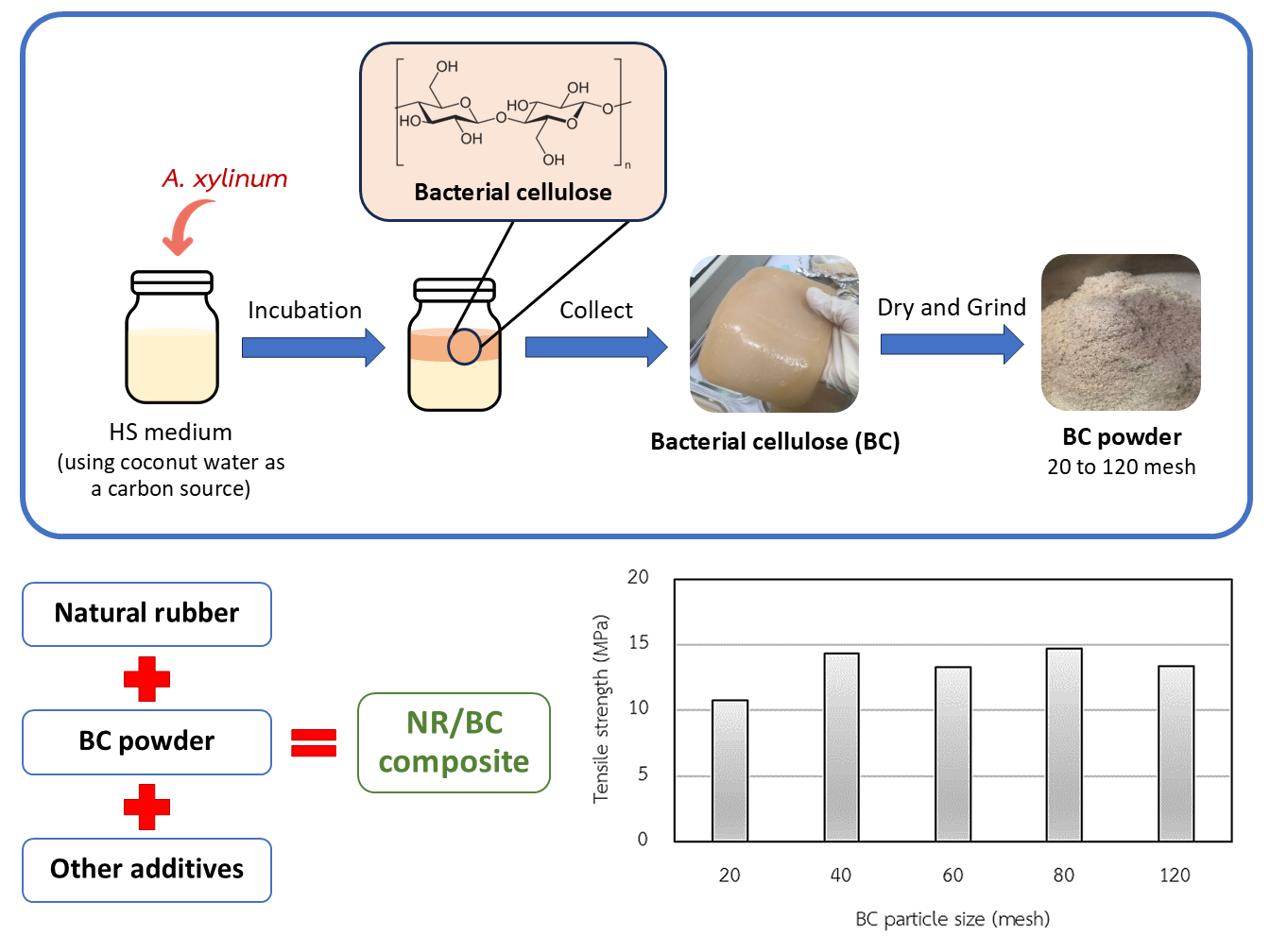
การศึกษานี้มีวัตถุประสงค์ในการประยุกต์ใช้แบคทีเรียลเซลลูโลสเป็นสารตัวเติมฐานชีวภาพสำหรับยางธรรมชาติ ซึ่งแบคทีเรียลเซลลูโลสเตรียมจากการเลี้ยงเชื้อ Acetobacter xylinum ด้วยอาหารสูตร Hestrin-Schramm (HS) โดยใช้น้ำมะพร้าวเป็นแหล่งคาร์บอน แบคทีเรียลเซลลูโลสที่ได้นำไปทำให้แห้งและบดเป็นผงและนำไปแยกขนาดด้วยเครื่องเขย่าตะแกรงร่อน วิเคราะห์หมู่ฟังก์ชั่นเซลลูโลสด้วยเทคนิคฟูเรียร์ทรานส์ฟอร์มอินฟราเรดสเปกโตรสโคปี ยางธรรมชาติคอมโพสิตเตรียมโดยการผสมยางธรรมชาติ สารเคมีต่างๆ และแบคทีเรียลเซลลูโลส ด้วยเครื่องผสมสองลูกกลิ้ง ศึกษาผลของปริมาณ (1, 2.5 และ 5 ส่วนในยางร้อยส่วน) และขนาดอนุภาค (20, 40, 60, 80 และ 120 เมช) ของแบคทีเรียลเซลลูโลสต่อพฤติกรรมการคงรูปและสมบัติเชิงกล ได้แก่ ความทนทานต่อแรงดึงและความสามารถในการยืดจนขาดของยางธรรมชาติคอมโพสิต ผลการศึกษาพบว่าสามารถสังเคราะห์แบคทีเรียลเซลลูโลสได้ ซึ่งขนาดและปริมาณของแบคทีเรียลเซลลูโลสไม่ส่งผลต่อพฤติกรรมการคงรูปของยาง นอกจากนี้การใช้แบคทีเรียลเซลลูโลสขนาด 80 เมช (180 ไมครอน) ปริมาณ 1 ส่วนในยางร้อยส่วน ให้ค่าความทนทานต่อแรงดึงสูงที่สุด อย่างไรก็ตาม ความสามารถในการยืดจนขาดของยางธรรมชาติคอมโพสิตแต่ละสูตรมีค่าไม่แตกต่างกันมากนัก
Article Details
เอกสารอ้างอิง
Kajornchaiyakul, V., 2004, Natural Rubber: Production and Applications, The Thailand Research Fund, Bangkok, 200 p. (in Thai)
Plastics Institute of Thailand 2024, Rubber Compound Technology, Available Source: https://rubber.oie.go.th/EDocument.aspx?pid=1171&cid=1172, June 25, 2024. (in Thai)
Lapphunthana-anan, C., Novel Carbon Black, Available Source: http://www.mahidolrubber.org/lc_rtec/basic_rubber/2554_carbonblack_rtec.pdf, June 25, 2024. (in Thai)
Intharapat, P., 2012, Filler in natural rubber from waste biomass, JSSE. 14(1): 30-43. (in Thai)
Lozada, E. R., Gutiérrez Aguilar, C. M., Jaramillo Carvalho, J. A., Sánchez, J. C. and Torres, G. B., 2023, Vegetable cellulose fibers in natural rubber composites, Polymers. 15(13): 1-16.
Dominic, M., Joseph, R., Sabura Begum, P.M., Parambath Kanoth, B., Chandra, J. and Thomas, S., 2020. Green tire technology: effect of rice husk derived nanocellulose (RHNC) in replacing carbon black (CB) in natural rubber (NR) compounding, Carbohydr. Polym. 230: 115620.
Isabela de Andrade, A. F., Alessandra, C. P., Valéria, R. R., Débora, G. B., Mellany Sarah, C. O., Giselle, M. M. and Charles Windson I. H., 2020, Bacterial cellulose: from production optimization to new applications, Int. J. Biol. Macromol. 164: 2598-2611.
Babac, C., Kutsal, T. and Piskin, E., 2009, Production and characterization of biodegradable bacterial cellulose membranes, Int. J. Nat. Eng. Sci. 3(2): 19-22.
Torres, F. G., Arroyo, J. J. and Troncoso, O. P., 2019, Bacterial cellulose nanocomposites: an all-nano type of material, Mater. Sci. Eng. C. 98: 1277-1293.
Chinsamran, K. and Suttisuwan, R., 2015, Development of bacterial cellulose production in molasses by using coconut juice as the nutrient supplement and adding of gelling agent, RMUTSB Acad. J. 3(2): 98-108. (in Thai)
Maichan, W., Kammanglakan, P., Sudpruek, S., Prudprom, K., Anchana, C., Pongpanich, J. and Laloknam, S., 2012, Production of bacterial cellulose by Acetobacter xylinum TISTR086 using agricultural products as carbon sources, J. Res. Unit Sci.Technol. Environ. Learning. 3(2): 92-97. (in Thai)
Jaturapiree, A., Chaichana, E., Saowapark, T., Chuenpraphai, B. and Jaturapiree, P., 2019, Production and characterization of bacterial cellulose produced by Acetobacter xylinum TSTR 975 from pineapple peel juice, RMUTP Res. J. 13(1): 180-192. (in Thai)
Julaluk, K., 2016, The production of bacterial cellulose from Acetobacter xylinum and application in industry, Rajabhat Agric. 15(2): 25-33. (in Thai)
Park, J. K., Jung, J. Y. and Khan, T., 2009, Bacterial Cellulose, pp. 724-739, in Phillips, G. O. and Williams, P. A. (Eds.), Handbook of Hydrocolloids, 2nd ed., Woodhead Publishing Series in Food Science, Technology and Nutrition, Cambridge, UK.
Reis, D. T., Santos Pereira, A. K., Scheidt, G. N. and Pereira, D. H., 2019, Plant and bacterial cellulose: production, chemical structure, derivatives and applications, Orbital: Electron. J. Chem. 11(5): 321-329.
Rolere, S., Liengprayoon, S., Vaysse, L., Jerome, S. B. and Bonfils, F., 2015, Investigating natural rubber composition with fourier transform infrared (FT-IR) spectroscopy: A rapid and non-destructive method to determine both protein and lipid contents simultaneously, Polym. Test. 43: 83-93.
Kajornchaiyakul, V., 2009, Rubber Products: Manufacturing and Technology, The Thailand Research Fund, Bangkok, 204 p. (in Thai)
Tantatherdtam, R., Kongtud, W. and Sriroth, K., 2010, Preparation and Properties of Natural Rubber Filled Coconut Shell and Palm Oil Bunch Fiber Composites, Proceedings of 48th Kasetsart University Annual Conference: Agro-Industry, pp. 523-529. (in Thai)
Lee, J. S., Parameswaran, B., Lee, J. P. and Park, S. C., 2008, Recent developments of key technologies on cellulosic ethanol production, J. Sci. Ind. Res. 67(11): 865-873.
Wongsorat, W., Suppakarn, N. and Jarukumjorn, K., 2011, Influence of filler types on mechanical properties and cure characteristics of natural rubber composites, Adv. Mater. Res. 264-265(2011): 646-651.
Thepchalerm, C., Koraneesak, C. and Paksa, J., 2021, Effect of Water Hyacinth Fibers Used as Filler in Natural Rubber Latex, Proceedings of the 14th Srinakarinwirot University Research Conference, pp. 492-501. (in Thai)
Martirani-VonAbercron, S.M. and Pacheco-Sánchez, D., 2023, Bacterial cellulose: a highly versatile nanomaterial, Microb. Biotechnol. 16(6): 1174-1178.
