
การพัฒนาพันธุ์ข้าวขาวดอกมะลิ 105 พลัส 4 ให้ต้านทานโรคไหม้ด้วยยีน Pi9 ทั้ง 4 อัลลีล (Pi2, Pi9, Piz และ Piz-t)
Article Sidebar
Main Article Content
บทคัดย่อ
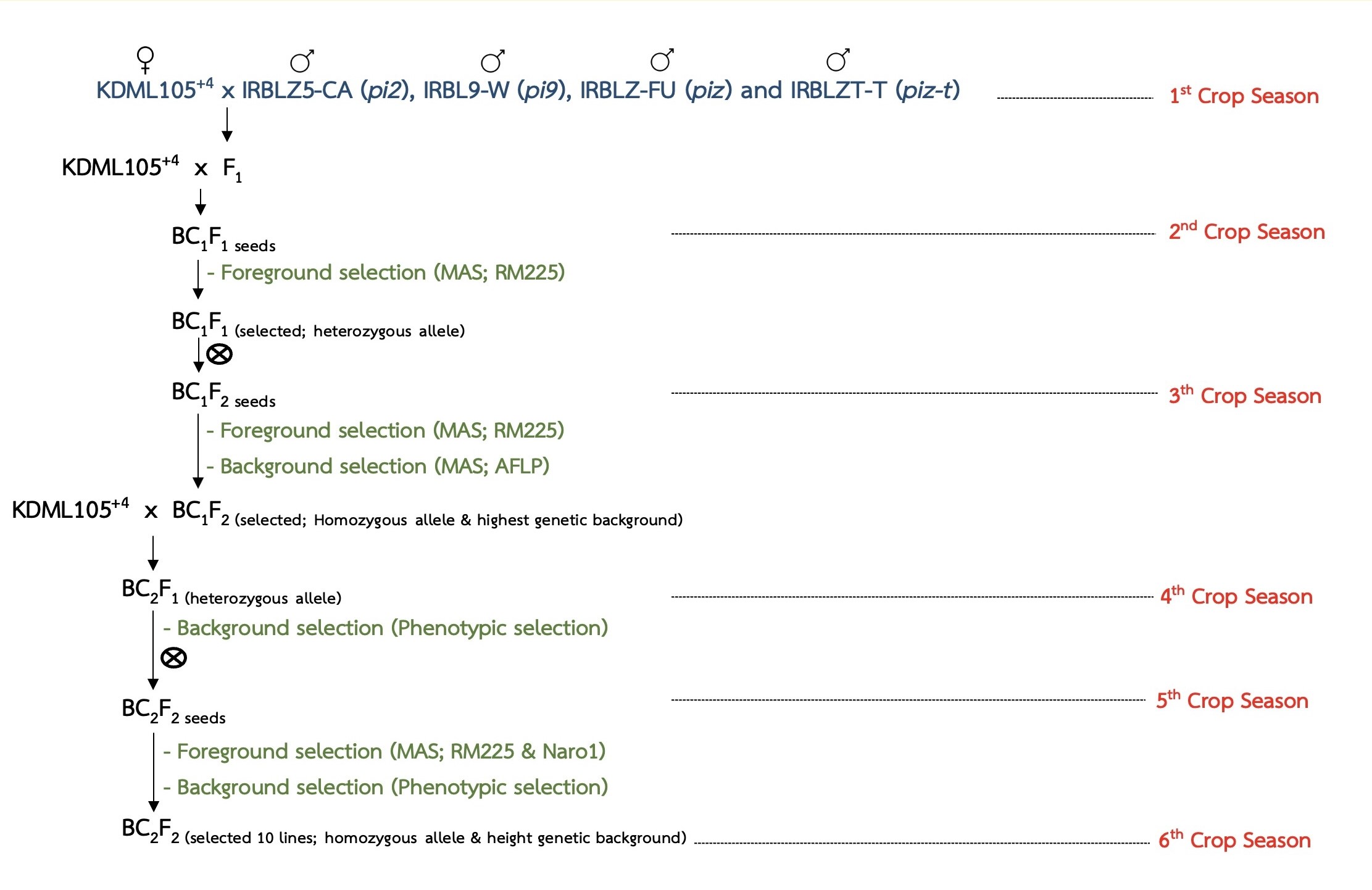
ข้าวพันธุ์ขาวดอกมะลิ 105 เป็นข้าวไทยคุณภาพสูงที่เป็นที่นิยมในการบริโภค แต่มักอ่อนแอต่อโรคไหม้ งานวิจัยนี้มีวัตถุประสงค์เพื่อถ่ายทอดยีนต้านทานโรคไหม้กลุ่ม Pi9 ทั้ง 4 อัลลีล ได้แก่ Pi2, Pi9, Piz และ Piz-t จากสายพันธุ์ IRBLZ5-CA, IRBL9-W, IRBLZ-FU และ IRBLZT-T ตามลำดับ ไปยังพันธุ์ขาวดอกมะลิ 105 พลัส 4 (KDML105+4) โดยใช้วิธีผสมกลับร่วมกับการคัดเลือกด้วยเครื่องหมายโมเลกุลแบบ SSR ได้แก่ RM225 และ Naro1 ถูกใช้เพื่อตรวจสอบยีนต้านทานโรคไหม้และยีนความหอม ตามลำดับ ขณะที่เครื่องหมายโมเลกุลแบบ AFLP ถูกใช้เพื่อคัดเลือกต้นที่มีพื้นฐานพันธุกรรมใกล้เคียงพันธุ์รับมากที่สุด นอกจากนี้ ยังประเมินลักษณะทางฟีโนไทป์เพื่อประกอบการคัดเลือกร่วมด้วย จากผลการทดลองสามารถคัดเลือกสายพันธุ์ข้าวลูกผสมกลับชั่วที่ BC2F2 ที่มีคุณลักษณะตรงตามเกณฑ์ได้จำนวน 10 สายพันธุ์ต่อคู่ผสม อย่างไรก็ตาม สายพันธุ์ลูกผสมที่ผ่านการคัดเลือกจำนวน 40 สายพันธุ์ควรนำไปปลูกทดสอบภายใต้สภาพแปลงทดลองเพื่อประเมินความเสถียรของลักษณะต้านทานโรคไหม้และประสิทธิภาพการให้ผลผลิตก่อนพิจารณาเข้าสู่กระบวนการปรับปรุงพันธุ์ในระดับสูงต่อไป รวมไปถึงศึกษาประสิทธิภาพในการต้านทานเชื้อโรคไหม้หลากหลายสายพันธุ์ภายใต้สภาพแวดล้อมจริงในพื้นที่ปลูกหลัก เพื่อให้ได้สายพันธุ์ข้าวที่เหมาะสมสำหรับการปลูกในพื้นที่เสี่ยงต่อการระบาดของโรคไหม้ และตอบสนองต่อความต้องการของเกษตรกรในพื้นที่ปลูกจริง
Article Details
เอกสารอ้างอิง
Sriboonjit, S. and Viboonpong, A., 2000, Evaluation of neck blast disease affected to KDML rice production by stochastic frontier method, Econ. J. 3: 39-52. (in Thai)
Rice Science Center 2019, Hommali 4 (KDML105+4) Rice Variety, Available Source: https://dna.kps.ku.ac.th/index.php/news-articles-rice-rsc-rgdu-knowledge/rice-breeding-lab/hommali4-rice-variety, January 18, 2019. (in Thai)
Sirithunya, P., Sreewongchai, T., Sriprakhon, S., Toojinda, T., Pimpisithavorn, S., Kosawang, C. and Smitamana, P., 2007, Assessment of genetic diversity in Thai isolates of Pyricularia grisea by random amplification of polymorphic DNA, J. Phytopathol. 156: 196-204.
Tian, D., Yun. D., Xiaoshuang, Y., Gang L., Qixiang, L., Haiying, Z., Ziqiang, C., Xinrui, G., Yan, S., Yuming, L. and Liming, Y., 2022, Association analysis of rice resistance genes and blast fungal avirulence genes for effective breeding resistance cultivars, Front. Microbiol. 13:1-11.
Chaipanya, C., Telebanco-Yanoria, M.J., Quime, B., Longya, A., Korinsak, S., Korinsak, S., Toojinda, T., Vanavichit, A., Jantasuriyarat, C. and Zhou, B., 2017, Dissection of broad-spectrum resistance of the Thai rice variety Jao Hom Nin conferred by two resistance genes against rice blast, Rice. 10(18): 1-11.
Liu, G., Lu, G., Zen, L. and Wang, G.L., 2002, Two broad-spectrum blast resistance genes, Pi9(t) and Pi2(t), are physically linked on rice chromosome 6, Mol. Genet. Genomics. 267: 472-480.
Allard, R.W., 1999, Principle of Plant Breeding, 2nd Ed., Wiley, Inc., New York.
Collard, B. and Mackill, D., 2010, Marker-assisted breeding for rice improvement, Euphytica. 142: 123-146.
Hasan, M.M., Rafii, M.Y., Ismail, M.R., Mahmood, M., Rahim, H.A., Alam, M.A., Ashkani, S., Malek, M.A. and Latif, M.A., 2015, Marker-assisted backcrossing: A useful method for rice improvement, Biotechnol. Biotechnol. Equip. 29(2): 237-254.
Melaku, G., Zhang, S. and Haileselassie, T., 2018, Comparative evaluation of rice SSR markers on different oryza species, J. Rice. Res. Dev. 1(1): 38-48.
Rattanapol, P., Sripichitt, P. and Sreewongchai, T., 2011, Development of Functional DNA Marker Specific to Aromatic Gene in Rice, The Proceeding of 49th Kasetsart University Annual Conference, 1-4 February, 2011. Kasetsart University, Bangkok, Thailand, pp. 574-580. (in Thai)
Benbouza, H., Jacquemin, J.M., Baudoin, J.P. and Mergeai, G., 2006, Optimization of a reliable, fast, cheap and sensitive silver staining method to detect SSR markers in polyacrylamide gels, Biotechnol. Agron. Soc. Environ. 10(2): 77-81.
Vos, P., Hogers, R., Bleeker, M., Reijans, M., Van de Lee, T., Hornes, M., Frijters, A., Pot, J., Peleman, J., Kuiper, M. and Zabeau, M., 1995, AFLP: A new technique for DNA fingerprinting, Nucl. Acids. Res. 23: 4407- 4414.
Pricharoen, M., Sreewongchai, T. and Sripichitt, P., 2018, Improvement of 2 Rice (Oryza sativa L.) Cultivars by Marker Assisted Backcrossing to Accelerate Generations, The Proceeding of 56th Kasetsart University Annual Conference, 6-9 February, 2018, Kasetsart University, Bangkok, Thailand, pp. 207-213. (in Thai)
Collard, B.C.Y., Jahufer, M.Z.Z., Brouwer, J.B. and Pang, E.C.K., 2005, An introduction to markers, quantitative trait loci (QTL) mapping and marker-assisted selection for crop improvement: the basic concepts, Euphytica. 142: 169-196.
Sreewongchai, T., Toojinda, T., Thanintorn, N., Kosawang, C., Vanavichit, A., Tharreau, D. and Sirithunya, P., 2010, Development of elite indica rice lines with wide spectrum of resistance to Thai blast isolates by pyramiding multiple resistance QTLs, Plant Breed. 129: 176-180.
Jitbumrong, N. and Kongprakhon, P., 2016, Marker assisted selection (MAS): A viable tool for developing blast resistance in glutinous rice, Khon Kaen Agr. J. 44(1): 265-271. (in Thai)
