
องค์ประกอบทางเคมี ปริมาณฟีนอลิกรวม และปริมาณฟลาโวนอยด์รวมในสารสกัดเอทานอลจากเปลือกลำต้นอบเชยไทย
Article Sidebar
Main Article Content
บทคัดย่อ
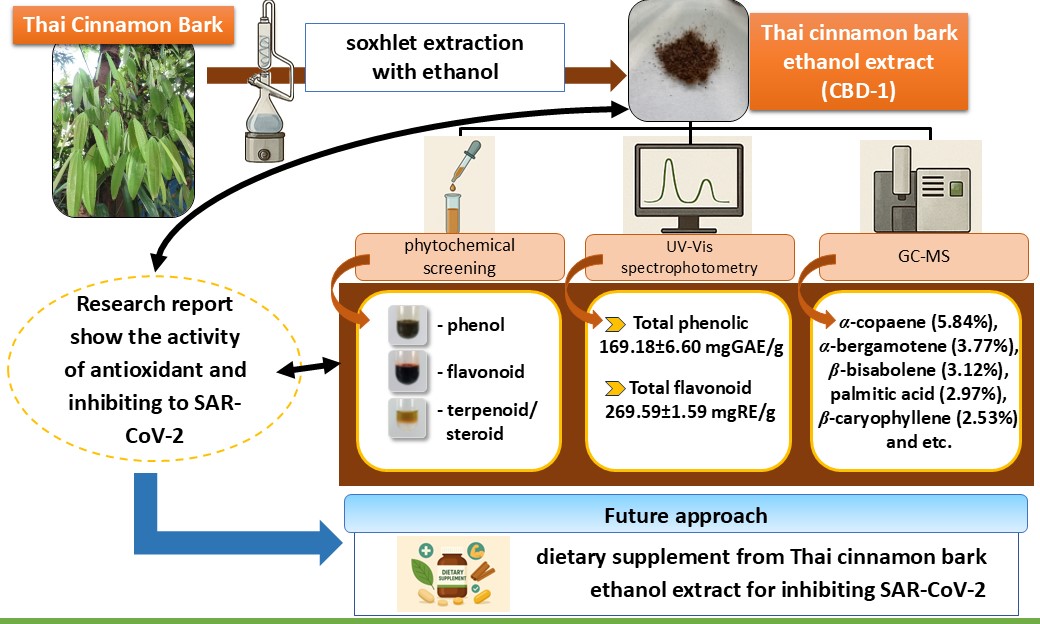
อบเชยไทย (Cinnamomum bejolghota (Buch.-Ham.) Sweet) เป็นพืชที่เนื้อไม้มีกลิ่นหอม มีสรรพคุณ เช่น แก้ลมวิงเวียน บำรุงหัวใจ ช่วยย่อยอาหาร ช่วยขับเหงื่อ แก้ไข้ แก้ท้องเสีย เป็นต้น เปลือกลำต้นเป็นส่วนประกอบในตำรับยาหอมแก้ลมวิงเวียน ยาหอมทิพโอสถ ยาหอมนวโกฐ ยาหอมอินทจักร์ ยาธาตุอบเชย ยามันทธาตุ ยาวิสัมพยาใหญ่ ยาริดสีดวงมหากาฬ และยาศุขไสยาศน์ ซึ่งอยู่ในบัญชียาหลักแห่งชาติสมุนไพร และยังเป็นส่วนประกอบในยาต้มแก้หวัดสำหรับบรรเทาอาการที่เกิดจาก covid-19 สารสกัดเอทานอลจากเปลือกอบเชยไทย (CBD-1) มีฤทธิ์ยับยั้งการเจริญของเชื้อ SARS-CoV-2 Omicron variant และเพื่อสนับสนุนการพัฒนาสมุนไพรไทย การศึกษานี้จึงมีวัตถุประสงค์เพื่อศึกษากลุ่มสารพฤกษเคมี องค์ประกอบทางเคมี และปริมาณสารสำคัญในส่วนสกัดเอทานอลจากเปลือกลำต้นอบเชยไทย ผลการศึกษาพบว่า CBD-1 มีสารกลุ่มฟีนอล ฟลาโวนอยด์ และเทอร์ปีนอยด์/สเตียรอยด์ เมื่อวิเคราะห์ด้วย GC-MS พบ α-copaene (5.84%), α-bergamotene (3.77%), β-bisabolene (3.12%), palmitic acid (2.97%), β-caryophyllene (2.53%), α-muurolene (2.47%), (+)-d-cadinene (2.40%), (-)-α amorphene (2.38%), (+)-cyclosativen (1.88%), ethyl linoleate (1.71%) และ (+)-g-gurjunene (1.67%) และเมื่อวิเคราะห์ด้วย UV-Vis spectrophotometry พบปริมาณฟีนอลิกรวมและปริมาณ ฟลาโวนอยด์รวม เท่ากับ 169.18±6.60 มิลลิกรัมสมมูลกับ Gallic acid 1 กรัม และ 269.59±1.59 มิลลิกรัมสมมูลกับ Rutin 1 กรัม ตามลำดับ CBD-1 มีกลุ่มสารพฤกษเคมี องค์ประกอบทางเคมี และปริมาณสารสำคัญที่น่าจะพิจารณานำไปพัฒนาต่อยอดเป็นผลิตภัณฑ์เสริมสุขภาพเพื่อต้านอนุมูลอิสระและต้านไวรัส เช่น SAR-CoV-2 ได้
Article Details
เอกสารอ้างอิง
Veesommai, U., 2009, Wild Trees in Thailand I, 2nd Ed., H.N. GROUP, Bangkok, 566 p. (in Thai)
Ruangrungsi, N., Chansriniyom, C. and Vipunngoun, N., (n.d.), Research on Thai Cinnamon to Assess Its Value and Significance for Consideration in the Declaration as a Controlled Herb, Research Report, Department of Thai Traditional and Alternative Medicine, 38 p. (in Thai)
Herbal Products Division, Food and Drug Administration, 2023, National List of Essential Herbal Medicines 2023, Minnie group, Pathum Thani, 132 p. (in Thai)
Center for Evidence-Based Thai Traditional Medicine and Herbal Medicine Pharmacy Division and Thai Traditional and Alternative Medicine Division Chao Phraya Abhaibhubejhr Hospital Prachinburi 2021, Healthcare Guide for the Public in the 3rd Wave of the COVID-19 Pandemic Using Thai Traditional Medicine and Herbal Remedies, Available Source: https://www.dop.go.th/download/knowledge/th1623742646919_0.pdf, February 15, 2025. (in Thai)
Atiphasaworn, P., Monggoot, S. and Pripdeevech P., 2017, Chemical composition, antibacterial and antifungal activities of Cinamomum bejolghota bark oil from Thailand, J. Appl. Pharm. Sci. 7(04): 69-73.
Kittiwattanokhun, A., Innajak, S., Tashiro, E., Imoto, M. and Watanapokasin, R., 2022, Cinnamomum bejolghota extract inhibits colorectal cancer cell metastasis and TGF-1-induced epithelial-mesenchymal transition via smad and non-smad signaling pathway, Sci. Pharm. 90(30): 1-18.
Quality Development and Academic Affairs Division, Medicinal Plant Research Institute, Department of Medical Science, 2022, Annual Report 2022 Medicinal Plant Research Institute, Department of Medical Science, Nonthaburi, 121 p. (in Thai)
Gogoi, B., Tamuli, K. J., Neipihoi., Bordoloi, M. and Sharma, H. K., 2021, Isolation and characterization of chemical constituents with in vitro anti-hypertensive and anthelmintic activities of Cinnamomum bejolghota (Buch.-Ham.) sweet leaves: An ethnomedicinal plant of North East India, S. Afr. J. Bot. 140: 161-166.
Le, T. P., Truong, B. N., Litaudon, M., Nguyen, T. L., Doan, T. M. H. and Pham, V. C., 2023, New alkaloids from the stem bark of Cinnamomum bejolghota, Phytochem. Lett. 55: 164-168.
Wang, J., Su, B., Jiang, H., Cui, N., Yu, Z., Yang, Y. and Sun, Y., 2020, Traditional uses, phytochemistry and pharmacological activities of the genus Cinnamomum (Lauraceae): A review, Fitoterapia. 146: 1-24.
Prasad, K. N., Yang, B., Dong, X., Jiang, G., Zhang, H., Xie, H. and Jiang, Y., 2009, Flavonoid contents and antioxidant activities from Cinnamomum species, Innov. Food Sci. Emerg. Technol. 10: 627 632.
Medicinal Research Institute, Department of Medical Sciences, Ministry of Public Health, 2007, Chemical Quality of Medicinal Plants (Volume 1), Printing House of National Office of Buddhism, Nakhon Pathom, 150 p.
Hazarika, A. and Saha, D., 2017, Preliminary phytochemical screening and evaluation of anti-diarrhoeal activity of ethanolic extract of leaves of Clerodendrum infortunatum, Int. J. Curr. Pharm. Res. 9(4): 143-146.
Sengul, M., Yildiz, H., Gungor, N., Cetin, B., Eser, Z. and Ercisli, S., 2009, Total phenolic content, antioxidant and antimicrobial activities of some medical plants, Pak. J. Pharm. Sci. 22(1): 102-106.
Madaan, R., Bansal, G., Kumar, S. and Sharma, A., 2011, Estimation of total phenols and flavonoids in extracts of Actaea spicata roots and antioxidant activity studies, Indian J. Pharm. Sci. 73(6): 666-669.
Gogoi, B., Kakoti, B. B., Sharma, N. and Borah, S., 2016, Pharmacognostic and preliminary phytochemical evaluation of Cinnmomum bejolghota (Buch.-Ham.) sweet bark, Indian J. Nat. Prod. Resour. 7(1): 59-64.
Sulastri, E., Zubair, M. S., Anas, N. I., Abidin, S., Hardani, R., Yulianti, R. and Aliyah., 2018, Total phenolic, total flavonoid, quercetin content and antioxidant activity of standardized extract of Moringa oleifera leaf from regions with different elevation, Pharmacogn. J. 10(6) Suppl: s104-s108.
Tiranakwit, T., Puangpun, W., Tamprasit, K., Wichai, N., Siriamornpun, S., Srisongkram, T. and Weerapreeyakul, N., 2023, Phytochemical screening on phenolic, flavonoid contents, and antioxidant activities of six indigenous plants used in Traditional Thai Medicine, Int. J. Mol. Sci. 24: 1-20.
Kowalczyk, M., Golonko, A., Swisłocka R., Kalinowska, M., Parcheta, M., Swiergiel A. and Lewandowski, W., 2021, Drug design strategies for the treatment of viral disease. plant phenolic compounds and their derivatives, Front. Pharmacol. 12: 1-21.
Tirado-Kulieva V, A., Hernández-Martínez, E. and Choque-Rivera, T. J., 2022, Phenolic compounds versus SARS-CoV-2: An update on the main findings against COVID-19, Heliyon. 8: 1-16.
Alzaabi, M.M., Hamdy, R., Ashmawy S, N., Hamoda, M. A., Alkhayat, F., Khademi, N. N., Joud, S.M.A.A., AEl-Keblawy, A. A. and Soliman, S. S. M., 2022, Flavonoids are promising safe therapy against COVID-19, Phytochem. Rev. 21: 291-312.
Antonio, A. da. S., Wiedemann, L. S. M. and Veiga-Junior, V. F., 2020, Natural products’ role against COVID-19, RSC Adv. 10: 23379-23393.
Souza, M. R. R., Droppa-Almeida, D., Kodel, H. A. C., Santos, T. B., Moraes, A. S., Krause L, C. and Bjerk T, R., 2025, In silico therapeutic potential of phytochemical from Commiphora leptophloeos Mart. - J. B. Gillett leaves essential oil against COVID-19, J. Braz. Chem. Soc. 36(2): 1-13.
Yabrir, B., Belhassan, A., Lakhlifi, T., Salgado, M. G., Bouachrine, M., Munoz, C. P., Gerli, C. L. and Ramirez, T. R., 2021, Minor composition compounds of Algarian herbal medicines as inhibitors of SARS-CoV-2 main protease: molecular docking and ADMET properties prediction, J. Chil. Chem. Soc. 66: 5067-5074.
Goyal, H.,Rana, D., Sharma, R., Lamba, D. and Kaur, J., 2023, Current perspective on vitamins and SARS-CoV-2 disease (COVID-19), Ann. Natl. Acad. Med. Sci. (India). 59: 186-195.
Duru, C. E., Duru, I. A. and Adegboyega, A. E., 2021, In silico identification of compounds from Nigella sativa seed oil as potential inhibitors of SARS-CoV-2 targets, Bull. Natl. Res. Cent. 45(57): 1-13.
National Library of Medicine 2025, Pubchem, Available Source: https://pubchem.ncbi.nlm.nih.gov/, August 11, 2025.
