
การทำนายคุณภาพอากาศในจังหวัดปทุมธานี ประเทศไทย โดยใช้ข้อมูลอุตุนิยมวิทยา ด้วยเทคนิคทางสถิติและการเรียนรู้ของเครื่อง
Article Sidebar
Main Article Content
บทคัดย่อ
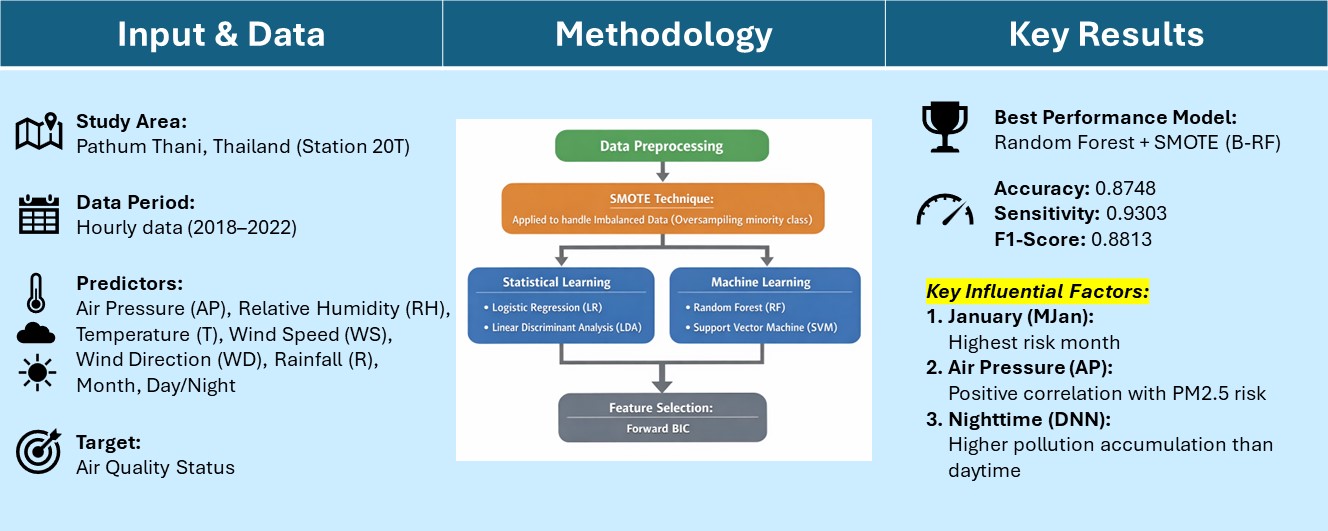
ปัญหามลพิษทางอากาศโดยเฉพาะฝุ่นละออง PM2.5 เป็นปัญหาสิ่งแวดล้อมที่มีผลกระทบอย่างรุนแรง ในประเทศไทย งานวิจัยนี้มีวัตถุประสงค์เพื่อเปรียบเทียบประสิทธิภาพของวิธีการในการทำนายคุณภาพอากาศในจังหวัดปทุมธานี และศึกษาปัจจัยที่มีผลในการทำนายคุณภาพอากาศในจังหวัดปทุมธานี โดยใช้การเรียนรู้เชิงสถิติและการเรียนรู้ของเครื่อง ได้แก่ การถดถอยลอจิสติกทวิภาค (Binary logistic regression) และการวิเคราะห์จำแนกกลุ่มเชิงเส้น (Linear discriminant analysis) ป่าสุ่ม (Random forest) และเครื่องเวกเตอร์ค้ำจุน (Support vector machine) โดยใช้เกณฑ์ในการประเมินแบบจำลองประกอบด้วยค่า ความแม่น (Accuracy) ความไว (Sensitivity) ความจำเพาะ (Specificity) ความเที่ยง (Precision) และ F1-score ผลการวิจัย พบว่า แบบจำลองที่ใช้เทคนิคป่าสุ่มบนข้อมูลที่มีการปรับสมดุลด้วยเทคนิค SMOTE ให้ผลลัพธ์แม่นยำสูงสุด โดยมีค่าความแม่นเท่ากับ 0.8748 ค่าความไวเท่ากับ 0.9303 ค่าความเที่ยงเท่ากับ 0.8373 และ F1-score เท่ากับ 0.8813 โดยปัจจัยที่ส่งผลต่อการทำนายคุณภาพอากาศมากที่สุด ได้แก่ เดือนมกราคม ความกดอากาศ ช่วงเวลากลางคืน รวมถึงตัวแปรอื่น ๆ เช่น ความชื้นสัมพัทธ์ อุณหภูมิ และความเร็วลม ซึ่งช่วยให้แบบจำลองสามารถคาดการณ์คุณภาพอากาศได้อย่างมีประสิทธิภาพ
Article Details
เอกสารอ้างอิง
Hardini, M., Sunarjo, R. A., Asfi, M. and Riza Chakim, M. H., Ayu Sanjaya, Y. P., 2023, Predicting air quality index using ensemble machine learning, ADI J. Recent. Innov (AJRI). 5 (1Sp): 78-86.
Yang, H., Wang, W. and Li, G., 202, Prediction method of PM2.5 concentration based on decomposition and integration, Measurement. 216(8): 112954.
Fang, Z., Yang, H., Li, C., Cheng, L., Zhao, M. and Xie, C., 2021, Prediction of PM2.5 hourly concentrations in Beijing based on machine learning algorithm and ground-based LiDAR, Arch. Environ. Prot. 47(3): 98–107.
Makhdoomi, A., Sarkhosh, M. and Ziaei, S., 2025, PM2.5 concentration prediction using machine learning algorithms: an approach to virtual monitoring stations, Sci. Rep. 15: 8076.
Warangkhana, R., 2023, A study of the effectiveness of model selection criteria for multiple regression model, Rajamangala Univ. Technol. Srivijaya Res. J (RST). 15(1), 198–212. (in Thai).
Pollution Control Department, 2024, Regional Air Quality and Situation Reports, Available Source: http://air4thai.pcd.go.th/webV3/#/StationDetail, Feb 2, 2024. (in Thai).
Pollution Control Department, 2025, “Pollution Control Department announces Thailand’s 2023 Air Quality Index.”, Available Source: https://www.pcd.go.th/laws/29909, Jan 25, 2025. (in Thai).
Cox, D. R., 1958, The regression analysis of binary sequences, J. R. Stat. Soc. Ser. B Methodol. 20(2): 215–232.
Choi, J., Gu, B., Chin, S. and Lee, J.-S., 2020, Machine learning predictive model based on national data for fatal accidents of construction workers, Autom. Constr. 110(3): 102974.
Adebiyi, M.O., Arowolo, M.O., Mshelia, M.D. and Olugbara, O.O., 2022, A linear discriminant analysis and classification model for breast cancer diagnosis, Appl. Sci. 12(22): 11455.
Breiman L., 2001, Random forests, Mach. Learn. 45: 5–32.
Ali, Y., Hussain, F. and Haque, M. M., 2024, Advances, challenges, and future research needs in machine learning-based crash prediction models: A systematic review, Accid. Anal. Prev. 194: 107378.
Liu, W., Guo, G., Chen, F. and Chen, Y., 2019, Meteorological pattern analysis assisted daily PM2.5 grades prediction using SVM optimized by PSO algorithm, Atmos. Pollut. Res. 10(5): 1482–1491.
Fiorentini, N. and Losa, M., 2020, Handling imbalanced data in road crash severity prediction by machine learning algorithms, Infrastructures. 5(7): 61.
