
ปัจจัยที่มีอิทธิพลต่อการยอมรับโรงไฟฟ้าขยะ RDF ในบริบทการจัดการขยะชุมชน
Article Sidebar
Main Article Content
บทคัดย่อ
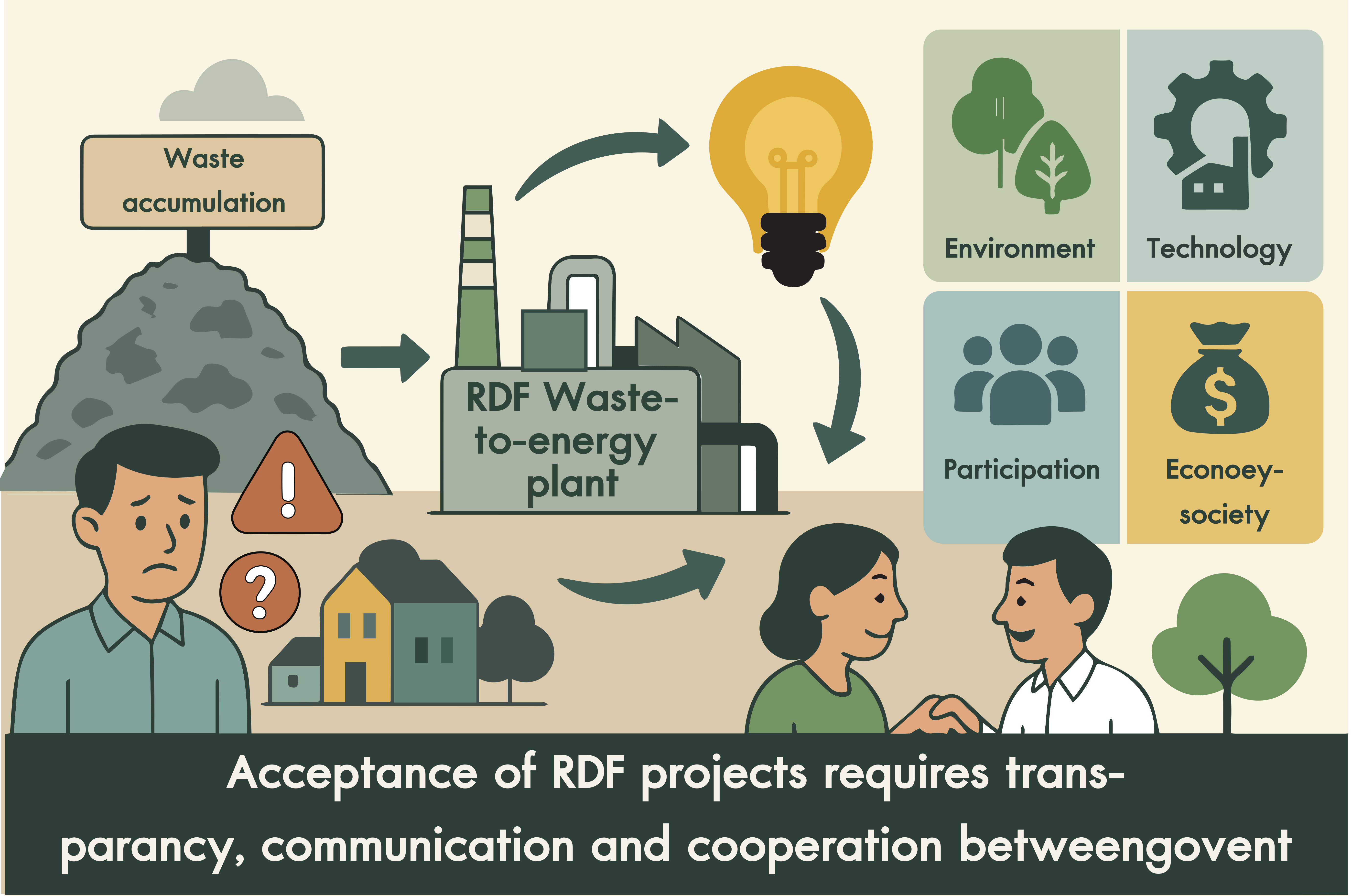
ปัญหาการจัดการขยะมูลฝอยชุมชนควบคู่กับการเปลี่ยนผ่านไปสู่พลังงานสะอาด เป็นความท้าทายสำคัญที่หลายประเทศทั่วโลกกำลังเผชิญ แม้ว่าเทคโนโลยีเชื้อเพลิงจากขยะ (Refuse derived fuel: RDF) จะถูกมองว่าเป็นแนวทางหนึ่งในการจัดการขยะตามแนวคิดเศรษฐกิจหมุนเวียน (Circular economy) อย่างไรก็ตาม การนำเทคโนโลยีดังกล่าวมาใช้ในทางปฏิบัติยังคงประสบปัญหา โดยเฉพาะประเด็นด้านการยอมรับของชุมชน ซึ่งเป็นปัญหาที่พบได้ในหลายพื้นที่ทั่วโลก งานวิจัยนี้จึงมุ่งศึกษาปัจจัยที่มีผลต่อทัศนคติ และการตัดสินใจของประชาชน โดยปรับมุมมองจากการมองปัญหาเป็นข้อจำกัดด้านความขัดแย้งเฉพาะพื้นที่ ไปสู่การพิจารณาความสัมพันธ์ระหว่างเทคโนโลยีและสังคมในภาพรวม
ผลการศึกษาพบว่า ความไว้วางใจต่อหน่วยงานที่รับผิดชอบโครงการ และการได้รับข้อมูลที่ชัดเจน โปร่งใส มีผลต่อการยอมรับของประชาชนมากกว่าปัจจัยด้านผลตอบแทนทางเศรษฐกิจ ข้อค้นพบนี้สะท้อนให้เห็นว่า การคัดค้านโครงการในระดับท้องถิ่นไม่ได้เกิดจากผลประโยชน์เพียงอย่างเดียว แต่ยังเกี่ยวข้องกับช่องว่างด้านนโยบายและการสื่อสารของภาครัฐ การศึกษานี้จึงไม่เพียงให้ข้อเสนอแนะสำหรับพื้นที่ศึกษาเท่านั้น แต่ยังช่วยเสนอแนวทางในการจัดการข้อจำกัดด้านความขัดแย้งและสร้างความร่วมมือระหว่างภาครัฐ ภาคเอกชน และชุมชน เพื่อสนับสนุนการดำเนินงานด้านพลังงานสะอาดและเป้าหมายการพัฒนาที่ยั่งยืน (SDGs) ซึ่งสามารถนำไปประยุกต์ใช้กับพื้นที่อื่น ๆ โดยเฉพาะในประเทศกำลังพัฒนาได้
Article Details
เอกสารอ้างอิง
Pollution Control Department 2024, Report on the Situation of Community Waste Disposal Sites in Thailand in 2023, Available Source: https://www.pcd.go.th/publication/31985/, May 9, 2024. (in Thai)
United Nations Development Programmer 2023, Sustainable Development Goals, Available Source: https://www.undp.org/sustainable-development-goals, April 16, 2023.
Nakhon Sawan Municipality 2023, 5-Year Development Plan (2023–2027) of Nakhon Sawan Municipality, 1st review/2023, Available Source: http://www.nsm.go.th/plan/plan5y/plan2566-2570-review-1.pdf, February 24, 2023. (in Thai)
Ministry of Energy 2018, Alternative Energy Development Plan B.E. 2561–2580 (2018–2037) (AEDP 2018), Energy Policy and Planning Office (EPPO), Available Source: https://www.eppo.go.th/index.php/th/eppo-intranet/item/541-aedp, February 24, 2023. (in Thai)
Department of Provincial Administration 2023, Official Registration Statistics System, Available Source: https://stat.bora.dopa.go.th/new_stat/webPage/statByYear.php, May 12, 2023. (in Thai)
Naresuan University, 2023, Project to Hire Consultants to Study the Feasibility and Analysis of the Fuel-Based Electricity Generation Project, Research Report, Naresuan University, Phitsanulok, 337 p. (in Thai)
Creswell, J.W., 2014, Research Design: Qualitative, Quantitative, and Mixed Methods Approaches, 4th Ed., Sage Publications., Thousand Oaks, 304 p.
Johnson, R.B. and Onwuegbuzie, A.J., 2004, Mixed methods research: A paradigm whose time has come, Educ. Res. 33(7): 14–26.
Office of Natural Resources and Environmental Policy and Planning 2023, Guidelines for Public Participation in the Environmental Impact Assessment Report Preparation Process, Available Source: https://eiathailand.onep.go.th/Show_Detail.aspx?DetailId=146, August 31, 2023. (in Thai)
Yamane, T., 1967, Statistics: An Introductory Analysis, 2nd Ed., Harper and Row, New York, 919 p.
Roddis, P., Pye, S. and Sharp, L., 2018, Identifying factors influencing local acceptance of renewable energy projects: A systematic review, Energy Policy, 123: 396–412.
Likert, R., 1967, The Human Organization: Its Management and Value, McGraw-Hill, New York, 258 p.
Moore, D.S., McCabe, G.P. and Craig, B.A., 2017, Introduction to the Practice of Statistics, 9th Ed., W.H. Freeman and Company, New York, 814 p.
Krippendorff, K., 2018, Content Analysis: An Introduction to Its Methodology, 4th Ed., Sage Publications, Thousand Oaks, CA, 472 p.
Chen, S.H., Huang, G.H. and Chen, C.W., 2005, A dynamic strategy planning theory and system for sustainable river basin land use management, J Environ. Manag. 75(1): 1–14.
United Nations, 2015, Transforming Our World: The 2030 Agenda for Sustainable Development, A/RES/70/1, United Nations, New York, 35 p.
Glasson, J., Therivel, R. and Chadwick, A., 2013, Introduction to Environmental Impact Assessment: Process, Practice and Prospects, 4th Ed., Routledge, London, 392 p.
Carroll, A.B., 1991, The pyramid of corporate social responsibility: Toward the moral management of organizational stakeholders, Bus. Horiz. 34(4): 39–48.
International Organization for Standardization, 2015, ISO 14001:2015 – Environmental Management Systems: Requirements with Guidance for Use., Geneva, 35 p.
Wongprayoon, A., 2023, Factors Affecting Public Acceptance of Waste-to-Energy Power Plants in Pathum Thani Province, Master Thesis, Thammasat University, Pathum Thani, 84 p. (in Thai)
Wüstenhagen, R., Wolsink, M. and Bürer, M.J., 2007, Social acceptance of renewable energy innovation: An introduction to the concept, Energy Policy, 35(5): 2683–2691.
Devine-Wright, P., 2007, Non-political associations and decision-making on energy, Energy Policy, 35(5): 2824–2831.
Sterman, J., 2000, Business Dynamics: Systems Thinking and Modeling for a Complex World, Irwin/McGraw-Hill, Boston, 982 p.
Sjostedt, H., Vulturius, G. and Eklöf, J., 2018, The acceptability of bioenergy projects: Exploring the influence of procedural and distributional justice, Energy Policy, 120: 246–254.
Garmendia, E. and Stagl, S., 2010, Public participation and the social acceptability of waste management plans: Lessons from Spain, J. Clean. Prod. 18(1): 81–94.
