
การประเมินฤทธิ์ยับยั้งเชื้อจุลินทรีย์และต้านอนุมูลอิสระของสารสกัดสมุนไพรในตำรับยาแผนไทยสำหรับการรักษาโรคติดเชื้อ
Article Sidebar
Main Article Content
บทคัดย่อ
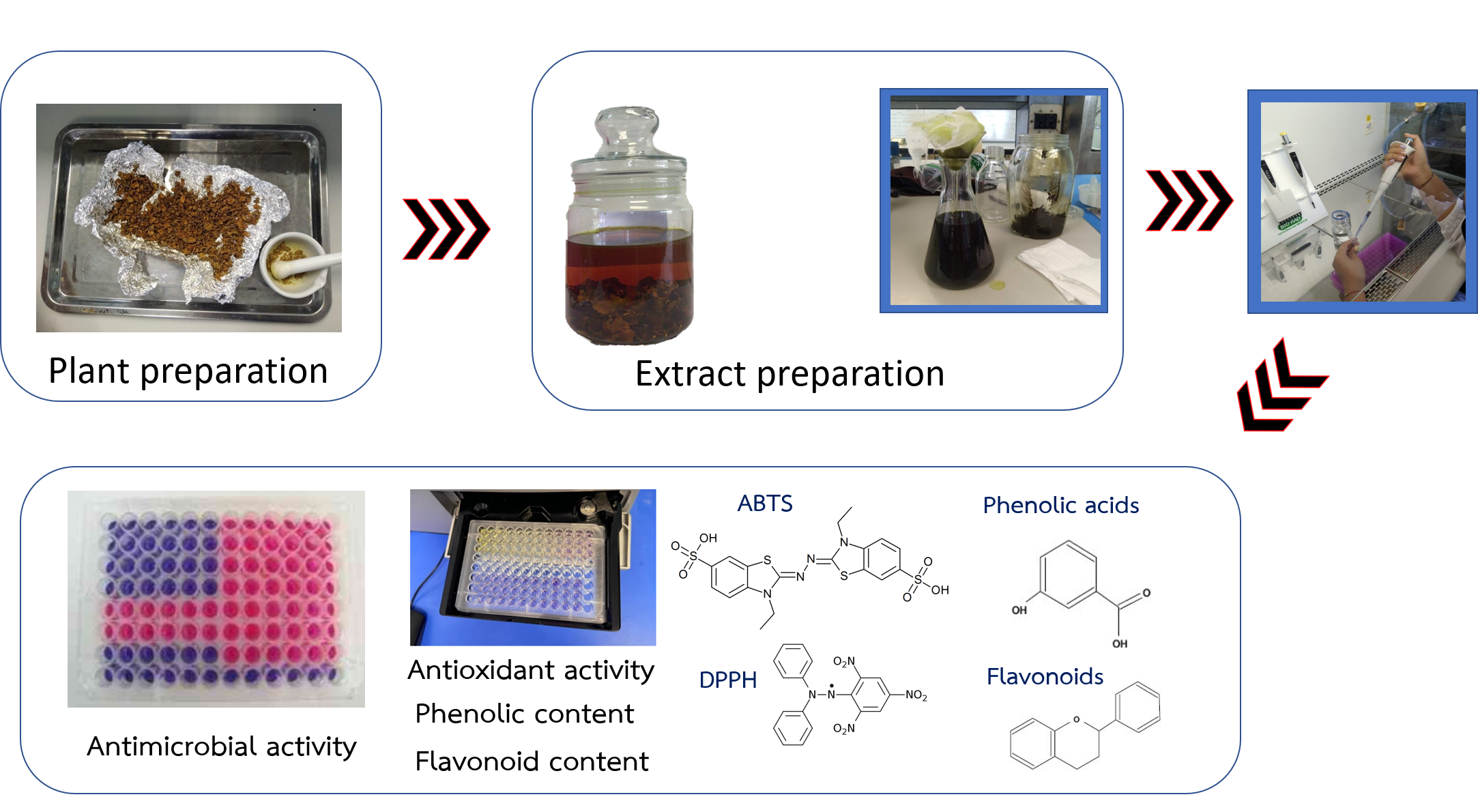
งานวิจัยนี้มีวัตถุประสงค์เพื่อประเมินสารสกัดหยาบจากตำรับยาแผนไทยของหลวงพินิจพลนิกร ในการยับยั้งจุลินทรีย์และต้านอนุมูลอิสระ โดยสกัดสารจากตำรับยาด้วยวิธีการแช่ในตัวทำละลาย 2 ชนิด คือ เอทิลอะซิเตท และเอทานอล จากนั้นทดสอบฤทธิ์ต้านจุลินทรีย์ด้วยวิธี และฤทธิ์ต้านอนุมูลอิสระ ด้วยวิธี DPPH และ ABTS Radical scavenging assays ในการทดสอบฤทธิ์ต้านจุลินทรีย์ทดสอบจุลินทรีย์ก่อโรคทั้งหมด 9 สายพันธุ์ ได้แก่ Staphylococcus aureus ATCC 25923, Methicillin-resistant Staphylococcus aureus (MRSA) SK1, Staphylococcus epidermidis, Escherichia coli ATCC 25922, Pseudomonas aeruginosa ATCC 27853, Candida albicans ATCC 90028, Cryptococcus neoformans ATCC 90112, Microsporum gypseum และ Talaromyces marneffei ผลการทดสอบพบว่าสารสกัดจากเอทานอลมีฤทธิ์ยับยั้งแบคทีเรียแกรมบวก S. aureus, MRSA และ S. epidermidis ได้ดีที่สุด ให้ค่า MIC ในช่วง 0.025-6.4 มิลลิกรัมต่อมิลลิลิตร ขณะที่สารสกัดจากเอทานอลมีฤทธิ์ต้านอนุมูลอิสระ DPPH และ ABTS ให้ค่า IC50 เท่ากับ 37.29±1.03 และ 276.65±0.41 ไมโครกรัมต่อมิลลิลิตร ตามลำดับ นอกจากนี้วิเคราะห์ปริมาณฟีโนลิกและฟลาโวนอยด์ ด้วยวิธี Folin-ciocalteu และ Colorimetric aluminum chloride ตามลำดับ พบว่าสารสกัดมีปริมาณฟีโนลิกและฟลาโวนอยด์ 67.00±0.51 มิลลิกรัมสมมูลของกรดแกลลิคต่อกรัมสารสกัด และ 15.20±1.00 มิลลิกรัมสมมูลของเคอร์ซิตินต่อกรัมสารสกัด ตามลำดับ จากผลการศึกษานี้ชี้ให้เห็นว่าตำรับยาแผนไทยมีศักยภาพนอกจากมีฤทธิ์ยับยั้งจุลินทรีย์ก่อโรคแล้วยังมีฤทธิ์ต้านอนุมูลอิสระที่ดีอีกด้วย
Article Details
เอกสารอ้างอิง
Sainz, R.M., Lombo, F. and Mayo, J.C., 2012, Radical decision in cancer: redox control of cell growth and death, Cancers. 4(2): 442-474.
Madarat, N., Khammak, W., Jantarasri, N., Buadee, S., Jiajun, K., Tasana, Buapa, S. and Phongsiri, S., 2022, Public Health Statistics A.D., 2022, Strategy and Planning Division of Office of the Permanent Secretary Ministry of Public Health, 156 p. (in Thai)
Chaitosa, R. and Maskasame, W., 2020, Study of side effects of patients receiving cisplatin in the treatment of cervical cancer by age group, RMJ. 43(4): 28-38. (in Thai)
Chungsamanukool, P., 2022, Incidence, risk factors, mortality rate, and impact of multidrug-resistant gram-negative bloodstream infectionsin photharam hospital, Reg 4-5 Med J. 41(1): 579-592. (in Thai)
Chaychalermsri, J., Pradubphongsa, P., Mitthamsiri and Sangardpawiriya, A., 2016, Diagnosis and management in patient with penicillin allergy, RTAMedJ. 69(3): 137-146. (in Thai)
Jansirisak, P., 2025, How to use herbal products safely, JOHCP. 5(1): 7-11. (in Thai)
Sirisom, N., Khongphakdee, T. and Supaphon, P., 2025, Evaluation of total phenolics, total flavonoids, antioxidant capacity and antimicrobial activity of herbal extracts in Thai traditional medicine recipes, JADES 15(42): 111-122. (in Thai)
Srithaworn, M., Thuyhun, A. and Chunhachart, O., 2015, Antioxidant and antibacterial activities of crude extracts from ya-keaw formula against shrimp pathogens, SDU Res. J. 8(2): 117-132. (in Thai)
Clinical and Laboratory Standards Institute (CLSI)., 2012, Reference Method for Broth Dilution Antimicrobial Susceptibility Tests for Bacteria that Grow Aerobically. Approved standard M7-A4. Clinical and Laboratory Standards Institute, Wayne, Pa. 63 p.
Clinical and Laboratory Standards Institute (CLSI)., 2002b, Reference Method for Broth Dilution Antimicrobial Susceptibility Testing of Yeasts. Approved Standard M27- A2. Clinical and Laboratory Standards Institute, Wayne, Pa. 29 p.
Clinical and Laboratory Standards Institute (CLSI)., 2002c, Reference Method for Broth Dilution Antimicrobial Susceptibility Testing of Filamentous Fungi. Approved Standard M38-A. Clinical and Laboratory Standards Institute, Wayne, Pa. 49 p.
Sarker, S.D., Nahar, L. and Kumarasamy, Y., 2007, Microtiterplate-based antibacterial assay incorporating resazurin as an indicator of cell growth, and its application in the in vitro antibacterial screening of phytochemicals, Methods. 42(4): 321-324.
Ghafar, M.F.A., Prasad, K.N. Weng, K.K. and Ismail, A., 2010, Flavonoid, hesperidine, total phenolic contents and antioxidant activities from citrus species, Afr. J. Biotechnol. 9(3): 326-330.
Binsan, W., S. Benjakul, W. Visessanguan, S. Roytrakul, M. Tanaka and H. Kishimura.,2008, Antioxidative activity of mungoong, an extract paste, from the cephalothorax of white shrimp (Litopenaeus vanamei), Food Chem. 106(1): 185-193.
Sam-ang, P., Phanumartwiwath, A. and Kodsueb, R., 2020, In vitro antibacterial and antioxidant activites of gall extracts from Paederia pilifera, Rajabhat J. Sci. Humanit. Soc. Sci. 21(1): 78-89. (in Thai)
Kantakapun, K. and Sukpornma. Y., 2016, Optimization of total phenolics and flavonoids from ginger using response surface methodology, J. Health Sci. 20(39): 69-80. (in Thai)
Pradabsang, C., Saengwiman, S., Srisawat, S. and Yipong, I., 2024, Solvent optimization of pitang leaves (Gynochthodes sublanceolata Miq.) extraction for bacterial growth inhibition, Prid. Sci. J. 2(1): 9-23. (in Thai)
Laohaprapanon, S. and Chanwun, T., 2017, Antibacterial of A Traditional Thai Herbal Recipe Against Staphylococcus epidermidis Isolated. Report. Faculty of Science and Technology, Rajamangala University of Technology Srivijaya, Nakhon Si Thammarat Campus, 74 p. (in Thai)
Maneepisamai, Y., Yasin, P. and Simarugumpai, S., 2012, Anti-inflammatory activity and anti-dermatitis-causing bacterial activity of Blumea balsamifera (L.) DC. leaf extracts, Chandrakasem Rajabhat Univ. J. 18(35): 33-40. (in Thai)
Pruksakorn, P., Jaima, C., Panyajai, P., Mekha, N., Autthateinchai, R. and Dhepakson, P., 2018, Antifungal activity of Rhinacanthus nasutus (L.) Kurz extracts against dermatophytes, J Thai Trad Alt Med. 16(2): 205-217. (in Thai)
Sirisombat, C., Thititanaapipong, P., Srithat, D. and Tongkasee., 2022, Formulation and stability testing of herbal gels with Cleome viscosa Linn. crude extract, J. Cannabis Res. 1(2): 1-14. (in Thai)
Teansuwan, N., Sripanidkulchai, B. and Jaipakdee, N., 2016, Effect of four herb extracts on melanin synthesis, Isan J Pharm Sci. 11(5): 33-42. (in Thai)
Chaachouay, N., 2025, Synergy, additive effect and antagonism of drugs with plant bioactive Compounds, Drugs Drug-Candidates. 4(1): 4
