
การประเมินปริมาณสารพฤกษเคมีและฤทธิ์ต้านอนุมูลอิสระของสารสกัดจากผลตำลึงดิบและสุก
Article Sidebar
Main Article Content
บทคัดย่อ
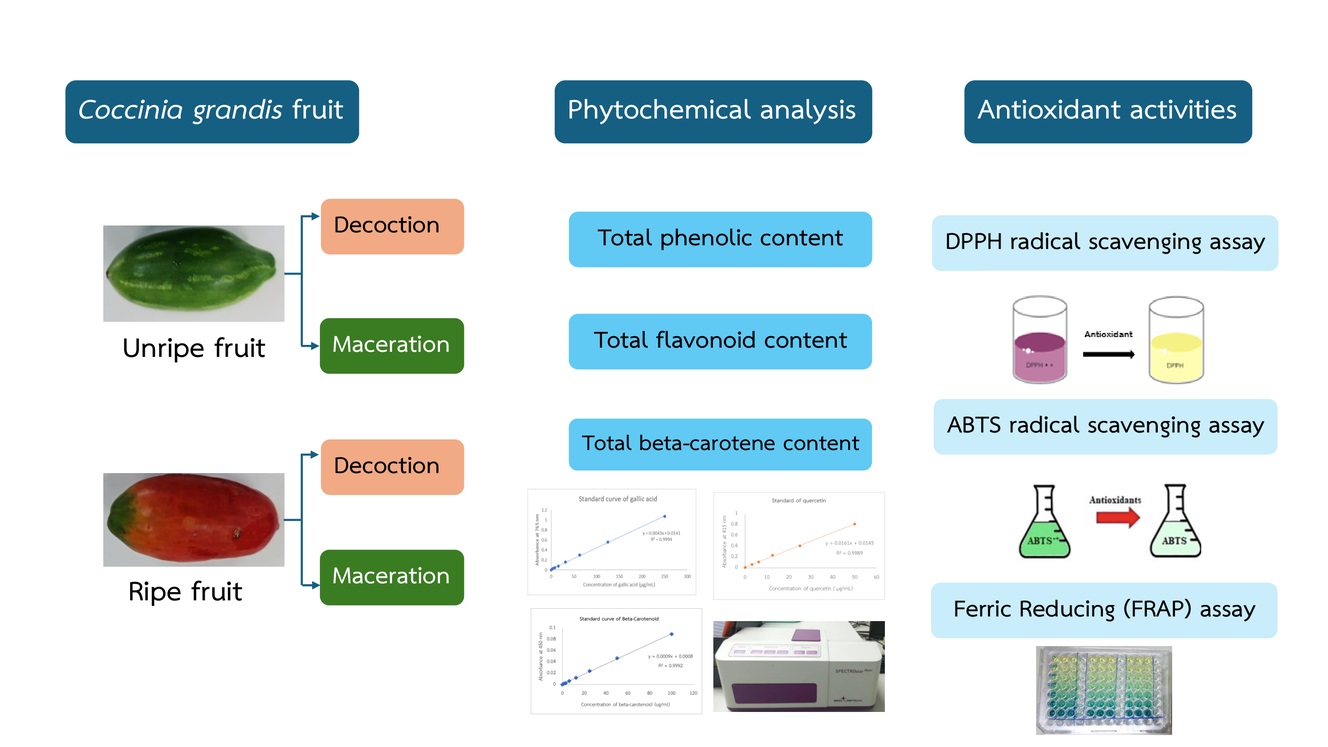
ตำลึง Coccinia grandis (L.) Voigt เป็นพืชเขตร้อนที่พบได้ทั่วไปและใช้เป็นอาหาร และได้รับความสนใจในฐานะแหล่งของสารต้านอนุมูลอิสระจากธรรมชาติ งานวิจัยนี้ศึกษาผลของชนิดตัวทำละลายและวิธีการสกัดต่อสารสกัดจากผลตำลึงที่ได้จากระยะการสุกที่แตกต่างกัน โดยสารสกัดน้ำถูกเตรียมด้วยวิธีต้มและสารสกัดเอทานอลถูกเตรียมด้วยวิธีแช่หมักจากผลทั้งระยะดิบและระยะสุก โดยทำการหาปริมาณสารฟีนอลิกรวม ปริมาณสารฟลาโวนอยด์รวม และปริมาณเบตาแคโรทีนรวม ฤทธิ์ต้านอนุมูลอิสระถูกประเมินด้วยวิธีการกำจัดอนุมูลอิสระ DPPH วิธีการกำจัดอนุมูลอิสระ ABTS และการทดสอบความสามารถในการรีดิวซ์เฟอริก (FRAP) ผลการศึกษาพบว่า สารสกัดเอทานอลในผลตำลึงดิบมีปริมาณสารฟีนอลิกรวมและฟลาโวนอยด์รวมสูงที่สุด ในขณะที่สารสกัดเอทานอลจากผลตำลึงสุกมีปริมาณเบต้าแคโรทีนสูงกว่าอย่างมีนัยสำคัญทางสถิติ (p < 0.05) สารสกัดเอทานอลจากผลตำลึงดิบแสดงฤทธิ์ต้านอนุมูลอิสระสูงที่สุด โดยมีค่าความเข้มข้นที่ยับยั้งได้ครึ่งหนึ่ง (IC50) ต่ำที่สุดในการทดสอบ DPPH (180.90 ± 20.25 µg/mL) และให้ค่าสูงสุดในการทดสอบ ABTS และ FRAP (55.94 ± 2.04 mg TE/g extract และ 105.34 ± 4.39 mmol FeSO₄/100 g extract) เมื่อเปรียบเทียบกับตัวอย่างทั้งหมด ในทางตรงกันข้าม สารสกัดที่เตรียมด้วยวิธีต้มให้ฤทธิ์ต้านอนุมูลอิสระค่อนข้างต่ำ ซึ่งอาจมีความเกี่ยวข้องกับการเสื่อมสลายของสารฟีนอลิกและฟลาโวนอยด์อันเกิดจากความร้อนในระหว่างกระบวนการสกัด ผลการศึกษานี้แสดงให้เห็นถึงศักยภาพของการใช้สารสกัดเอทานอลจากผลตำลึงดิบในการพัฒนาเป็นวัตถุดิบสำหรับผลิตภัณฑ์อาหารฟังก์ชันหรือผลิตภัณฑ์เสริมอาหาร
Article Details
เอกสารอ้างอิง
Alugoju, P., Dinesh, B.J. and Latha, P., 2015, Free radicals: properties, sources, targets, and their implication in various diseases, J. Clin. Biochem. 30(1): 11–26.
Willcox, J.K., Ash, S.L. and Catignani, G.L., 2004, Antioxidants and prevention of chronic disease, Crit. Rev. Food Sci. Nutr. 44(4): 275–295.
Rahaman, M.M., Hossain, R., Herrera-Bravo, J., Islam, M.T., Atolani, O., Adeyemi, O.S., et al., 2023, Natural antioxidants from some fruits, seeds, foods, natural products, and associated health benefits: An update, Food Sci. Nutr. 11: 1657–1670.
e-Flora of Thailand, Coccinia grandis (L.) Voigt, Thailand, Available source: https://botany.dnp.go.th/eflora/index.html, December 8, 2025.
Meenatchi, P., Purushothaman, A. and Maneemegalai, S., 2017, Antioxidant, antiglycation and insulinotrophic properties of Coccinia grandis (L.) in vitro: Possible role in prevention of diabetic complications, J. Tradit. Complement. Med. 7: 54–64.
Lee, I.Y. and Joo, N., 2022, Identification and quantification of key phytochemicals, phytohormones, and antioxidant properties in Coccinia grandis during fruit ripening, Antioxidants 11: 2218.
Chatterjee, A. and Chatterjee, S., 2012, Proximate analysis, phytochemical screening and anti-inflammatory activity of Coccinia indica, Int. J. Pharm. Chem. Biol. Sci. 2: 299–304.
Singh, G., Gupta, P., Rawat, P., Puri, A., Bhatia, G. and Maurya, R., 2007, Antidyslipidemic activity of polyprenol from Coccinia grandis in high-fat diet-fed hamster model, Phytomedicine 14(12): 792–798.
Singleton, V.L., Orthofer, R. and Lamuela-Raventos, R.M., 1999, Analysis of total phenols and other oxidation substrates and antioxidants by means of Folin–Ciocalteu reagent, Methods Enzymol. 299: 152–178.
Stanković, M.S., 2011, Total phenolic content, flavonoid concentration and antioxidant activity of Marrubium peregrinum L. extracts, Kragujev. J. Sci. 33: 63–72.
Doka, O., Gitta, F., Luterotti, S., Bićanić, D.D., Spruijt, R., Buijnsters, J., et al., 2013, Simple and rapid quantification of total carotenoids in lyophilized apricots (Prunus armeniaca L.) by means of reflectance colorimetry and photoacoustic spectroscopy, Food Technol. Biotechnol. 51: 453–459.
Sithisarn, P., Rojsanga, P., Sithisarn, P. and Kongkiatpaiboon, S., 2015, Antioxidant activity and antibacterial effects on clinical isolated Streptococcus suis and Staphylococcus intermedius of extracts from several parts of Cladogynos orientalis and their phytochemical screenings, Evid.-Based Complement. Altern. Med. 2015: 908242.
Thaipong, K., Boonprakob, U., Crosby, K., Cisneros-Zevallos, L. and Hawkins, B.D., 2006, Comparison of ABTS, DPPH, FRAP, and ORAC assays for estimating antioxidant activity from guava fruit extracts, J. Food Compos. Anal. 19: 669–675.
Vongsak, B., Sithisarn, P., Mangmool, S., Thongpraditchote, S., Wongkrajang, Y. and Gritsanapan, W., 2013, Maximizing total phenolics, total flavonoids contents and antioxidant activity of Moringa oleifera leaf extract by the appropriate extraction method, Ind. Crops Prod. 44: 566–571.
Sik, B., Hanczné, E.L., Kapcsándi, V. and Ajtony, Z., 2020, Conventional and nonconventional extraction techniques for optimal extraction processes of rosmarinic acid from six Lamiaceae plants as determined by HPLC-DAD measurement, J. Pharm. Biomed. Anal. 184: 113173.
Antony, A. and Farid, M., 2022, Effect of temperatures on polyphenols during extraction, Appl. Sci. 12: 2107.
Chaaban, H., Ioannou, I., Chebil, L., Slimane, M., Gérardin, C., Paris, C., et al., 2017, Effect of heat processing on thermal stability and antioxidant activity of six flavonoids, J. Food Process. Preserv. 41: e13203.
Kapoor, L., Simkin, A.J., Doss, C.G.P. and Siva, R., 2022, Fruit ripening: dynamics and integrated analysis of carotenoids and anthocyanins, BMC Plant Biol. 22: 27.
Kondhare, D. and Lade, H., 2017, Phytochemical profile, aldose reductase inhibitory, and antioxidant activities of Indian traditional medicinal Coccinia grandis (L.) fruit extract, 3 Biotech 7: 378.
Gulcin, I., 2020, Antioxidants and antioxidant methods: an updated overview, Arch. Toxicol. 94: 651–715.
Yadav, L.P., Gangadhara, K., Singh, A.K., Yadav, V., Apparao, V.V., Pawar, A., et al., 2025, Genetic variability, morphological diversity, and antioxidant potential in gynoecious Coccinia accessions: implications for breeding and biofortification, BMC Plant Biol. 25: 844.
Nishino, A., Yasui, H. and Maoka, T., 2017, Reaction and scavenging mechanism of β-carotene and zeaxanthin with reactive oxygen species, J. Oleo Sci. 66(1): 77–84.
Biehler, E., Mayer, F., Hoffmann, L., Krause, E., & Bohn, T., 2010, Comparison of three spectrophotometric methods for carotenoid determination in frequently consumed fruits and vegetables. J. Food Sci. 75(1): C55–C61.
