
ระบบลิฟต์รีเจนนาเรทีฟเพื่อส่งเสริมระบบอาคารสีเขียว
Article Sidebar
Main Article Content
บทคัดย่อ
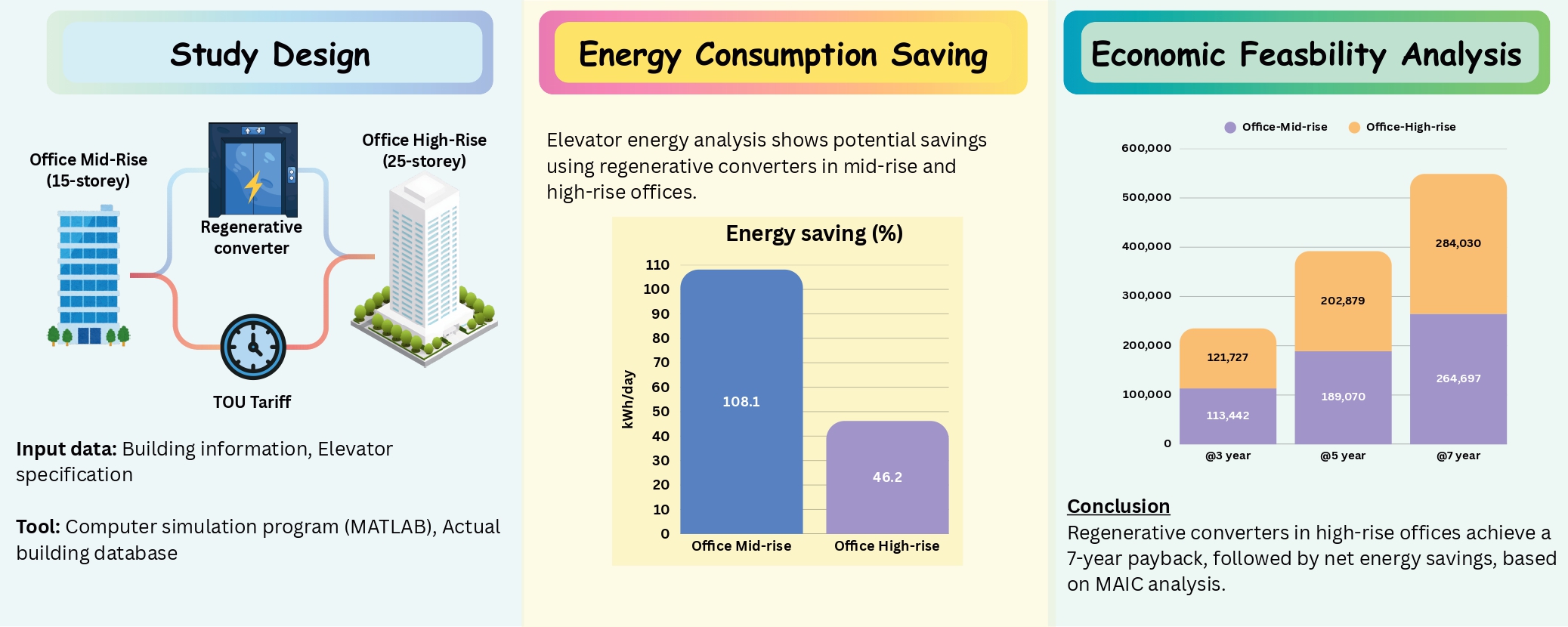
ระบบฟังก์ชันลิฟต์นำพลังงานกลับเป็นระบบการประหยัดพลังงานในลิฟต์โดยการเปลี่ยนพลังงานจลน์และพลังงานศักย์ที่เกิดขึ้นขณะลิฟต์เคลื่อนที่ให้เป็นพลังงานไฟฟ้าเพื่อนำกลับมาหมุนเวียนใช้ใหม่ภายในอาคารซึ่งจะส่งเสริมมาตรการอาคารสีเขียวโดยในงานวิจัยนี้จะทำการวิเคราะห์การใช้และผลิตพลังงานของลิฟต์โดยสารเพื่อนำไปสู่การคำนวณหาค่าใช้จ่ายส่วนเพิ่มที่ยอมรับได้ (Maximum allowable incremental cost: MAIC)สำหรับการตัดสินใจลงทุนติดตั้งเทคโนโลยีนี้ต่อไปการศึกษาอาศัยกรณีศึกษาอาคารสำนักงาน 2 รูปแบบ คืออาคารขนาดกลาง (Mid-rise) 15 ชั้น และอาคารสูง (High-rise) 25 ชั้น ภายใต้ข้อมูลลิฟต์โดยสารแบบไม่มีเกียร์ (Gearless) ผลการศึกษาพบว่าในช่วงเวลาที่มีการใช้งานหนาแน่นแบบจำลองอาคารขนาดกลางมีสัดส่วนการกู้คืนพลังงานสูงถึงร้อยละ 108.1 ของพลังงานที่ใช้ในการขับเคลื่อนซึ่งสูงกว่าอาคารสูงที่มีสัดส่วนร้อยละ 46.2 แต่อย่างไรก็ตามเมื่อพิจารณาปริมาณพลังงานไฟฟ้าสะสมที่ผลิตคืนได้จริงตลอดทั้งวันพบว่าความสูงของอาคารและปริมาณการสัญจรที่มากกว่า เป็นปัจจัยสำคัญที่ทำให้อาคารสูงสามารถผลิตกระแสไฟฟ้าคืนสู่ระบบในเชิงสัมบูรณ์ได้มากกว่าอาคารขนาดกลางส่งผลให้การประเมินความคุ้มค่าทางเศรษฐศาสตร์ด้วยค่า MAIC ระบุว่า อาคารสูงมีศักยภาพและเพดานงบประมาณในการลงทุนที่สูงกว่าอาคารขนาดกลาง พร้อมกันนี้ได้ทำการวิเคราะห์ความอ่อนไหว (Sensitivity analysis) ของตัวแปรความหนาแน่นในการใช้งานความสูงของอาคาร และอัตราค่าไฟฟ้าเพื่อประกอบการตัดสินใจด้วยแล้ว
Article Details
เอกสารอ้างอิง
United Nations Environment Programส and Global Alliance for Buildings and Construction, 2024, Global Status Report for Buildings and Construction: Beyond foundations: Mainstreaming Sustainable Solutions to Cut Emissions from the Buildings Sector, United Nations Environment Programme, Nairobi.
Ministry of Energy, 2018, Energy Efficiency Plan: EEP 2018 (2018–2037), Department of Alternative Energy Development and Efficiency, Thailand. (in Thai)
Tukia, T., Uimonen, S., Siikonen, M. L., Donghi, C. and Lehtonen, M., 2018, High-resolution modeling of elevator power consumption, J. Build. Eng. 18: 210-219.
Rashed, A. N. Z., Yarrarapu, M., Prabu, R. T., Antony, G. S. R., Edeswaran, L., Kumar, E. S., Aswitha, K., Snehith, N. and Shaik, H. A., 2024, Connected smart elevator systems for smart power and time saving, Sci. Rep. 14(1): Article 19330.
Cao, Y. and Ming, X., 2025, Digital twin-driven low-carbon service design and modularization in central air conditioning ecosystems: A multi-criteria and co-intelligence approach, Sustainability. 17(21): 9877.
Rahman, A., Aziz, T., Masood, N. A. and Deeba, S. R., 2021, A time of use tariff scheme for demand side management of residential energy consumers in Bangladesh, Energy Rep. 7: 3189-3198.
Tang, H., Zhang, Y. and Zheng, Z., 2025, How time-of-use tariffs and storage costs shape optimal hybrid storage portfolio in buildings, Buildings. 16(1): 42.
Dambrauskas, K., Vanagas, J., Zimnickas, T., Kalvaitis, A. and Ažubalis, M., 2020, A method for efficiency determination of permanent magnet synchronous motor, Energies. 13(4): 1004.
Fernández V., J. R., Cortés, P. and Aparicio, P., 2008, Fuzzy Logic-Based Elevator Group Control System for Energy Optimization Purpose, In 2008 International Conference on Information Technology and Applications pp. 439-444.
Zrnić, N., Dragović, A., Kosanić, N. and Milovanović, V., 2023, Development and state-of-the art in green elevators technologies: A survey, Engineering TODAY. 2(3): 7-24
Ikhe, Y., Hajare, A., Pandey, D., Lichade, J., Jain, K., Mate, M. and Dahiwade, S., 2025, Regenerative braking in elevators with BESS, Int. J. Multidiscip. Res. (IJFMR). 7(6).
Venizelou, V., Philippou, N., Hadjipanayi, M., Makrides, G., Efthymiou, V. and Georghiou, G. E., 2018, Development of a novel time-of-use tariff algorithm for residential prosumer price-based demand side management, Energy. 142: 633-646.
Badruddin, S., Robertson-Gillis, C. R., Ashworth, J. and Wright, D., 2020, Impact of tariff structure on the economics of behind-the-meter solar microgrids, Clean. Eng. Technol. 2: 100039.
Kantawong, S., 2013, Modelling of Power Generation Controller for Permanent Magnet Motor Elevator by Energy Regenerative Unit (ERU), Master Thesis, Rajamangala University of Technology Thanyaburi, Pathum Thani, 171 p. (in Thai)
Uimonen, S., Tukia, T., Donghi, C. and Lehtonen, M., 2020, Analysis of elevator energy efficiency and regenerative potential in tall buildings, Energy Build. 210: 109743.
