
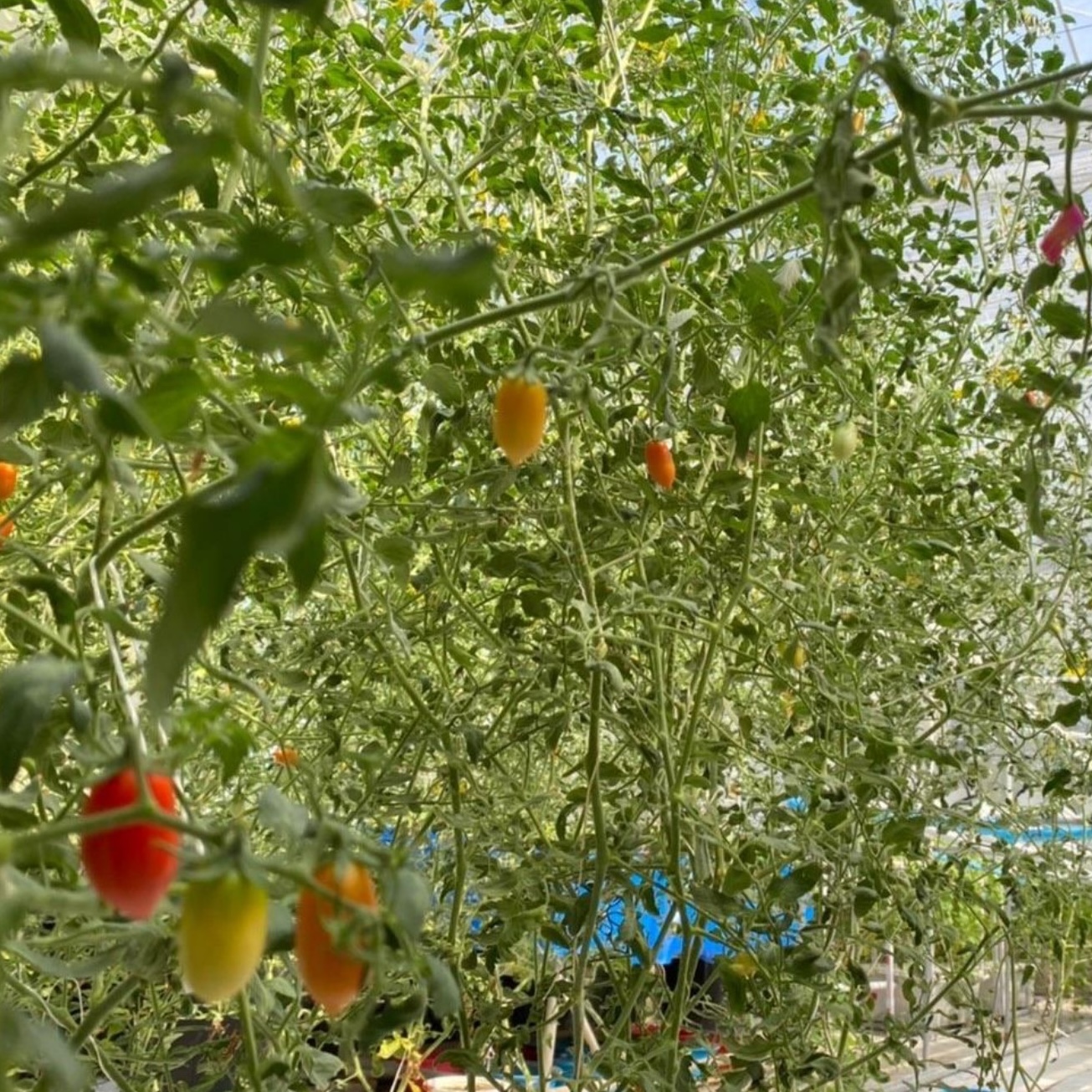
อิทธิพลของการพรางแสงต่อการเปลี่ยนแปลงทางสรีรวิทยาและผลผลิตมะเขือเทศเชอรี่ในโรงเรือน
Article Sidebar
Main Article Content
บทคัดย่อ
ความเป็นมาและวัตถุประสงค์: ปัจจุบันมีการปลูกมะเขือเทศเชอรี่ในโรงเรือนเพื่อลดปัญหาโรคและแมลง แต่การปลูกพืชในโรงเรือนอาจประสบปัญหาความเข้มแสงสูง การพรางแสงเป็นวิธีหนึ่งที่ช่วยแก้ไขปัญหาดังกล่าว การทดลองนี้มีวัตถุประสงค์เพื่อศึกษาอิทธิพลของการพรางแสงต่อการเปลี่ยนแปลงทางสรีรวิทยาและผลผลิตมะเขือเทศเชอรี่ในโรงเรือน
วิธีดำเนินการวิจัย: วางแผนการทดลองแบบสุ่มสมบูรณ์โดยแบ่งการทดลองออกเป็น 2 ทรีตเมนต์ ได้แก่ ไม่พรางแสง และพรางแสง 10 เปอร์เซ็นต์ ทำการทดลอง 5 ซ้ำ/ทรีตเมนต์ ในมะเขือเทศเชอรี่ 2 พันธุ์ ได้แก่ พันธุ์โทนี่ TA 104 และพันธุ์สวีทบอย 1 วิเคราะห์ความแตกต่างระหว่างทรีตเมนต์ด้วยวิธีStudent’s t-test (P < 0.05)
ผลการวิจัย: การพรางแสงทำให้จุดชดเชยแสงและจุดอิ่มแสงของมะเขือเทศลดลงอย่างมีนัยสำคัญ นอกจากนี้ การพรางแสงยังเพิ่มอัตราการสังเคราะห์ด้วยแสงสุทธิ ค่าการนำไหลปากใบ และอัตราการคายน้ำของพันธุ์โทนี่ TA 104 อย่างมีนัยสำคัญ แต่การพรางแสงลดอัตราการสังเคราะห์ด้วยแสงสุทธิในพันธุ์สวีทบอย 1 การพรางแสงมีแนวโน้มทำให้น้ำหนักผลของพันธุ์สวีทบอย 1 ลดลงแต่ไม่มีผลต่อน้ำหนักผลของพันธุ์โทนี่ TA 104 นอกจากนี้ การพรางแสงมีแนวโน้มเพิ่มปริมาณไลโคปีนในพันธุ์โทนี่ TA 104
สรุป: การพรางแสงไม่มีผลต่อปริมาณของแข็งทั้งหมดที่ละลายน้ำได้และปริมาณวิตามินซีในมะเขือเทศเชอรี่ทั้งสองพันธุ์ ดังนั้น การพรางแสงส่งผลต่อการตอบสนองทางสรีรวิทยาแต่ไม่สามารถเพิ่มผลผลิตของมะเขือเทศเชอรี่อย่างมีนัยสำคัญ
Article Details

อนุญาตภายใต้เงื่อนไข Creative Commons Attribution-NonCommercial-NoDerivatives 4.0 International License.
เอกสารอ้างอิง
Anthon, G. and D.M. Barrett. 2007. Standardization of a rapid spectrophotometric method for lycopene analysis. Acta Hortic. 758: 111–128. https://doi.org/10.17660/ActaHortic.2007.758.12.
Bai, Y. and P. Lindhout. 2007. Domestication and breeding of tomatoes: What have we gained and what can we gain in the future?. Ann. Bot. 100(5): 1085–1094. https://doi.org/10.1093/aob/mcm150.
Baskins, S., J.K. Bond and T. Minor. 2019. Unpacking the growth in per capita availability of fresh market tomatoes. Available Source: https://www.ers.usda.gov/publications/pub-details?pubid=92441, April 6, 2022.
Camejo, D., P. Rodríguez, M. Angeles Morales, J.M. Dell’Amico, A. Torrecillas and J.J. Alarcón. 2005. High temperature effects on photosynthetic activity of two tomato cultivars with different heat susceptibility. J. Plant Physiol. 162(3): 281–289. https://doi.org/10.1016/j.jplph.2004.07.014.
Charlo, H.C.O., R. Castoldi, L.A. Ito, C. Fernandes and L.T. Braz 2007. Productivity of cherry tomatoes under protected cultivation carried out with different types of pruning and spacing. Acta Hortic. 761: 323–326. https://doi.org/10.17660/ActaHortic.2007.761.43.
Cook, R. and L. Calvin. 2005. Greenhouse tomatoes change the dynamics of the North American fresh tomato industry. Available Source: https://www.ers.usda.gov/publications/pub-details?pubid=45477, April 8, 2022.
Gill, N.S. and L. Kaur 2019. Economics of cherry tomato (Solanum lycopersicum var. cerasiforme) cultivation. J. Pharmacogn. Phytochem. 8(6): 880–881.
Gomez, R., J. Costa, M. Amo, A. Alvarruiz, M. Picazo and J.E. Pardo. 2001. Physicochemical and colorimetric evaluation of local varieties of tomato grown in SE Spain. J. Sci. Food Agric. 81(11): 1101–1105. https://doi.org/10.1002/jsfa.915.
Harel, D., H. Fadida, S. Gantz, K. Shilo and H. Yasuor. 2013. Evaluation of low pressure fogging system for improving crop yield of tomato (Lycopersicon esculentum Mill.) grown under heat stress conditions. Agronomy. 3(2): 497–507. https://doi.org/10.3390/agronomy3020497.
Hernández, V., P. Hellín, J. Fenoll and P. Flores. 2019. Interaction of nitrogen and shading on tomato yield and quality. Sci. Hortic. 255: 255–259. https://doi.org/10.1016/j.scienta.2019.05.040.
Jeeatid, N., J. Modnok, S. Techawongstien, C. Lapjit and S. Techawongstien. 2021. Fruit quality and carotenoids in fruits of cherry tomato (Solanum lycopersicum) grown under plant factory. Khon Kaen Agr. J. 49(3): 634–642. (in Thai)
Keren, N. and A. Krieger-Liszkay. 2011. Photoinhibition: Molecular mechanisms and physiological significance. Physiol. Plant. 142(1): 1–5. https://doi.org/10.1111/j.1399-3054.2011.01467.x.
Ketsakul, S. 2015. Tomato Production Technology. Available Source: https://www.doa.go.th/research/research-detail.php?id=114, March 10, 2022. (in Thai)
Khamchumphol, N., S. Wonprasaid and T. Machikowa. 2021. Effects of varieties and environments on quality and antioxidants of tomato. KKU Sci. J. 49(1): 108–116.
Kittas, C., N. Rigakis, N. Katsoulas and T. Bartzanas. 2009. Influence of shading screens on microclimate, growth and productivity of tomato. Acta Hortic. 807: 97–102. https://doi.org/10.17660/ActaHortic.2009.807.10.
Lopez-Andreu, F.J., A. Lamela, R.M. Estaban and J.G. Collado. 1986. Evolution of quality parameters in the maturation stage of tomato fruits. Acta Hortic. 191: 387–394. https://doi.org/10.17660/ActaHortic.1986.191.45.
Mathews, S. 2006. Phytochrome-mediated development in land plants: Red light sensing evolves to meet the challenges of changing light environments. Mol. Ecol. 15(12): 3483–3503. https://doi.org/10.1111/j.1365-294x.2006.03051.x.
Meteorological Development Division. 2021. Climate Center. Weather conditions in Thailand 2021. Available Source: https://www.tmd.go.th/programs/uploads/yearlySummary/สรุปสภาวะอากาศปี%202564.pdf, March 2, 2022. (in Thai)
Meteorological Development Division. 2022. Climate Center. Weather conditions in Thailand January 2022. Available Source: https://www.tmd.go.th/programs/uploads/monthlySummaryมกราคม%2025565.pdf, March 2, 2022. (in Thai)
Nath, A., B.C. Deka, A. Singh, R.K. Patel, D. Paul, L.K. Misra and H. Ojha. 2012. Extension of shelf life of pear fruits using different packaging materials. J. Food Sci. Technol. 49(5): 556–563. https://doi.org/10.1007/s13197-011-0305-4.
Phromjuang, N., N. Leksungnoen and P. Tor-ngern. 2019. Diurnal stomatal conductance of tree species responding to urban environments at the Chulalongkorn University Centenary Park. Thai Journal of Science and Technology. 8(4): 386–397. https://doi.org/10.14456/tjst.2019.46. (in Thai)
Rittiram, J. and A. Tira-umphon. 2019. Effects of light intensity on growth and yield of lettuce in plant factory system. Khon Kaen Agr. J. 47(6): 1243–1250. (in Thai)
Rockwell, N.C., Y.S. Su and J.C. Lagarias. 2006. Phytochrome structure and signaling mechanisms. Annu. Rev. Plant Biol. 57: 837–858. https://doi.org/10.1146/annurev.arplant.56.032604.144208.
Shahak, Y., E.E. Gussakovsky, Y. Cohen, S. Lurie, R. Stern, S. Kfir, A. Naor, I. Atzmon, I. Doron and Y. Greenblat-Avron. 2004. ColorNets: A new approach for light manipulation in fruit trees. Acta Hortic. 636: 609–616. https://doi.org/10.17660/ActaHortic.2004.636.76.
Shaish, A., A. Ben-Amotz and M. Avron. 1991. Production and selection of high β-carotene mutants of Dunaliella bardawil (Chlorophyta). J. Phycol. 27(5): 652–656. https://doi.org/10.1111/j.0022-3646.1991.00652.x.
Sharrock, R.A. 2008. The phytochrome red/far-red photoreceptor superfamily. Genome Biol. 9(8): 230. https://doi.org/10.1186/gb-2008-9-8-230.
Stommel, J.R., J.A. Abbott and R.A. Saftner. 2005. USDA 02L1058 and 02L1059: Cherry tomato breeding lines with high fruit β-carotene content. HortScience. 40(5): 1569–1570. https://doi.org/10.21273/HORTSCI.40.5.1569.
Takebe, M. and T. Yoneyama 1995. An analysis of nitrate and ascorbic acid in crop exudates using a simple reflection photometer system. Japanese Society of Soil Science and Plant Nutrition. 66(2): 155–158. https://doi.org/10.20710/dojo.66.2_155.
Teitel, M., O. Liron, Y. Haim and I. Seginer. 2008. Flow through inclined and concertina-shape screens. Acta Hortic. 801(5): 99–106. https://doi.org/10.17660/ActaHortic.2008.801.5.
Thornley, J.H.M. and I.R. Johnson. 1990. Plant and Crop Modeling. Oxford University Press, New York, USA. 669 pp.
Williams, M., E.B. Rastetter, D.N. Fernandes, M.L. Goulden, S.C. Wofsy, G.R. Shaver, J.M. Melillo, J.W. Munger, S.M. Fan and K.J. Nadelhoffer. 1996. Modelling the soil-plant-atmosphere continuum in a Quercus–Acer stand at Harvard Forest: The regulation of stomatal conductance by light, nitrogen and soil/plant hydraulic properties. Plant Cell Environ. 19(8): 911–927. https://doi.org/10.1111/j.1365-3040.1996.tb00456.x.
Yeshiwas, Y. and K. Tolessa. 2017. Postharvest quality of tomato (Solanum lycopersicum) varieties grown under greenhouse and open field conditions. Int. J. Biotechnol. Mol. Biol. Res. 9(1): 1–6. https://doi.org/10.5897/IJBMBR2015.0237.
Zhang, Y. and J.R. Stommel. 2000. RAPD and AFLP tagging and mapping of Beta (B) and Beta modifier (MoB), two genes which influence β-carotene accumulation in fruit of tomato (Lycopersicon esculentum Mill.). Theor. Appl. Genet. 100: 368–375. https://doi.org/10.1007/s001220050048.
