
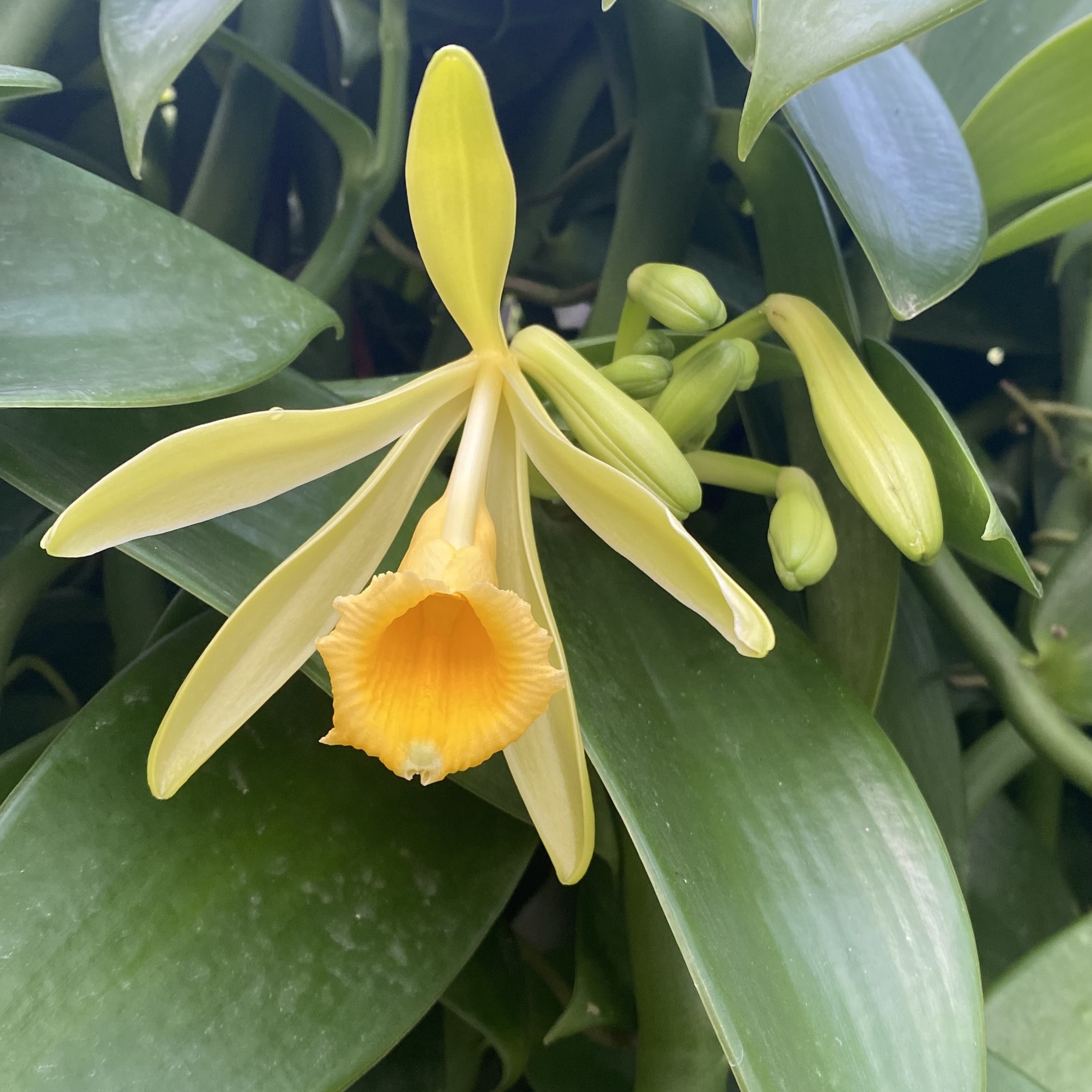
การศึกษาการเจริญเติบโต การออกดอก และการพัฒนาฝักของวานิลลาปอมโปนาที่ปลูกเลี้ยงในสภาพพรางแสง จังหวัดราชบุรี
Article Sidebar
Main Article Content
บทคัดย่อ
ความเป็นมาและวัตถุประสงค์: วานิลลาปอมโปนาเป็นพันธุ์การค้าที่ปลูกเลี้ยงได้ง่าย ทนต่อโรคและการเปลี่ยนแปลงของสภาพอากาศ ใช้ประโยชน์ในด้านเภสัชกรรมและเครื่องหอม การศึกษานี้จึงมีวัตถุประสงค์เพื่อติดตามการเจริญเติบโต การออกดอก และการพัฒนาฝักของวานิลลาปอมโปนาที่ปลูกเลี้ยงในสภาพพรางแสงร่วมกับสวนกล้วยไม้สกุลหวายตัดดอกที่จังหวัดราชบุรี
วิธีดำเนินการวิจัย: ศึกษาการเจริญเติบโตของต้นอายุ 4 ปี แบ่งเป็น 2 ลักษณะ คือ 1) เถาที่ไม่ออกดอก ได้แก่ ความยาว และการหยุดชะงักการเจริญเติบโตที่บริเวณปลายยอด และ 2) เถาที่ออกดอก ติดตามต่อเนื่อง 2 ปี ของการให้ผลผลิต ได้แก่ ขนาด ช่วงเวลาออกดอกและการพัฒนาช่อดอก การเจริญเติบโตของฝัก การพัฒนาเมล็ด ปริมาณการออกดอก และการสูญเสียที่เกิดขึ้น
ผลการวิจัย: เถาที่ไม่ออกดอกมีความยาวเพิ่มขึ้นเฉลี่ยเดือนละ 30.2 เซนติเมตร และเกิดการหยุดชะงักการเจริญเติบโตที่บริเวณปลายยอดรวมร้อยละ 50 ส่วนเถาที่ออกดอกมีขนาดเส้นผ่านศูนย์กลางเฉลี่ย 12.5 มิลลิเมตร ความยาวปล้องเฉลี่ย 7.1 เซนติเมตร โดยเริ่มออกดอกในช่วงฤดูหนาว (8 กุมภาพันธ์ 2564 และ 4 มกราคม 2565) ตาดอกใช้เวลา 1 สัปดาห์ ในการพัฒนาเป็นช่อดอกอ่อน จากนั้น ใช้เวลา 3 สัปดาห์ ในการพัฒนาจนกระทั่งดอกแรกเริ่มบาน และบานติดต่อกันเป็นเวลา 4 ถึง 16 วัน ขึ้นอยู่กับจำนวนดอกในช่อ (เฉลี่ย 6.2 ดอกต่อช่อ) ดอกต้องได้รับการผสมจึงสามารถติดฝักได้ การเจริญเติบโตของฝักเป็นแบบ S curve ขนาดเพิ่มขึ้นอย่างรวดเร็วตั้งแต่สัปดาห์ที่ 1–4 หลังได้รับการผสมเกสร และมีค่าสูงสุดในสัปดาห์ที่ 5 ความยาวเฉลี่ย 8.9 เซนติเมตร และเส้นผ่านศูนย์กลางเฉลี่ย 1.89 เซนติเมตร จากนั้น มีขนาดคงที่ไปจนถึงระยะเก็บเกี่ยวที่อายุ 36 สัปดาห์ เมล็ดพัฒนาจากลักษณะอ่อนนุ่ม สีขาวขุ่น และเปลี่ยนเป็นสีดำแข็ง เมื่อถึงระยะเก็บเกี่ยว โดยได้ผลผลิตรวมร้อยละ 53 จากจำนวนดอกอ่อนทั้งหมด และเกิดความเสียหายตั้งแต่ดอกบานจนกระทั่งฝักถึงระยะเก็บเกี่ยวร้อยละ 47
สรุป: วานิลลาปอมโปนาสามารถเจริญเติบโต ออกดอก และติดฝักได้ในการปลูกภายใต้สภาพพรางแสงร้อยละ 50 ร่วมกับการปลูกกล้วยไม้หวายในจังหวัดราชบุรี แต่พบความเสียหายระหว่างกระบวนการผลิตค่อนข้างสูง ข้อมูลที่ได้จึงเป็นแนวทางนำไปสู่การศึกษาและพัฒนากระบวนการผลิตวานิลลาในเขตราบลุ่มภาคกลางต่อไป
Article Details

อนุญาตภายใต้เงื่อนไข Creative Commons Attribution-NonCommercial-NoDerivatives 4.0 International License.
เอกสารอ้างอิง
Anandaraj, M., J. Rema, B. Sasikumar and R.S. Bhai. 2005. Vanilla (Extension Pamphlet). Available Source: https://nemaloknig.net/read–390908, June 23, 2023.
Brunschwig, C., F.X. Collard, S.L. Andrzejewski and P. Raharivelomanana. 2017. Tahitian vanilla (Vanilla × tahitensis): A vanilla species with unique features, pp. 29–47. In H. El-Shemy, ed. Active Ingredients from Aromatic and Medicinal Plants. InTech, Rijeka.
Cedar Lake Ventures Incorporated. 2018. Climate and average weather year round in Veracruz Mexico. Available Source: https://weatherspark.com/y/8657/Average–Weather–in–Veracruz–Mexico–Year–Round, December 20, 2021.
Chusri, O., S. Sachati, N. Boonchanang and S. Srimomgkol. 2015. Combination and selection of vanilla for high vanillin content. In S. Sachati, ed. Research and Development of Medicinal Plants and Spices Potential Report. Department of Agriculture, Bangkok, Thailand. (in Thai)
Ehlers, D., M. Pfister and S. Bartholomae. 1994. Analysis of Tahiti vanilla by high-performance liquid chromatography. Z. Lebensm. Unters. Forsch. 199: 38–42. https://doi.org/10.1007/BF01192950.
Fouché, J.G. and L. Jouve. 1999. Vanilla planifolia: History, botany, and culture in Reunion Island. Agronomie. 19(8): 689–703. https://doi.org/10.1051/agro:19990804.
Galeas, M.D.P. 2015. Gas Chromatography-Mass Spectrometry and Gas Chromatography-Olfactometry Analysis of Aroma Compounds of Vanilla pompona Schiede. MS Thesis, The State University of New Jersey, New Jersey, USA.
Hernández-Hernández, J. 2019. Mexican vanilla production, pp. 3–26. In D. Havkin-Frenkel and F.C. Belange, eds. Handbook of Vanilla. John Wiley & Sons, Inc., England.
Kasemsap, P. 2011. Effect of Drought Stress on Chlorophyll Fluorescence and Net CO2 Exchange Rate of Vanilla planifolia Jacks. ex Andrews. BS Special Problem, Kasetsart University, Bangkok. (in Thai)
Kasemsap, P. 2013. Biology 2. 6th Edition. Darnsutha Printing Ltd, Bangkok, Thailand. (in Thai)
Malachuamong, L. 2015. Study on Photosynthesis and Growth of Four Vanilla Cultivars. MS Thesis, Kasetsart University, Bangkok. (in Thai)
Noort, F. 2019. Vanilla in Dutch greenhouses: A discovery-from research to production, pp. 157–163. In D. Havkin-Frenkel and F.C. Belanger, eds. Handbook of Vanilla. John Wiley & Sons, Inc., England.
Quirós, E.V. 2019. Vanilla production in Costa Rica, pp. 41–51. In D. Havkin-Frenkel and F.C. Belanger, eds. Handbook of Vanilla. John Wiley & Sons, Inc., England.
Sagarik, R. 2006. Orchids for Beginner. 3rd Edition. Vasira Ltd, Bangkok, Thailand. (in Thai)
Thai Meteorological Department. 2021. Seasons in Thailand. Available Source: www.tmd.go.th/info, August 27, 2022. (in Thai)
Trade Map. 2023. Trade statistics for international business development. Available Source: https://www.trademap.org, April 1, 2023.
Udomdee, W., R. Darak, K. Faiupara, C. Rattanawisanon and K. Donyuprai. 2019. Study of Vanilla Production Technology. Research Report, Department of Agriculture, Bangkok, Thailand. (in Thai)
Yeh, C.H., K.Y. Chen and Y.I. Lee. 2021. Asymbiotic germination of Vanilla planifolia in relation to the timing of seed collection and seed pretreatments. Bot. Stud. 62(1): 6. https://doi.org/10.1186/s40529-021-00311-y.
