
The Results of Using the Low-Grade Barracuda Mango as a Substitute for Fresh Milk in Pudding Products
Article Sidebar
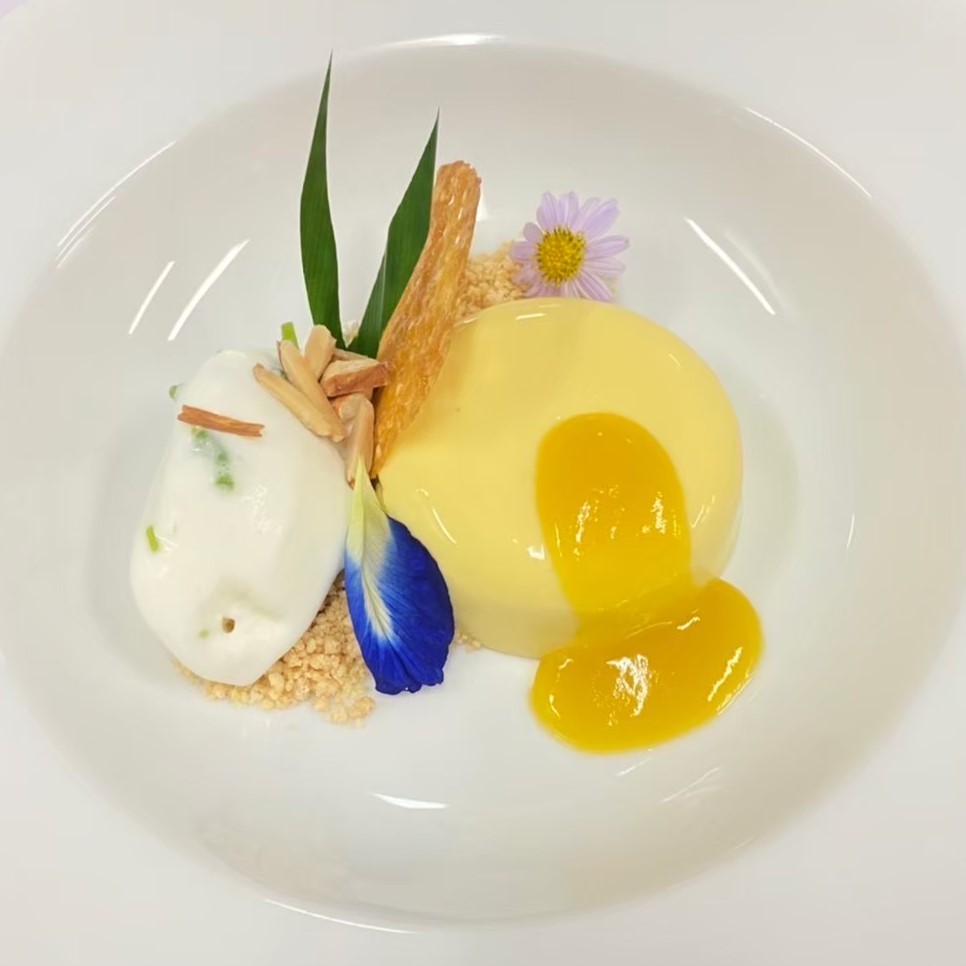
Main Article Content
Abstract
Background and Objectives: Barracuda mango has high nutritional values, such as vitamin C, vitamin A, potassium, and beta-carotene. It is famous among both Thais and foreigners because of its sweet taste, bright color and scent. This research aimed to develop a pudding recipe that uses Barracuda mangoes as a substitute for milk to make the substandard Barracuda mangoes more valuable.
Methodology: A randomized complete block design (RCBD) was used to find the most suitable proportion of the substituted mangoes instead of using fresh milk in the recipe. The tests were divided into 4 recipes, which used different proportions of Barracuda mangoes at 0, 30, 45, and 60%. The sensory qualities, physical properties, and nutritional values of the pudding were evaluated. The one-way ANOVA was applied for variance analysis, and Duncan’s new multiple range test (DMRT) was used for the mean comparison with a 95% confidence interval.
Main Results: The replacement of fresh milk with 30–45% mango juice did not affect the pudding appearance (P > 0.05), while the use of 60% mango juice affected the characteristics of pudding (P < 0.05). The increase of mango juice substitution for fresh milk resulted in higher values of a* and b* but lower values of L* and hardness (P < 0.05). Puddings that replaced fresh milk with 45% mango juice had the highest acceptance scores for appearance, color, flavor, taste, texture, and overall preference. One serving (120 g) of mango pudding contains 126.78
kcal of energy, 14.98 grams of carbohydrate, 2.59 grams of protein, 6.24 grams of fat, 138.03 micrograms REA of vitamin A, 920.98 micrograms of beta-carotene, and 4.99 micrograms of vitamin C.
Conclusions: The use of mango juice as a replacement for fresh milk by 45% was most accepted
and the antioxidants were also increased. The Barracuda pudding can be a healthy option for dessert and a value-added addition to the low-grade mango.
Article Details

This work is licensed under a Creative Commons Attribution-NonCommercial-NoDerivatives 4.0 International License.
References
Buachoon, N. and S. Kookid. 2019. Total phenolic and antioxidant activity of mango CV. Nam Dok Mai in Sa Kaeo province. VRU Research and Development Journal Science and Technology. 14(1): 121–132. (in Thai)
Bureau of Nutrition. 2018. Food Composition Table of Thai Foods. The Printing Office Agency of The War Veterans Organization, Bangkok, Thailand. 143 pp. (in Thai)
Bureau of Nutrition. 2022. Knowledge about the amount of antioxidants (vitamin C, vitamin E, and beta-carotene) in fruits promotes health. Available Source: https://nutrition2.anamai.moph.go.th, April 30, 2022. (in Thai)
Chimkerd, C., N. Rungraung, P. Thiyajai, S. Purttiponthanee, Y. Sahasakul, D. Trachootham and T. Winuprasith. 2019. Formulation of vegetable pudding for elderly and their storage effect on total phenolics and antioxidant activies. Srinakharinwirot University Journal of Sciences and Technology. 11(21): 64–76. (in Thai)
Lhaothong, P., N. Chuaykarn and S. Preuttiwilai. 2019. Product Development of Sacha Inchi Pudding Contains High Protein. Research Report, Rajamangala University of Technology Srivijaya, Songkhla. (in Thai)
National Bureau of Agricultural Commodity and Food Standard. 2015. Thai Agricultural Standard (TAS 5-2015): Mango. Ministry of Agriculture and Cooperatives, Bangkok, Thailand. (in Thai)
Naykaset. 2010. “Nam Dok Mai Mango” super delicious. Available Source: https://www.thairath.co.th, April 30, 2022. (in Thai)
Onsamlee, G. 2020. Use of stevia extract in coconut milk pudding. TSTJ. 28(6): 1075–1085. https://doi.org/10.14456/tstj.2020.85. (in Thai)
Park, S.G., T.H. Song, D.H. Kim, G.H. Kim and K.I. Jang. 2014. Quality properties of peach pudding added with Korean peach (Prunus persica L. Batsch) juice and gelatin. J. Korean Soc. Food Sci. Nutr. 43(2): 265–272. http://dx.doi.org/10.3746/jkfn.2014.43.2.265.
Pasukamonset, P., A. Jamphon, S. Duangnum and P. Channarong. 2018. Physical characteristics and nutrition values of pudding substituted with white bean milk. SWU Sci. J. 34(1): 125–137. (in Thai)
Phuchkaset. 2014. Nam Dok Mai mango: Benefits, properties and cultivation. Available Source: https://puechkaset.com, April 30, 2022. (in Thai)
Pongprayoon, N., P. Suwakhon and A. Jarunrattanasri. 2019. Production of syrup from low grade Nam Dok Mai mango (Mangifera indica Linn.). Agricultural Sci. J. 50(Suppl.1): 104–110.
Ponklang, W., W. Sorndech, R. Lueachan, S. Butseekhot, T. Ploypetchara and S. Siricoon. 2021. Impact of plant-based gelling agents on physicochemical properties and sensory quality of functional pudding containing antioxidant from gooseberry extracts. TSTJ. 29(6): 1010–1020. https://doi.org/10.14456/tstj.2021.84. (in Thai)
Ruangthamsing, R., P. Piyasuwanying and N. Siriwong. 2016. Formulation development of milk pudding substituted with corn milk. KKU Sci. J. 44(2): 345–354. (in Thai)
Rumainum, I.M., K. Worarad, V. Srilaong and K. Yamane. 2018. Fruit quality and antioxidant capacity of six Thai mango cultivars. Agric. Nat. Resour. 52(2): 208–214. https://doi.org/10.1016/j.anres.2018.06.007.
Sangkaeo, W. and T. Pongpunya. 2018. The development of young coconut milk pudding enriched whey protein. Agricultural Sci. J. 49(Suppl 2): 101–104. (in Thai)
Sanguansub, J., O. Ruangwong, P. Seehanam, P. Maniwara and C. Tiyayon. 2023. Evaluation of fruit quality and principal component analysis of spongy tissue symptom in ‘Namdokmai Sithong’ mango. Journal of Agriculture. 39(1): 81–90. (in Thai)
Seeta, N. and P. Kwanmuang. 2017. Effect of varieties of Thai ripe mango on the quality of drinking mango juice, pp. 762–770. In Proc. the 55th Kasetsart University Annual Conference: Science and Genetic Engineering, Architecture and Engineering, Agro-Industry, Natural Resources and Environment, January 31–February 3, 2017. (in Thai)
Special Food Co., Ltd. 2022. Before becoming a delicious pudding like today What have you been through? Let’s get to know pudding! Available Source: https://specialfood.co.th, April 30, 2022. (in Thai)
Suklim, A., K. Laothaworn, W. Panichkornkul and N. Tongcom. 2018. Delopment of germinated brown rice pudding product, pp. 268–273. In Proc. the 6th Academic Science and Technology Conference, June 6, 2018. (in Thai)
Thaiudom, S. and S. Pracham. 2018. The influence of rice protein content and mixed stabilizers on textural and rheological properties of jasmine rice pudding. Food Hydrocoll. 76: 204–215. https://doi.org/10.1016/j.foodhyd.2016.11.027.
Tudpor, K., P. Sringaokham, N. Thaweesak, P. Reunthong and T. Laoakka. 2021. Effects of black sesame-fortified pudding consumption on psychological stress of community-dwelling older person. RDHSJ. 14(2): 175–181. (in Thai)
Yuenyongputtakal, W., K. Limroongreungrat, S. Sangnark and N. Krasaechol. 2019. Development of Pudding as Protein Functional Food from Marine Fish Meat and Pulses. Research Report, Burapha University, Chonburi. (in Thai)
