ผลของการเสริมสารธรรมชาติที่ผลิตผ่าน Penergetic Technology ในอาหารต่อสมรรถภาพการผลิต คุณภาพซาก และคุณภาพเนื้อในสุกรระยะขุน
Article Sidebar
Main Article Content
บทคัดย่อ
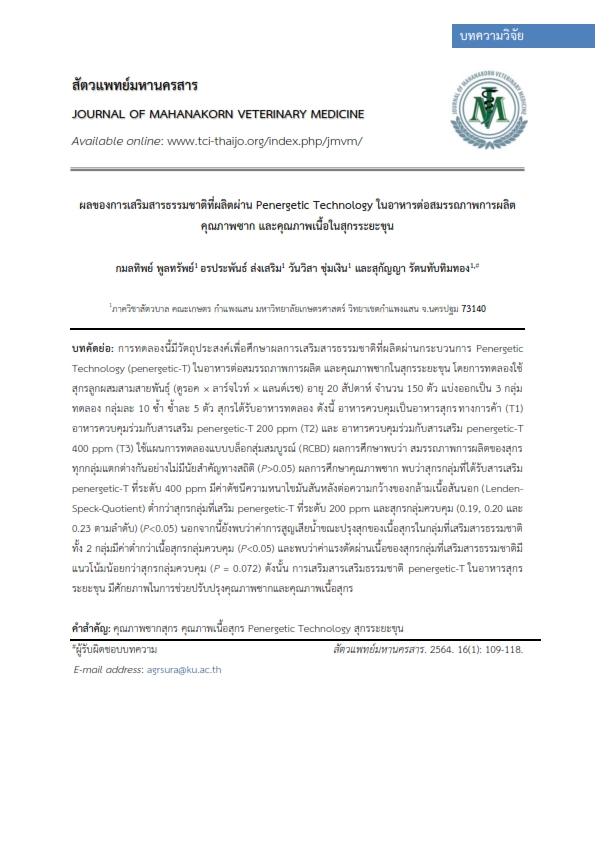
การทดลองนี้มีวัตถุประสงค์เพื่อศึกษาผลการเสริมสารธรรมชาติที่ผลิตผ่านกระบวนการ Penergetic Technology (penergetic-T) ในอาหารต่อสมรรถภาพการผลิต และคุณภาพซากในสุกรระยะขุน โดยการทดลองใช้สุกรลูกผสมสามสายพันธุ์ (ดูรอค × ลาร์จไวท์ × แลนด์เรซ) อายุ 20 สัปดาห์ จำนวน 150 ตัว แบ่งออกเป็น 3 กลุ่มทดลอง กลุ่มละ 10 ซ้ำ ซ้ำละ 5 ตัว สุกรได้รับอาหารทดลอง ดังนี้ อาหารควบคุมเป็นอาหารสุกรทางการค้า (T1) อาหารควบคุมร่วมกับสารเสริม penergetic-T 200 ppm (T2) และ อาหารควบคุมร่วมกับสารเสริม penergetic-T 400 ppm (T3) ใช้แผนการทดลองแบบบล็อกสุ่มสมบูรณ์ (RCBD) ผลการศึกษาพบว่า สมรรถภาพการผลิตของสุกรทุกกลุ่มแตกต่างกันอย่างไม่มีนัยสำคัญทางสถิติ (P>0.05) ผลการศึกษาคุณภาพซาก พบว่าสุกรกลุ่มที่ได้รับสารเสริม penergetic-T ที่ระดับ 400 ppm มีค่าดัชนีความหนาไขมันสันหลังต่อความกว้างของกล้ามเนื้อสันนอก (Lenden-Speck-Quotient) ต่ำกว่าสุกรกลุ่มที่เสริม penergetic-T ที่ระดับ 200 ppm และสุกรกลุ่มควบคุม (0.19, 0.20 และ 0.23 ตามลำดับ) (P<0.05) นอกจากนี้ยังพบว่าค่าการสูญเสียน้ำขณะปรุงสุกของเนื้อสุกรในกลุ่มที่เสริมสารธรรมชาติทั้ง 2 กลุ่มมีค่าต่ำกว่าเนื้อสุกรกลุ่มควบคุม (P<0.05) และพบว่าค่าแรงตัดผ่านเนื้อของสุกรกลุ่มที่เสริมสารธรรมชาติมีแนวโน้มน้อยกว่าสุกรกลุ่มควบคุม (P = 0.072) ดังนั้น การเสริมสารเสริมธรรมชาติ penergetic-T ในอาหารสุกรระยะขุน มีศักยภาพในการช่วยปรับปรุงคุณภาพซากและคุณภาพเนื้อสุกร
Article Details

อนุญาตภายใต้เงื่อนไข Creative Commons Attribution-NonCommercial-NoDerivatives 4.0 International License.
เอกสารอ้างอิง
Anderson, R. A., A. M. Roussel., N. Zouari., S. Mahjoub., J. M. Matheau, and A. Kerkeni. 2001. Potential antioxidant effects of zinc and chromium supplementation in people with type 2 diabetes mellitus. J. Am. Coll. Nutr. 20: 212-218.
A.O.A.C. 1990. Official Methods of Analysis. 15th ed. Association of Official Analytical Chemical, Inc., Virgenia.
Boleman, S. L., S. J. Boleman, T. D. Bidner, L. Southern, T. L. Ward, J. E. Pontif, and M. M. Pike. 1995. Effect of chromium picolinate on growth body composition and tissue accretion in pigs. J. Anim. Sci. 73:2033-2042.
Cogliani, C., H. Goossens, and C. Greko. 2011. Restricting antimicrobial use in food animal: lessons from Europe. Microbe. 6 (6):274-279.
Hanbunchong, A., and A. Sinchermsiri. 1989. Feed analysis and evaluation. Department of Animal science Faculty of Agriculture, Kasetsart University, Bangkok.
Hertog-Meischke, M. J. A., F. J. M. Smulders, J. G. Van Logtestijin, and F. Van Knapen. 1997. The effect of electrical stimulation on the water- holding, capacity and protein denaturation of two bovine muscles. J. Anim. Sci. 75: 118-124.
Jaturasittha, S. 2007. Meat management. 4th ed. Ming muang publishing. Chiang Mai. 170 p.
Kanthapanit, C. 1986. Meat Science. Thaiwatthanapranit, Bangkok. (in Thai)
Khajaren, J. H., S. Khajaren, H. D. Ashmead, and S. P. Ashemead. 2006. The effect of chromium bisglycinate - nicotinamide chelate supplementation on growth and carcass quality in growing and finishing Pigs. Int. J. Appl. Res. Vet. Med. 4(3): 193-198.
Lee, K. W., H. Evert, and A. C. Bevnen. 2004. Essential oils in broiler nutrition. J. Poult Sci. 3: 738-752.
Matthews, J. O., L. L. Southern, J. M. Fernandez, J. E. Pontif, T. D. Bidner, and R. L. Odgaard. 2001. Effect of chromium picolinate and chromium propionate on glucose and insulin kinetics of growing finishing barrows. J. Anim. Sci. 79: 2172-2178.
Meiler, P. 2018. With the impulse of nature. Available source: http://www.penergetic.ca/wp-content/uploads/With-the-impulse-of-nature.pdf, November 15, 2018.
Nuria, V. S., Y. Belguesmia, R. Raspoet, E. Auclair, F. Gancel, I. Kempf, and D. Drider. 2019. Benefits and inputs from lactic acid bacteria and their bacteriocins as alternatives to antibiotic growth promoters during food animal production. J. Front. microbiol. 10: 57.
Office of agricultural economics. 2019. Agricultural production index. Available source : http://www.oae.go.th/view/1/agriculturalproductioninde, May 3, 2020.
Peres, L. M., A. M. Bridi, C. A. Silva, N. Andreo, C. C. P. Barata, and J. G. N. Dario. 2014. Effect of supplementing finishing pigs with different sources of chromium on performance and meat quality. R. Bras. Zootec. 43 (7): 369-375.
Pfeiffer, H., and H. Falkenberg. 1972. Masse am Lenden-spiegel zur objektiven Ermittlung der Schlacht-korperzusammensetzung bei Schwein. Tierzucht. 26:466-467.
Raksasiri, Viliy., J. Sethakul, and R. Sitthigripong. 2005. Effect of dietary chromium picolinate supplemented with iron on the carcass and meat quality of pigs. Kasetsart university. Bangkok. (in Thai)
Sethakul, J., K. Tuntivisoottikul, and R. Sitthigripong. 2003. Grading of pig Carcass by using LSQ. Agricultural Sci. J. 34(4-6): 228-231. (in Thai)
Ward, T. L., L. L. Southern, and T. D. Bidner. 1997. Interactive effect of dietary chromium tripicolinate and crude protein level in growing – finishing pig provided inadequate and adequate pen space. J. Anim. Sci. 57: 1001 –1008.
Zhang, H., B. Dong, and M. Zhang. 2011. Effect of chromium picolinate supplementation on growth performance and meat characteristics of swine. Biol Trace Elem Res. 141: 159-169.
