Ethnobotany and erosion of food plant knowledge in culinary traditions of Thai Song DamEthnobotany and erosion of food plants knowledge in culinary traditions of Thai Song Dam
Keywords:
Indigenous knowledge, Socioeconomic factors, Laos SongAbstract
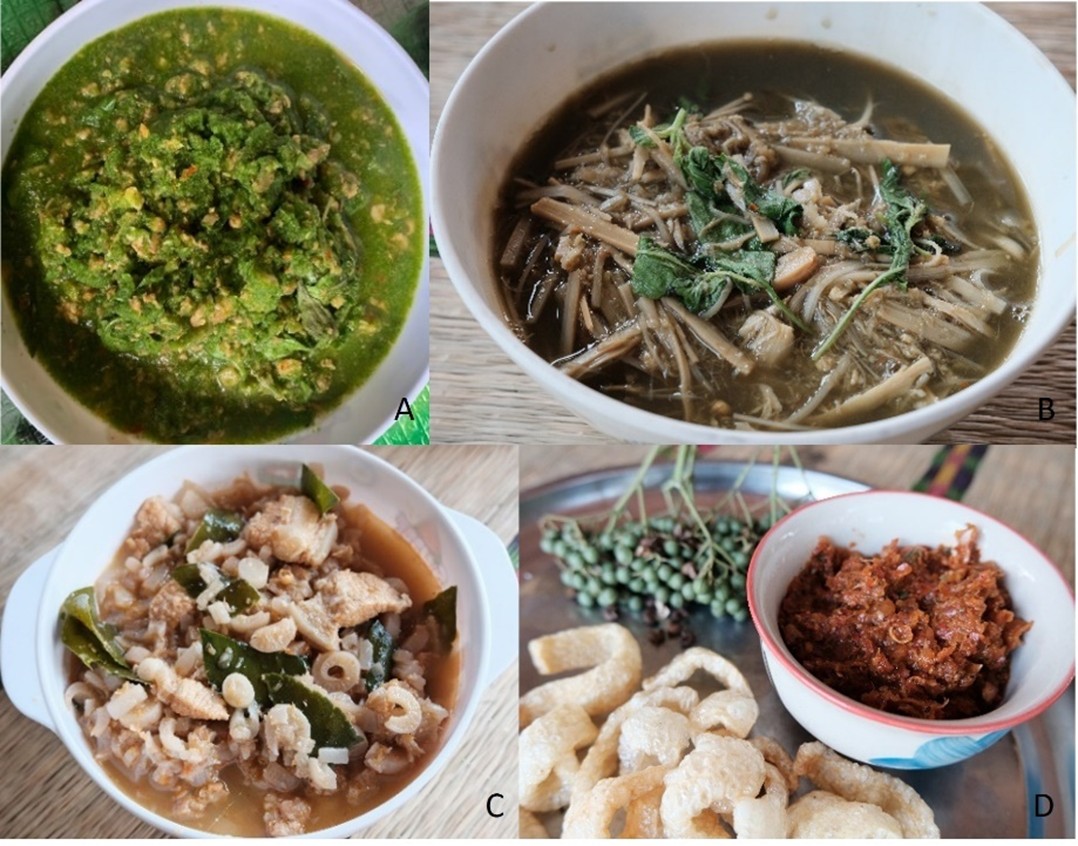
Food consumption patterns have increasingly aligned with urbanized dietary trends, replacing local vegetables with commercially driven crops and contributing to the progressive erosion of traditional food practices. Thai Song Dam is an ethnic group that places importance on food. This research aims to document the food plants used in the traditional cuisine of the Thai Song Dam community in Khao Yoi district, Phetchaburi province. Data were collected through participatory observation with Thai Song Dam food experts. The study identified nine significant dishes of the Thai Song Dam and a total of 16 plant species. Zanthoxylum rhetsa is an important plant ground into curry paste to provide a unique aroma and a spicy and numbing flavor. Most Thai Song Dam villagers have knowledge of nearly all food plant species; however, some people have never consumed some plant species such as the pseudostem of Musa balbisiana and Wolffia globosa. A study investigating the factors associated with the erosion of food plant knowledge within the community employed structured interviews with 30 Thai Song Dam villagers. The findings indicated that socioeconomic factors did not significantly influence the number of plant species recognized by the villagers. In contrast, factors such as age, level of education, and culinary skills were correlated with the number of plant species actually consumed. Understanding these factors related to knowledge erosion is essential to inform targeted conservation strategies within the community, thereby supporting local food security and preserving plant biodiversity.
References
Sripoona S, Termsaithong P, Gubtapol K, Chulilung P, Mankeb P. Nutritional content evaluation of traditional food recipes consumed by ethnic communities of Tai Dam in Loei, Thailand. IJAT. 2023;19(4): 1843-1856. http://www.ijat-aatsea.com ISSN 2630-0192.
Jayakumar G, Ajithabai M, Sreedevi S, Viswanathan P, Remeshkumar B. Ethnobotanical survey of the plants used in the treatment of diabetes. IJTK. 2010;9(1):100–4.
Estomba D, Ladio A, Lozada M. Medicinal wild plant knowledge and gathering patterns in a Mapuche community from northwestern Patagonia. J Ethnopharmacol. 2006;103:109-19. 10.1016/j.jep.2005.07.015.
Suksri C. The changing cultural landscape of a Lao Song community in a new context: A case study of Pahaew. JARS. 2012;9(1):43-60. https://doi.org/10.56261/jars.v9i1.168596.
Pooma R. Suddee S, editors. Tem Smitinand’s Thai Plant Names, revised edition 2014. Bangkok: Office of the Forest Herbarium, Department of National Park, Wildlife and Plant Conservation; 2014.
Sirak C, Sutthiphisan S. An analysis of community identity for the development of tourist attractions through the participatory process of the Tai-Yuan and Lao Khrang cultural communities in Kamphaeng Saen district, Nakhon Pathom province. JLAMS. 2020;7(1):70-81. Retrieved from https://so14.tci-thaijo.org/index.php/jlams/article/view/75.
Wiwatsetchut P. Research report on traditional food of the Thai Song Dam in Bang Rakam, Phitsanulok: an analysis based on popular trends and sociology. Bangkok: Office of the National Culture Commission; 1989. Retrieved from http://research.culture.go.th/index.php/research/item/218-2012-09-15-23-53-57.html (in Thai)
Wongkattiya N, Akekawatchai C, Sanguansermsri P, Fraser I H, Pratoomsoot C, Sanguansermsri D. Chemical compositions and biological properties of essential oils from Zanthoxylum rhetsa (Roxb.) DC and Zanthoxylum limonella Alston. AJTCAM. 2018;15(2):12-8. https://doi.org/10.21010 /ajtcamv15i2.2.
Suksathan R, Trisonthi C, Trisonthi P, Wangpakapattanawong P. Notes on spice plants in the genus Zanthoxylum (Rutaceae) in northern Thailand. TFB (Botany). 2009;37:197–204. Retrieved from https://li01.tci-thaijo.org/index.php/ThaiForestBulletin/article/view/24374.
Supabphol R, Tangjitjareonkun J. Chemical constituents and biological activities of Zanthoxylum limonella (Rutaceae): A Review. TJPR. 2014;13(12):2119-30. http://dx.doi.org/10.4314/tjpr.v13i12.25.
On-Nom N, Promdang P, Inthachat W, Kanoongon P, Sahasakul Y, Chupeerach C, et al. Wolffia globosa-based nutritious snack formulation with high protein and dietary fiber contents. Foods. 2023;12:2647. https://doi.org/10.3390/foods12142647.
Chatamphaiwong P, Rattanasanitphan S, Thawiwuthiamon M. Research report on the study of local wisdom: A case study of traditional food. Bangkok: Office of the National Health Commission; 2021.
Hazlett DL, Torres-Herrera JC. Socioeconomic value and growth of naturalized Musa balbisiana L.A. Colla leaves in Honduras. Econ. Bot. 2012;66:60-70. https://doi.org/10.1007/s12231-012-9189-0.
Nguanchoo V, Wangpakapattanawong P, Balslev H, Inta A. Hmong medicinal plant knowledge transmission and retention in social modernity. Hum. Ecol. 2022;50:419–33. https://doi.org/10.1007/s10745-022-00326-4.
Begossi A, Hanazaki N, Tamashiro JY. Medicinal plants in the Atlantic Forest (Brazil): Knowledge, use, and conservation. Hum. Ecol. 2002;30(3):281–99. doi: 10.1023/A:1016564217719.
Joseph L. Turner N. The Old Foods Are the New Foods! : Erosion and revitalization of indigenous food systems in northwestern North America. Front. sustain. food syst. 2020;4. 10.3389/fsufs.2020.596237.
Downloads
Published
How to Cite
Issue
Section
License
Copyright (c) 2025 University of Phayao

This work is licensed under a Creative Commons Attribution-NonCommercial-NoDerivatives 4.0 International License.
ผู้นิพนธ์ต้องรับผิดชอบข้อความในบทนิพนธ์ของตน มหาวิทยาลัยพะเยาไม่จำเป็นต้องเห็นด้วยกับบทความที่ตีพิมพ์เสมอไป ผู้สนใจสามารถคัดลอก และนำไปใช้ได้ แต่จะต้องขออนุมัติเจ้าของ และได้รับการอนุมัติเป็นลายลักษณ์อักษรก่อน พร้อมกับมีการอ้างอิงและกล่าวคำขอบคุณให้ถูกต้องด้วย
The authors are themselves responsible for their contents. Signed articles may not always reflect the opinion of University of Phayao. The articles can be reproduced and reprinted, provided that permission is given by the authors and acknowledgement must be given.