Leftover medicine among patients with non-communicable diseases in the community of Phayao province: prevalence, quantity, value, and the associated factors
Keywords:
Leftover medicines, Non-communicable diseases, Associated factors, Community medication managementAbstract
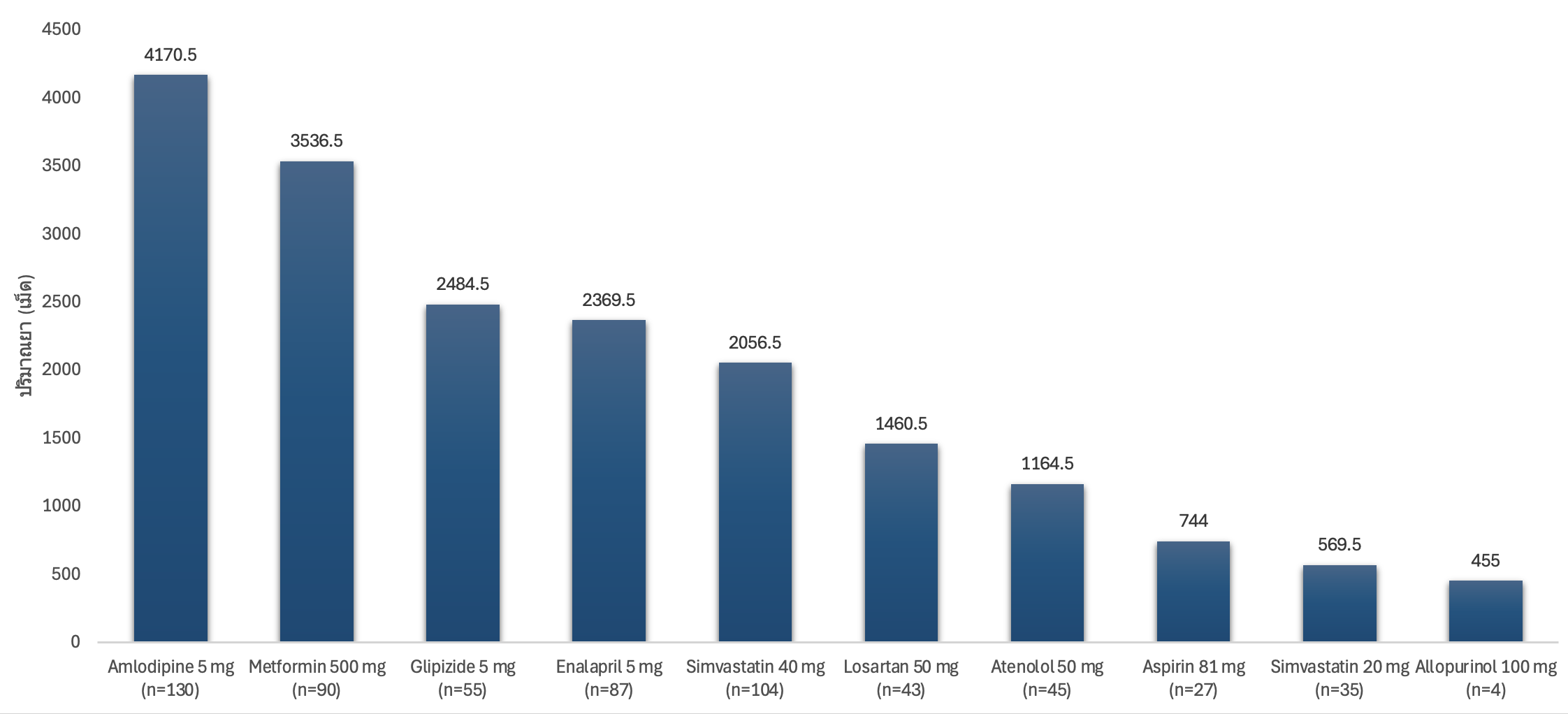
Leftover medicines among patients with non-communicable diseases (NCDs) are an important issue affecting Thailand’s public health system. This study aims to investigate the prevalence, quantity, value, and associated factors of leftover medicines among patients with NCDs in a community setting in Phayao Province. A cross-sectional observational study was conducted through home visits. Data was collected via structured interviews and analyzed using descriptive statistics and multivariable logistic regression. Among 361 participants, 89.8% had at least one item of leftover medicine, with a median of two items per person. The total amount of leftover pills was 21,534, with an estimated value of 18,340.4 baht. Amlodipine 5 mg has the highest quantity and value of leftover medication. The leading causes of leftover medicines were forgetting to take medications (55.6%) and receiving medicine exceeding the appointment interval (52.5%). Factors significantly associated with having leftover medicines for more than eight weeks included having multiple chronic conditions (adjusted odds ratio [aOR] 1.51; 95% confidence interval [CI]: 1.06–2.13), use of herbal or dietary supplements within the past six months (aOR 2.33; 95%CI: 1.01–5.34), and incorrect medication use (aOR 9.87; 95%CI: 2.37–41.04). While most patients practiced appropriate medicine management, such as returning leftover medicine to healthcare facilities, some exhibited risky behaviors, including sharing medicines with others and improper disposal. The findings highlight that multiple comorbidities, herbal product use, and non-compliance are key contributors to leftover medicine among patients with NCDs. Developing a screening system for at-risk patients, promoting medication adherence, establishing appropriate prescribing practices, and educating the public on proper medicine management are essential strategies to reduce the burden of leftover medicine and its negative impact on healthcare systems, economic resources, and the environment.
References
Geremew S, Ayenew W, Gebregeorgise DT, Habte BM. Prevalence of unused medications and determinants among the general public in Addis Ababa, Ethiopia. BMC Public Health. 2024;24(1). DOI: 10.1186/s12889-024-20645-z.
Tegegne AA, Mekasha YT, Girma M, Limenh LW, Yohannes L, Genet G, et al. Assessing the prevalence of unused medicines at home and associated factors: a community-based cross-sectional study. BMC Public Health. 2024;24(1). DOI: 10.1186/s12889-024-20847-5.
Gulchusak P. Study on the problem of leftover medications in diabetic patients at chronic disease clinic Ban Khwao Hospital, Chaiyaphum province. Chai Med J. 2022;42(1):66-74. [in Thai]
Punnapapaisan W, Kittiboonyakun P, Saramunee K. Designing the system for management of unused medicine in patients with diabetes mellitus by using root cause analysis framework. TJPP. 2018;2:300-14. [in Thai]
Taheri Soodejani M. Non-communicable diseases in the world over the past century: a secondary data analysis. Front Public Health. 2024;12. DOI: 10.3389/fpubh.2024.1436236.
Bhoothookngoen P, Sanchan N. Prevalence of noncommunicable diseases and social determinants of health in Thailand: Insights from public datasets. THJPH. 2024;54(2):918-36.
Ehrhart AL, Granek EF, Nielsen-Pincus M, Horn DA. Leftover drug disposal: Customer behavior, pharmacist recommendations, and obstacles to drug take-back box implementation. Waste Manag. 2020;118:416-25. DOI: 10.1016/j.wasman.2020.08.038.
Asmamaw G, Agedew T, Tesfaye B, Sasamo S, Gena S, Argeta M, et al. Prevalence of leftover medicines, disposal practices, and associated factors in Arba Minch Town, Southern Ethiopia. SAGE Open Med. 2023;11. DOI: 10.1177/20503121231158214.
Begum MM, Rivu SF, Hasan MMA, Nova TT, Rahman MM, Alim MA, et al. Disposal practices of unused and leftover medicines in the households of Dhaka Metropolis. Pharmacy (Basel). 2021;9(2). DOI: 10.3390/pharmacy9020103.
Srijuntrapun P, Maluangnon K. The management of unused and expired medications in Thai households: Influencing factors and prevailing practices. PLoS One. 2024;19. DOI: 10.1371/journal.pone.0309266.
Constantino VM, Fregonesi BM, Tonani KAA, Zagui GS, Toninato APC, Nonose E, et al. Storage and disposal of pharmaceuticals at home: a systematic review. Cien Saude Colet. 2020;25(2):585-94. DOI: 10.1590/1413-81232020252.10882018.
Tantipiwattanaskul K, Pongthananikorn S, Pimpong T, Nutprakong W, Pattoom T, Saengungsumalee S. Survey of hospital pharmacists’ opinions on current situation of unused medication problem. AMJ. 20237(2):381-401. [in Thai]
Poophalee T, Koonsawat C, Phuradchaphon T, Srisaknok T. Explanations and handling of unused medicines in patients with type 2 diabetes and hypertension: A case of a community at Ubon Ratchathani. TJPP. 2018;10(1):3-13. [in Thai]
World Health Organization. Adherence to long-term therapies: evidence for action [Internet]. Geneva: World Health Organization; 2003 [cited 2025 Jun 12]. Available from: https://apps.who.int/iris/handle/10665/42682.
Ministry of Public Health, Drug and Medical Supplies Information Center. Reference Price (Drugs) [Internet]. Nonthaburi: Ministry of Public Health, Drug and Medical Supplies Information Center;2024 [cited 2024 Feb 2]. Available from: https://dmsic.moph.go.th/index/drugsearch/3. [in Thai]
Ministry of Public Health, Drug and Medical Supplies Information Center. Normal Procurement Reference Price (Drugs) [Internet]. Nonthaburi: Ministry of Public Health, Drug and Medical Supplies Information Center; 2024. [cited 2024 Feb 2]. Available from: https://dmsic.moph.go.th/index/drugsearch/1. [in Thai]
Lemeshow S, Jr DWH, Klar J, Lwanga SK. Stanley Lemeshow, David W Hosmer Jr, Janelle Klar and Stephen K. Lwanga. Adequacy of sample size in health studies; 1990. P. 42.
Peduzzi P, Concato J, Kemper E, Holford TR, Feinstein AR. A simulation study of the number of events per variable in logistic regression analysis. J Clin Epidemiol. 1996;49(12):1373-9. DOI: 10.1016/s0895-4356(96)00236-3.
Diabetes Association of Thailand. Clinical practice guideline for diabetes mellitus 2023. [Internet]. [cited 2025 Jun 19]. Available from: https://www.dmthai.org/new/index.php/sara-khwam-ru/sahrab-bukhkhl-thawpi/diabetes-book/naewthang-wech-ptibati-sahrab-rokh-bea-hwan-2566. [in Thai]
Royal College of Physicians of Thailand. 2024 RCPT clinical practice guideline on management of dyslipidemia for atherosclerotic cardiovascular disease prevention. 2nd ed. Bangkok: Krungthep Wechsarn; 2024. [in Thai]
Thai Hypertension Society. 2019 Thai guidelines on the treatment of hypertension. Chiang Mai: Tric Think; 2019. [in Thai]
AlabdulKader A, Alsheikh S, Alghamdi R, AlHarkan K, AlShamlan N, Alqahtani H, et al. Association between multi-morbidities and polypharmacy among older adults at an academic medical center in Saudi Arabia. Med Arch. 2023;77(6):471-6. DOI: 10.5455/medarh.2023.77.471-476.
Almodóvar AS, Nahata MC. Associations between chronic disease, polypharmacy, and medication-related problems among medicare beneficiaries. J Manag Care Spec Pharm. 2019;25(5):573-7. DOI: 10.18553/jmcp.2019.25.5.573.
Ananchaisarp T, Rungruang S, Theerakulpisut S, Kamsakul P, Nilbupha N, Chansawangphop N, et al. Usage of herbal medicines among the elderly in a primary care unit in Hat Yai, Songkhla province, Thailand. Asian Biomed (Res Rev News). 2021;15(1):35-42. DOI: 10.2478/abm-2020-0005.
Shahjalal M, Chakma SK, Ahmed T, Yasmin I, Mahumud RA, Hossain A. Prevalence and determinants of using complementary and alternative medicine for the treatment of chronic illnesses: A multicenter study in Bangladesh. PLoS One. 2022;17(1):e0262221.
DOI: 10.1371/journal.pone.0262221.
Wongkalasin S, Promasatayaprot V, Chaiyasong S. Causes and disposal practices of leftover medicines among diabetes mellitus patients, Thailand. JSJU. 2021;56(6):370-8. DOI: 10.35741/issn.0258-2724.56.6.31.
Downloads
Published
How to Cite
Issue
Section
License
Copyright (c) 2025 University of Phayao

This work is licensed under a Creative Commons Attribution-NonCommercial-NoDerivatives 4.0 International License.
ผู้นิพนธ์ต้องรับผิดชอบข้อความในบทนิพนธ์ของตน มหาวิทยาลัยพะเยาไม่จำเป็นต้องเห็นด้วยกับบทความที่ตีพิมพ์เสมอไป ผู้สนใจสามารถคัดลอก และนำไปใช้ได้ แต่จะต้องขออนุมัติเจ้าของ และได้รับการอนุมัติเป็นลายลักษณ์อักษรก่อน พร้อมกับมีการอ้างอิงและกล่าวคำขอบคุณให้ถูกต้องด้วย
The authors are themselves responsible for their contents. Signed articles may not always reflect the opinion of University of Phayao. The articles can be reproduced and reprinted, provided that permission is given by the authors and acknowledgement must be given.