Risk factors for Necrotizing enterocolitis in very low birth weight infants at Nongkhai Hospital
Keywords:
Necrotizing enterocolitis, Preterm infants, Very low birth weightAbstract
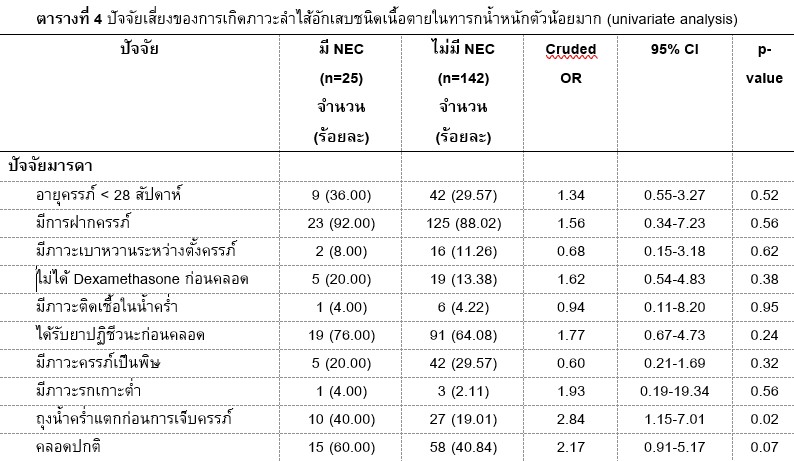
Necrotizing enterocolitis (NEC) is a critical gastrointestinal emergency in neonates, particularly those born preterm, with incidence varying across populations. Prematurity and low birth weight are well established major risk factors, while additional contributors reported in previous studies include perinatal hypoxia, formula feeding, apnea, central venous catheterization, and polycythemia. This study aimed to identify risk factors associated with NEC in very low birth weight (VLBW) infants (birth weight < 1,500 g) admitted to the neonatal intensive care unit (NICU) at Nong Khai Hospital. A total of 167 VLBW infants were included, of whom 25 developed NEC. Data were analyzed using univariate analysis, with variables showing p<0.20 further evaluated via multivariate logistic regression; statistical significance was set at p<0.05. Univariate analysis identified seven potential risk factors: premature rupture of membranes, sepsis, ventilator- associated pneumonia, umbilical arterial catheterization, blood transfusion, mechanical ventilation, and patent ductus arteriosus. Multivariate analysis revealed that only blood transfusion was independently associated with NEC (adjusted OR 6.13, 95% CI: 1.23–30.47, p=0.01). These findings underscored the importance of careful evaluation of transfusion requirements in VLBW infants and vigilant monitoring for NEC following each transfusion or administration of blood components.
References
Llanos AR, Moss ME, Pinzòn MC, Dye T, Sinkin RA, Kendig JW. Epidemiology of neonatal necrotizing enterocolitis: a population-based study. Paediatr Perinat Epidemiol. 2002;16(4):342-9.
Holman RC, Stoll BJ, Curns AT, Yorita KL, Steiner CA, Schonberger LB. Necrotizing enterocolitis hospitalizations among neonates in the United States. Paediatr Perinat Epidemiol. 2006;20(6):498-506.
Sankaran K, Puckett B, Lee DS, Seshia M, Boulton J, Qiu Z, Lee SK; Variations in incidence of necrotizing enterocolitis in Canadian neonatal intensive care units. J Pediatr Gastroenterol Nutr. 2004;39(4):366-72.
Yee WH, Soraisham AS, Shah VS, Aziz K, Yoon W, Lee SK, et al. Incidence and timing of presentation of necrotizing enterocolitis in preterm infants. Pediatrics. 2012;129(2):e298-304.
Gephart SM, McGrath JM, Effken JA, Halpern MD. Necrotizing Enterocolitis Risk. Adv Neonatal Care. 2012;12:77-89.
Llanos AR, Moss ME, Pinzòn MC, Dye T, Sinkin RA, Kendig JW. Epidemiology of neonatal necrotizing enterocolitis: a population-based study. Paediatr Perinat Epidemiol. 2002;16(4):342-9.
Carter BM, Diane Davis H, FAAN, Tanaka D, Schwartz T. The relationship between black race, Maternal infection and NEC in the preterm infant. Newborn and Infant Nursing Reviews. 2013;13(4):166-170.
Dominguez KM, Moss RL. Necrotizing enterocolitis. Clin Perinatol. 2012;39(2):387-401.
Fox TP, Godavitarne C. What really causes necrotizing enterocolitis?. ISRN Gastroenterol. 2012:2012;628317. doi: 10.5402/2012/628317.
Samuels N, van de Graaf RA, de Jonge RCJ, Reiss IKM, Vermeulen MJ. Risk factors for necrotizing enterocolitis in neonates: a systematic review of prognostic studies. BMC Pediatr. 2017;17(1):105.
Lu CY, Liu KF, Qiao GX, Luo Y, Cheng HQ, DU SZ. Risk factors for necrotizing enterocolitis in preterm infants: a Meta analysis. Zhongguo Dang Dai Er Ke Za Zhi. 2022;24(8):908-916.
Sangkhathat S, Kunapermsiri T, Leksrisakun P, Laohapensang M. Gastric perforation in very low birth weight infants following indomethacin administration: 2 case reports. Siriraj Hosp Gaz. 2000;52(7):492-496.
Berman L, Moss RL. Necrotizing enterocolitis: an update. Semin Fetal Neonatal Med. 2011; 16(3):145-50.
Alsaied A, Islam N, Thalib L. Global incidence of Necrotizing Enterocolitis: a systematic review and Meta-analysis. BMC Pediatr. 2020;20(1):344.
Walsh MC, Kliegman RM. Necrotizing enterocolitis: treatment based on staging criteria. Pediatr Clin North Am. 1986;33(1):179-201.
Stout G, Lambert DK, Baer VL, Gordon PV, Henry E, Wiedmeier SE, et al. Necrotizing enterocolitis during the first week of life: a multicentered case-control and cohort comparison study. J Perinatol. 2008;28(8):556-60.
Patel RM, Knezevic A, Shenvi N, Hinkes M, Keene S, Roback JD, et al. Association of red blood cell transfusion, anemia, and necrotizing enterocolitis in very low-birth-weight infants. JAMA. 2016;315(9):889-97. DOI: 10.1001/jama.2016.1204.
MohanKumar K, Namachivayam K, Song T, Cha JB, Slate A, Hendrickson JE, et al. A murine neonatal model of necrotizing enterocolitis caused by anemia and red blood cell transfusions. Nat Commun. 2019;10(1):3494 DOI: 10.1038/s41467-019-11199-5.
Gordon PV, Swanson JR, Attridge JT, Clark R. Emerging trends in acquired neonatal intestinal disease: Is it time to abandon Bell’s criteria?. J Perinatol. 2007;27(11):661-71. DOI: 10.1038/sj.jp.7211782.
Been JV, Lievense S, Zimmermann LJ, Kramer BW, Wolfs TG. Chorioamnionitis as a risk factor for necrotizing enterocolitis: a systematic review and meta-analysis. J Pediatr. 2013;162(2):236–242.
Gunasekaran V, Rodriguez RJ, Porcelli P, Jawale N, Shenberger J, Garg PM. Clinical impact of the PDA and its management on outcomes of preterm infants with NEC: A review. Am J Perinatol. 2025;10 10.1055/a-2685-2169. doi: 10.1055/a-2685-2169.
Khashu M, Dame C, Lavoie PM, De Plaen IG, Garg PM, Sampath V, et al. Current Understanding of Transfusion-associated Necrotizing Enterocolitis: Review of Clinical and Experimental Studies and a Call for More Definitive Evidence. Newborn (Clarksville). 2022;1(1):201-8.
Downloads
Published
How to Cite
Issue
Section
License
Copyright (c) 2025 University of Phayao

This work is licensed under a Creative Commons Attribution-NonCommercial-NoDerivatives 4.0 International License.
ผู้นิพนธ์ต้องรับผิดชอบข้อความในบทนิพนธ์ของตน มหาวิทยาลัยพะเยาไม่จำเป็นต้องเห็นด้วยกับบทความที่ตีพิมพ์เสมอไป ผู้สนใจสามารถคัดลอก และนำไปใช้ได้ แต่จะต้องขออนุมัติเจ้าของ และได้รับการอนุมัติเป็นลายลักษณ์อักษรก่อน พร้อมกับมีการอ้างอิงและกล่าวคำขอบคุณให้ถูกต้องด้วย
The authors are themselves responsible for their contents. Signed articles may not always reflect the opinion of University of Phayao. The articles can be reproduced and reprinted, provided that permission is given by the authors and acknowledgement must be given.