Formulation development and satisfaction assessment of herbal steam inhalation recipe: A pilot study
Keywords:
Powder, Tablet, Herbal formulation, Herbal steam inhalationAbstract
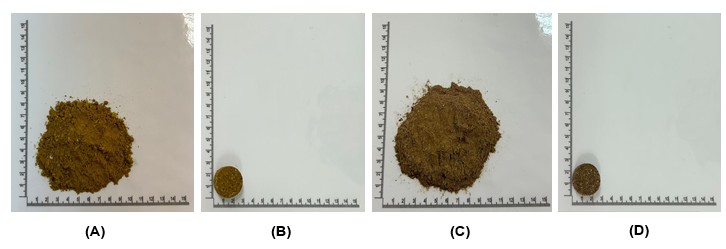
Allergic rhinitis remains a chronic health problem. Despite the availability of effective treatments, there is a growing trend among patients to focus on easily accessible and safe herbal products. This pilot study aimed to develop and compare the formulation and physical characteristics of the herbal steam inhalation recipe in tablet and powder forms, and to evaluate the satisfaction among volunteers. Two herbal recipe formulations, each consisting of four sub-formulations with varying ratios of herbal powder and binder (Polyvinylpyrrolidone-K90: PVP-K90), were prepared. Stability was assessed through visual inspection, weight variation, and disintegration time. Among the tested formulations, herbal steam inhalation recipe 1 (formula 4: 75% (w/w) of herbal powder, 25% (w/w) of an 8% (w/w) PVP-K90 solution) and herbal steam inhalation recipe 2 (formula 2: 55% (w/w) of herbal powder, 45% (w/w) of an 8% (w/w) PVP-K90 solution) demonstrated optimal tablet formation, showing compact structures without cracks or moisture. Both formulations met pharmacopeial standards for disintegration time and tested positive for flavonoids and alkaloids. Satisfaction was evaluated in 30 volunteers using the Wilcoxon Signed Ranks Test at a significance level of p-value < 0.05. Results indicated that herbal steam inhalation recipe 1 (formula 4) in tablet form was rated significantly higher than its powder counterpart in terms of usability and convenience. Similarly, herbal steam inhalation recipe 2 (formula 2) in tablet form achieved significantly higher scores for usability, convenience, and overall satisfaction compared with the powder form. In conclusion, the study demonstrates that tableted herbal steam inhalation recipe formulations provide superior physical stability and greater user acceptance than powdered preparations, supporting the potential for developing the formulation into tablet dosage forms that are of high quality, convenient for healthcare facility and daily use.
References
Wise SK, Damask C, Roland LT, Ebert C, Levy JM, Lin S, et al. International consensus statement on allergy and rhinology: Allergic rhinitis – 2023. Int Forum Allergy Rhinol. 2023;13(4):293-859.
Savouré M, Bousquet J, Jaakkola JJK, Jaakkola MS, Jacquemin B, Nadif R. Worldwide prevalence of rhinitis in adults: A review of definitions and temporal evolution. Clin Transl Allergy. 2022;12(3):e12130.
Min YG. The pathophysiology, diagnosis and treatment of allergic rhinitis. Allergy Asthma Immunol Res. 2010;2(2):65-76.
Brožek JL, Bousquet J, Agache I, Agarwal A, Bachert C, Bosnic-Anticevich S, et al. Allergic Rhinitis and its Impact on Asthma (ARIA) guidelines-2016 revision. J Allergy Clin Immunol. 2017;140(4):950–8.
Helman SN, Barrow E, Edwards T, DelGaudio JM, Levy JM, Wise SK. The role of allergic rhinitis in chronic rhinosinusitis. Immunol Allergy Clin North Am. 2020;40(2):201-14.
Reidy PM, Dworkin JP, Krouse JH. Laryngeal effects of antigen stimulation challenge with perennial allergen Dermatophagoides pteronyssinus. Otolaryngol Head Neck Surg. 2003;128(4):455-62.
Department of Thai Traditional and Alternative Medicine. Manual of disease group codes, symptoms and procedures in Thai traditional medicine [Internet]. Nonthaburi: Ministry of Public Health; 2019 [cited 2025 Aug 26]. Available from: https://www.dtam.moph.go.th/wp-content/uploads/2023/11/DL0003-15062558-ICD-10-TM.pdf (In Thai)
Chaiprakaiwan S, Makhon N, Samerwong A, Laysing J. Relieving symptoms of Long COVID with Thai traditional medicine and Ocimum tenuiflorum L. Multidiscip J Health. 2022;4(2):1–14. (In Thai)
Tungsukruthai P, Nootim P, Worakunphanich W, Tabtong N, Pawa KK. Feasibility of herbal steam bath on nasal allergic rhinitis symptoms: a randomized controlled trial. J Tradit Thai Med Res. 2020;6(1):76. (In Thai)
Pharitatham P. Herbal medicine for symptomatic treatment from head to toe. 1st ed. Bangkok: Ton Tham Publishing; 2016. (In Thai)
Kurakula M, Rao GSNK. Pharmaceutical assessment of polyvinylpyrrolidone (PVP): As excipient from conventional to controlled delivery systems with a spotlight on COVID-19 inhibition. J Drug Deliv Sci Technol. 2020;60:102046.
Ministry of Public Health. Guideline for implementing relaxation measures of businesses and activities to prevent the spread of COVID-19. 1st ed. Bangkok: Aksorn Graphic and Design Publishing; 2020. (In Thai)
Asawahame C, Sutjarittangtham K, Eitssayeam S, Tragoolpua Y, Sirithunyalug B, Sirithunyalug J. Antibacterial activity and inhibition of adherence of Streptococcus mutans by propolis electrospun fibers. AAPS Pharm Sci Tech. 2015;16(1):182-191.
Siripornkitti W. Production and quality of fermented fish powder and fermented fish block. Annual Academic Conference 2019. 2020;3(6):6. (In Thai)
Sombun J. Herbal products part 2: physical standards of herbal tablets [Internet]. Nakhon Pathom: Faculty of Pharmacy, Mahidol University; 2013 [cited 2025 Aug 26]. Available from: https://pharmacy.mahidol.ac.th/th/knowledge/article/154. (In Thai)
Hamadnalla HMY, Hamad MAB, Adam AAI. Phytochemical investigation, antimicrobial, antioxidant and anti-diabetic potential of Guiera senegalensis leaves extracts. Op Acc J Bio Sci & Res. 2020;1(3):1-4.
Maheshwaran L, Nadarajah L, Senadeera SP, Ranaweera CB, Chandana AK, Pathirana RN. Phytochemical testing methodologies and principles for preliminary screening/qualitative testing. APRJ. 2024;12(5):11-38.
Sánchez-Viesca F, Gómez R. On the chemistry of Sonnenschein test for strychnine. Am. J. Chem. 2021;11(3):49-51.
Hertzog MA. Considerations in determining sample size for pilot studies. Res Nurs Health. 2008;31(2):180-91.
Leelatheeraphat K. Consumer satisfaction with Kao Pee Nong Thai desserts [Independent study]. Bangkok: Krirk University; 2013. (In Thai)
Rungjindarat N, Jaiyai T, Sinthupachee A, Phansaita N. Analyzing food and beverages through sensory evaluation for acceptance testing: concepts, experimental planning, and selection of appropriate statistics. Dusit Thani Coll J. 2023;17(3):190-204. (In Thai)
Wu Y, Zhang F, Kuang D, Li D, Yan J, Yang J, et al. Efficacy of botanical lozenges in the treatment of chronic pharyngitis: a randomized controlled trial. Front Pharmacol. 2024;15:1162883.
Kafedjiiski K. Effect of binder type on physical and in vitro properties of high dose inosine acedoben dimepranol tablets. Pharmacia. 2022;69(4):947-53.
Appelhaus J, Steffens KE, Wagner KG. Effect of liquid load level and binder type on the tabletability of mesoporous silica based liquisolids. AAPS PharmSciTech. 2024;25(8):246.
Teodorescu M, Bercea M, Morariu S. Biomaterials of PVA and PVP in medical and pharmaceutical applications: Perspectives and challenges. Biotechnol Adv. 2019;37(1):109-131.
Frank S, Capriotti J, Brown SM, Tessema B. Povidone-Iodine Use in Sinonasal and Oral Cavities: A Review of Safety in the COVID-19 Era. Ear Nose Throat J. 2020;99(9):586-593.
The International Pharmacopoeia. 3rd ed. Vol. 5, Tests and general requirements for dosage forms: Quality specifications for pharmaceutical substances and tablets. Geneva: World Health Organization; 2003.
The United States Pharmacopeia 35 / The National Formulary 30. Rockville (MD): The United States Pharmacopeial Convention; 2012.
United States Pharmacopeial Convention. USP-NF 2091: Weight Variation of Dietary Supplements. Scribd; [cited 2025 Dec 25]. Available from: https://www.scribd.com/document/877119850/USP-NF-2091-Weight-Variation-of-Dietary-Supplements.
Windarsih A, Indrianingsih AW, Suryani R, Wiyono T, Noviana E, Darsih C, et al. Evaluation of the antioxidant, antidiabetic, and antibacterial activity of Curcuma domestica, Zingiber officinale, Alpinia galanga, Curcuma xanthorrhiza, and Kaempferia galanga concurrent with its metabolite’s constituent analysis. J Food Sci Technol. 2024;61(5):1653-63.
Jikah AN, Edo GI. Turmeric (Curcuma longa): an insight into its food applications, phytochemistry and pharmacological properties. Vegetos. 2025;38(3):845-66.
Ratseewo J, Chumroenphat T, Li H, Siriamornpun S. Changes in chemical composition, volatile compound, and bioactive compounds retention in shallots (Allium ascalonicum L.) under different drying methods. Food Chem X. 2025;27:102419.
Kiełtyka-Dadasiewicz A, Esteban J, Jabłońska-Trypuć A. Antiviral, antibacterial, antifungal, and anticancer activity of plant materials derived from Cymbopogon citratus (DC.) Stapf Species. Pharmaceuticals. 2024;17(6):705.
Costa G, Gonzalez-Manzano S, Gonzalez-Paramas A, Figueiredo IV, Santos-Buelga C, Batista MT. Flavan hetero-dimers in the Cymbopogon citratus infusion tannin fraction and their contribution to the antioxidant activity. Food Funct. 2015;6(3):932-7.
Ke X, Chen Z, Wang X, Kang H, Hong S. Quercetin improves the imbalance of Th1/Th2 cells and Treg/Th17 cells to attenuate allergic rhinitis. Autoimmunity. 2023;56(1):2189133.
Yamada S, Shirai M, Inaba Y, Takara T. Effects of repeated oral intake of a quercetin-containing supplement on allergic reaction: a randomized, placebo-controlled, double-blind parallel-group study. Eur Rev Med Pharmacol Sci. 2022;26(12):4331-45.
Shah AJ, Gilani AH. Bronchodilatory effect of Acorus calamus (Linn.) is mediated through multiple pathways. J Ethnopharmacol. 2010;131(2):471–7.
Audu J, Mahmood F, Lawa B. Protective effects of crude and alkaloidal extracts of Tamarindus indica against acute inflammation and nociception in rats. J Acute Dis. 2017;6(2):78–81.
Maryuni DR, Prameswari DA, Astari SDS, Permata S. Identification of active compounds in red onion (Allium ascalonicum L.) peel extract by LC-ESI-QTOF-MS/MS and determination of its antioxidant activity. J Teknol Hasil Pertanian. 2022;15(1):20-33.
Downloads
Published
How to Cite
Issue
Section
License
Copyright (c) 2025 University of Phayao

This work is licensed under a Creative Commons Attribution-NonCommercial-NoDerivatives 4.0 International License.
ผู้นิพนธ์ต้องรับผิดชอบข้อความในบทนิพนธ์ของตน มหาวิทยาลัยพะเยาไม่จำเป็นต้องเห็นด้วยกับบทความที่ตีพิมพ์เสมอไป ผู้สนใจสามารถคัดลอก และนำไปใช้ได้ แต่จะต้องขออนุมัติเจ้าของ และได้รับการอนุมัติเป็นลายลักษณ์อักษรก่อน พร้อมกับมีการอ้างอิงและกล่าวคำขอบคุณให้ถูกต้องด้วย
The authors are themselves responsible for their contents. Signed articles may not always reflect the opinion of University of Phayao. The articles can be reproduced and reprinted, provided that permission is given by the authors and acknowledgement must be given.