Ecological determinants affecting the occurrence of leptospirosis in Trang
Keywords:
Ecology, Determinants, LeptospirosisAbstract
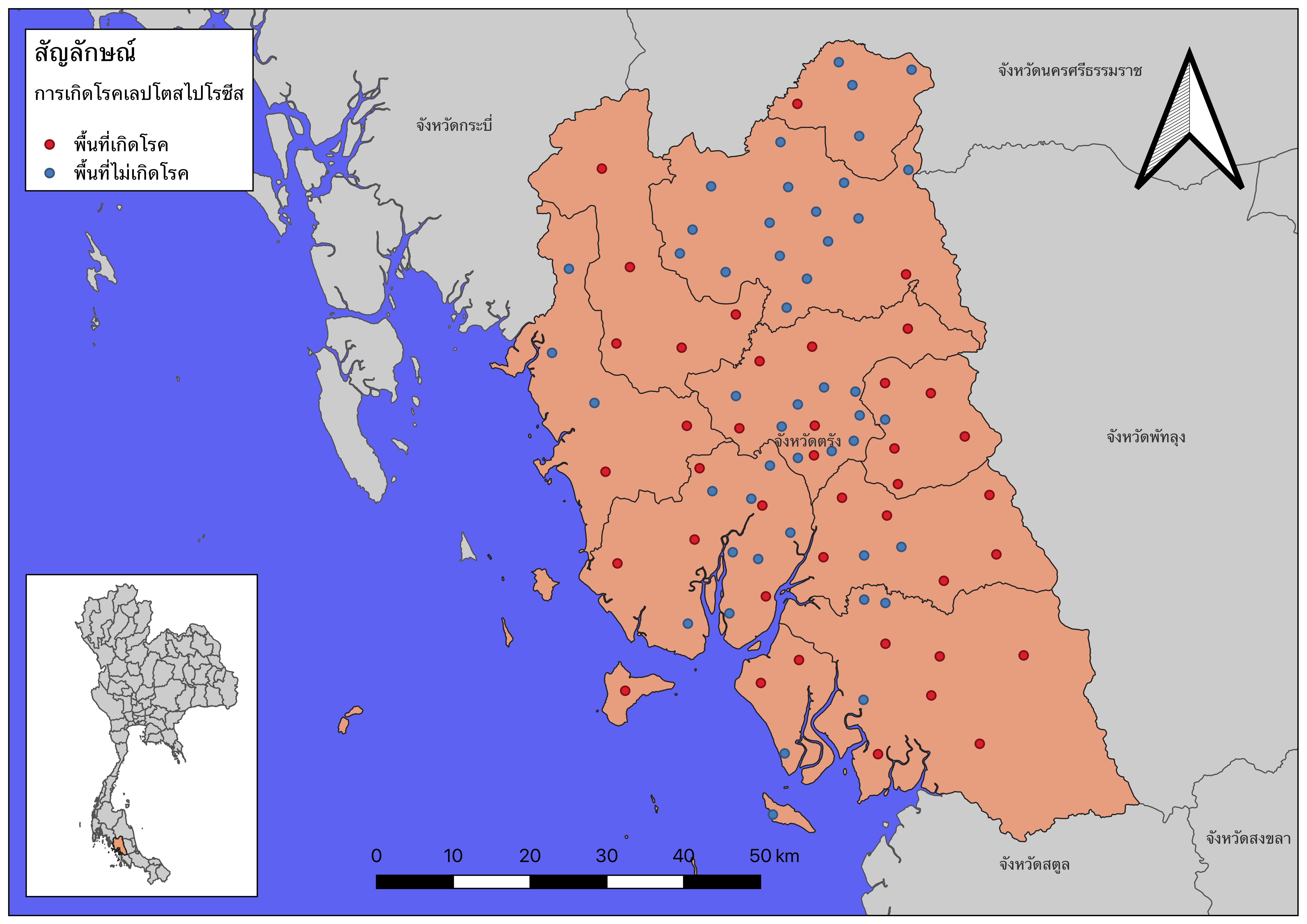
This study is an ecological study aimed to examine the ecological determinants influencing the occurrence of leptospirosis in Trang Province, Thailand. Secondary data on reported leptospirosis cases from 2017 to 2023 were obtained from disease surveillance reports of the Trang Provincial Public Health Office, 2017 to 2023. The ecological variables included average temperature, average rainfall, elevation, relative humidity, soil pH, and population density. The data were analyzed using binary logistic regression with the backward stepwise technique. The results showed that relative humidity (OR = 1.407, 95% CI: 1.135–1.744, p = 0.002) and average rainfall (OR = 1.029, 95% CI: 1.009–1.048, p = 0.003) were significantly associated with the occurrence of leptospirosis in Trang Province. In contrast, average temperature, elevation, soil pH, and population density were not significantly related to the occurrence of the disease. The findings indicate that certain ecological factors, particularly humidity and rainfall, play an important role in the distribution of leptospirosis in Trang Province. This information will be essential for supporting the planning of more effective disease surveillance, prevention, and control measures in the area.
References
Department of Disease Control, Ministry of Public Health, Thailand. Leptospirosis details [Internet]. Nonthaburi: DDC; 2024 [cited 2024 Jan 20]. Available from: https://ddc.moph.go.th/disease_detail.php?d=16. (in Thai)
Department of Disease Control, Ministry of Public Health, Thailand. 506 disease surveillance reporting system [Internet]. Nonthaburi: DDC; 2024 [cited 2024 Jan 20]. Available from: http://doe1.moph.go.th/surdata/disease.php?dcontent=old&ds=43. (in Thai)
Trang Provincial Public Health Office. Epidemiological surveillance report 506, 2023-2024. Trang: Trang Provincial Public Health Office; 2024. (in Thai)
Trang Provincial Office. Summary of Trang Province [Internet]. Trang: Trang Provincial Office; 2021 [cited 2023 Sep 1]. Available from: https://ww2.trang.go.th/files/com_news_devpro1/2021-04_31cf1c2d3822032.pdf. (in Thai)
Zakharova OI, Korennoy FI, Toropova NN, Burova OA, Blokhin AA. Environmental risk of leptospirosis in animals: The case of the republic of Sakha (Yakutia), Russian Federation. Pathogens. 2020; 23;9(6):504.
Mohammadinia A, Saeidian B, Pradhan B, Ghaemi Z. Prediction mapping of human leptospirosis using ANN, GWR, SVM and GLM approaches. BMC Infect Dis. 2019;13;19(1):971.
Zakharova OI, Korennoy FI, Iashin IV, Toropova NN, Gogin AE, Kolbasov DV, et al. Ecological and socio-economic determinants of livestock animal leptospirosis in the Russian Arctic. Front Vet Sci. 2021;8:658675.
Centers for Disease Control and Prevention. Principles of epidemiology in public health practice (3rd edition), lesson 1, section 11: epidemic disease occurrence [Internet]. Atlanta: U.S. Department of Health and Human Services; 2012 [cited 2024 Jan 20]. Available from: https://archive.cdc.gov/#/details?url=https://www.cdc.gov/csels/dsepd/ss1978/lesson1/section11.html.
Rodríguez Valero N, Moriñigo HM, Martínez MJ, Peiró A, Oliveira I, Bodro M, et al. Leptospirosis in Spanish travelers returning from Chiang Mai: a case series. Travel Med Infect Dis. 2018;23:77-9.
Fick SE, Hijmans RJ. WorldClim 2: new 1 km spatial resolution climate surfaces for global land areas. Int J Climatol. 2017;37(12):4302-15.
Cerasoli F, D’Alessandro P, Biondi M. Worldclim 2.1 versus Worldclim 1.4: climatic niche and grid resolution affect between version mismatches in habitat suitability models predictions across Europe. Ecol Evol. 2022;12(2):e8430.
Bucklin DN, Basille M, Romañach SS, Brandt LA, Mazzotti FJ, Watling JI. Considerations for building climate based species distribution models. USGS / University of Florida; 2016. Report No.: WEC375/UW420.
Kaiyawan Y. Principles and application of logistic regression analysis for research. Rajamangala University of Technology Srivijaya Research Journal. 2012;4(1):1-12. (in Thai)
Wichapeng S, Chadsuthi S, Modchang C. Impact of rainfall on the transmission of leptospirosis in Si Sa Ket, Thailand. J Phys Conf Ser. 2021;1719:012024.
Phosri A. Effects of rainfall on human leptospirosis in Thailand: evidence of multi-province study using distributed lag non-linear model. Stoch Environ Res Risk Assess. 2022;36(12):4119–32.
Joshi YP, Kim EH, Cheong HK. The influence of climatic factors on the development of hemorrhagic fever with renal syndrome and leptospirosis during the peak season in Korea: an ecologic study. BMC Infect Dis. 2017;17(1):406.
Sumi A, Telan EFO, Chagan-Yasutan H, Piolo MB, Hattori T, Kobayashi N. Effect of temperature, relative humidity and rainfall on dengue fever and leptospirosis infections in Manila, the Philippines. Epidemiol Infect. 2017;145(1):78–86.
Hacker KP, Sacramento GA, Cruz JS, de Oliveira D, Nery N Jr, Lindow JC, et al. Influence of rainfall on Leptospira infection and disease in a tropical urban setting, Brazil. Emerg Infect Dis. 2020;26(2):311-4.
Sutiningsih D, Sari DP, Permatasari CD, Azzahra NA, Rodriguez-Morales AJ, Yuliawati S, et al. Geospatial analysis of abiotic and biotic conditions associated with leptospirosis in the Klaten Regency, Central Java, Indonesia. Trop Med Infect Dis. 2024;9(10):225.
Kaewduanglek S, Wichapeng S, Chatusut S. Forecasting leptospirosis incidence by season using meteorological factors in Thailand, 2010-2018. J Public Health Acad. 2021;30(5):802-13. (in Thai)
Hinjoy S, Kongyu S, Doung Ngern P, Doungchawee G, Colombe SD, Tsukayama R, et al. Environmental and behavioral risk factors for severe leptospirosis in Thailand. Trop Med Infect Dis. 2019;4(2):79.
Luenam A. Spatial correlation analysis of leptospirosis and its association with remote sensing data in Thailand, 2013-2015 [thesis/dissertation]. Bangkok: Huachiew Chalermprakiet University; 2020. (in Thai)
Zhao J, Liao J, Huang X, Zhao J, Wang Y, Ren J, et al. Mapping risk of leptospirosis in China using environmental and socioeconomic data. BMC Infect Dis. 2016;16:343.
Silva AEP, Conceição GMS, Chiaravalloti Neto F. Spatial analysis and factors associated with leptospirosis in Santa Catarina, Brazil, 2001-2015. Rev Soc Bras Med Trop. 2020;53:e20200466.
Maulana M, Stefani D, Matahari R, Wulandari WK. Environmental risk factors of leptospirosis: systematic review. Epidemiol Soc Health Rev. 2024;6(1):1-12.
Galan DI, Roess AA, Pereira SVC, Schneider MC. Epidemiology of human leptospirosis in urban and rural areas of Brazil, 2000-2015. PLoS One. 2021;16(3):e0247763.
Viroj J, Claude J, Lajaunie C, Cappelle J, Kritiyakan A, Thuainan P, et al. Agro-environmental determinants of leptospirosis: a retrospective spatiotemporal analysis (2004-2014) in Mahasarakham Province (Thailand). Trop Med Infect Dis. 2021;6(3):115.
Chadsuthi S, Chalvet-Monfray K, Geawduanglek S, Wongnak P, Cappelle J. Spatial-temporal patterns and risk factors for human leptospirosis in Thailand, 2012-2018. Sci Rep. 2022;12(1):5066.
Luenam A, Puttanapong N. Modelling and analyzing spatial clusters of leptospirosis based on satellite-generated measurements of environmental factors in Thailand during 2013-2015. Geospat Health. 2020;15(2):856.
Downloads
Published
How to Cite
Issue
Section
License
Copyright (c) 2026 University of Phayao

This work is licensed under a Creative Commons Attribution-NonCommercial-NoDerivatives 4.0 International License.
ผู้นิพนธ์ต้องรับผิดชอบข้อความในบทนิพนธ์ของตน มหาวิทยาลัยพะเยาไม่จำเป็นต้องเห็นด้วยกับบทความที่ตีพิมพ์เสมอไป ผู้สนใจสามารถคัดลอก และนำไปใช้ได้ แต่จะต้องขออนุมัติเจ้าของ และได้รับการอนุมัติเป็นลายลักษณ์อักษรก่อน พร้อมกับมีการอ้างอิงและกล่าวคำขอบคุณให้ถูกต้องด้วย
The authors are themselves responsible for their contents. Signed articles may not always reflect the opinion of University of Phayao. The articles can be reproduced and reprinted, provided that permission is given by the authors and acknowledgement must be given.