ปัจจัยกำหนดทางนิเวศวิทยาที่มีผลต่อการเกิดโรคเลปโตสไปโรซีสในจังหวัดตรัง
คำสำคัญ:
นิเวศวิทยา, ปัจจัยกำหนด, โรคเลปโตสไปโรซีสบทคัดย่อ
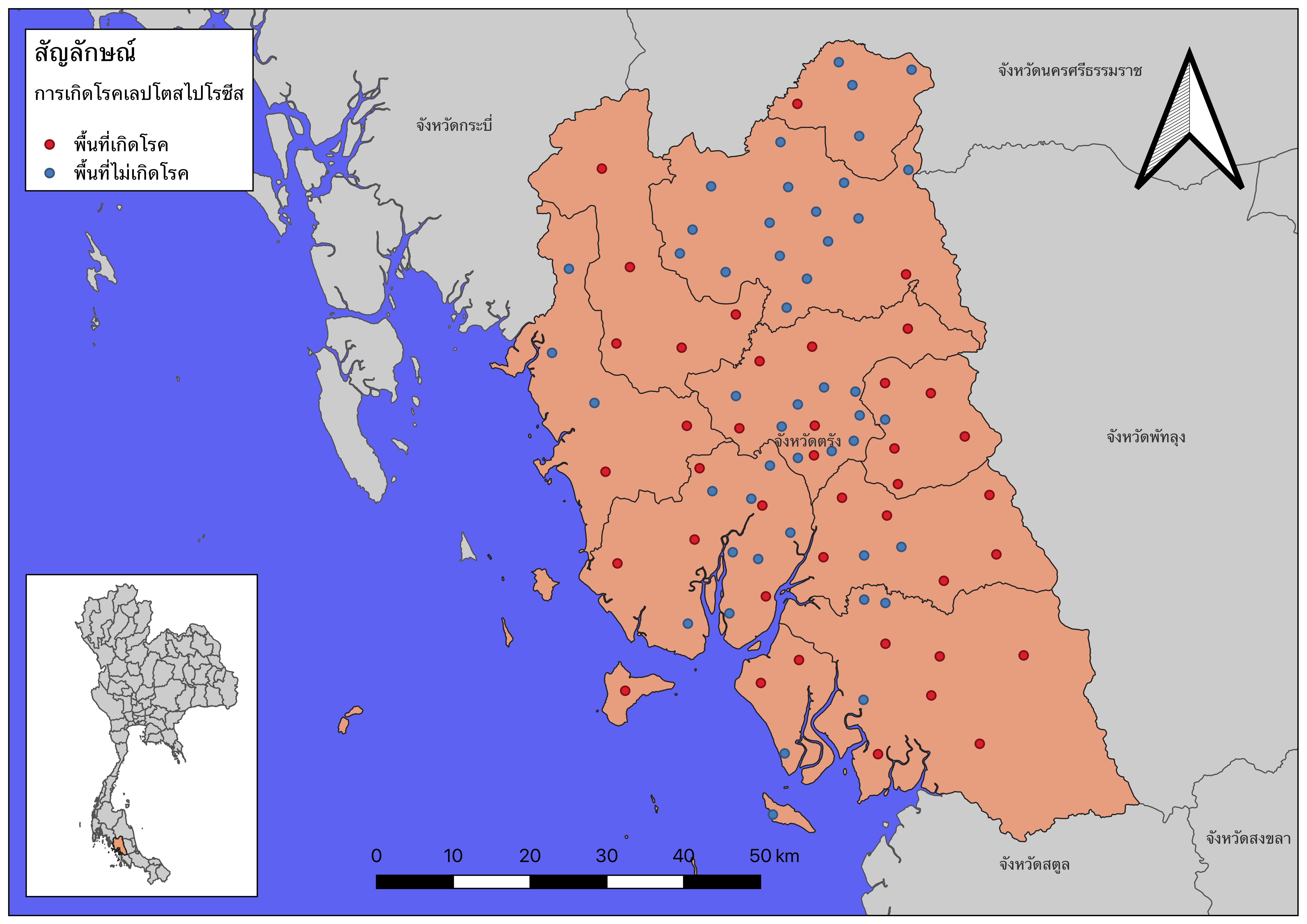
การศึกษานี้ เป็นการศึกษาเชิงนิเวศวิทยา มีวัตถุประสงค์เพื่อศึกษาปัจจัยกำหนดทางนิเวศวิทยาที่มีผลต่อการเกิดโรคเลปโตสไปโรซีสในจังหวัดตรัง โดยใช้ข้อมูลทุติยภูมิของผู้ป่วยโรคเลปโตสไปโรซีส ในปี 2560-2566 จากรายงานการเฝ้าระวังโรคของสำนักงานสาธารณสุขจังหวัดตรัง ปี 2560–2566 ตัวแปรทางนิเวศวิทยาที่ใช้ในการศึกษา ได้แก่ อุณหภูมิเฉลี่ย ปริมาณน้ำฝนเฉลี่ย ระดับความสูง ความชื้นสัมพัทธ์ ค่า pH ของดิน และความหนาแน่นของประชากร วิเคราะห์ด้วยสถิติการถดถอยโลจีสติกทวินาม (binary logistic regression) ด้วยเทคนิค Backward stepwise ผลการศึกษา พบว่าปัจจัยที่มีความสัมพันธ์กับการเกิดโรคเลปโตสไปโรซีสในจังหวัดตรัง อย่างมีนัยสำคัญทางสถิติ ได้แก่ ความชื้นสัมพัทธ์ (OR = 1.407, 95% CI: 1.135–1.744, p = 0.002) และปริมาณน้ำฝนเฉลี่ย (OR = 1.029, 95% CI: 1.009–1.048, p = 0.003) ส่วนปัจจัยอุณหภูมิเฉลี่ย ระดับความสูง ค่า pH ของดินและความหนาแน่นของประชากร ไม่ส่งผลต่อการเกิดโรคเลปโตสไปโรซีสในจังหวัดตรัง จากผลการศึกษานี้แสดงให้เห็นว่าปัจจัยทางนิเวศวิทยาบางประการ โดยเฉพาะความชื้นและปริมาณฝน มีบทบาทสำคัญต่อการกระจายของโรคเลปโตสไปโรซีสในพื้นที่จังหวัดตรัง ซึ่งจะเป็นข้อมูลสำคัญที่ใช้สนับสนุนการวางแผนมาตรการเฝ้าระวังป้องกันและควบคุมโรคในพื้นที่ได้อย่างมีประสิทธิภาพมากยิ่งขึ้น
เอกสารอ้างอิง
Department of Disease Control, Ministry of Public Health, Thailand. Leptospirosis details [Internet]. Nonthaburi: DDC; 2024 [cited 2024 Jan 20]. Available from: https://ddc.moph.go.th/disease_detail.php?d=16. (in Thai)
Department of Disease Control, Ministry of Public Health, Thailand. 506 disease surveillance reporting system [Internet]. Nonthaburi: DDC; 2024 [cited 2024 Jan 20]. Available from: http://doe1.moph.go.th/surdata/disease.php?dcontent=old&ds=43. (in Thai)
Trang Provincial Public Health Office. Epidemiological surveillance report 506, 2023-2024. Trang: Trang Provincial Public Health Office; 2024. (in Thai)
Trang Provincial Office. Summary of Trang Province [Internet]. Trang: Trang Provincial Office; 2021 [cited 2023 Sep 1]. Available from: https://ww2.trang.go.th/files/com_news_devpro1/2021-04_31cf1c2d3822032.pdf. (in Thai)
Zakharova OI, Korennoy FI, Toropova NN, Burova OA, Blokhin AA. Environmental risk of leptospirosis in animals: The case of the republic of Sakha (Yakutia), Russian Federation. Pathogens. 2020; 23;9(6):504.
Mohammadinia A, Saeidian B, Pradhan B, Ghaemi Z. Prediction mapping of human leptospirosis using ANN, GWR, SVM and GLM approaches. BMC Infect Dis. 2019;13;19(1):971.
Zakharova OI, Korennoy FI, Iashin IV, Toropova NN, Gogin AE, Kolbasov DV, et al. Ecological and socio-economic determinants of livestock animal leptospirosis in the Russian Arctic. Front Vet Sci. 2021;8:658675.
Centers for Disease Control and Prevention. Principles of epidemiology in public health practice (3rd edition), lesson 1, section 11: epidemic disease occurrence [Internet]. Atlanta: U.S. Department of Health and Human Services; 2012 [cited 2024 Jan 20]. Available from: https://archive.cdc.gov/#/details?url=https://www.cdc.gov/csels/dsepd/ss1978/lesson1/section11.html.
Rodríguez Valero N, Moriñigo HM, Martínez MJ, Peiró A, Oliveira I, Bodro M, et al. Leptospirosis in Spanish travelers returning from Chiang Mai: a case series. Travel Med Infect Dis. 2018;23:77-9.
Fick SE, Hijmans RJ. WorldClim 2: new 1 km spatial resolution climate surfaces for global land areas. Int J Climatol. 2017;37(12):4302-15.
Cerasoli F, D’Alessandro P, Biondi M. Worldclim 2.1 versus Worldclim 1.4: climatic niche and grid resolution affect between version mismatches in habitat suitability models predictions across Europe. Ecol Evol. 2022;12(2):e8430.
Bucklin DN, Basille M, Romañach SS, Brandt LA, Mazzotti FJ, Watling JI. Considerations for building climate based species distribution models. USGS / University of Florida; 2016. Report No.: WEC375/UW420.
Kaiyawan Y. Principles and application of logistic regression analysis for research. Rajamangala University of Technology Srivijaya Research Journal. 2012;4(1):1-12. (in Thai)
Wichapeng S, Chadsuthi S, Modchang C. Impact of rainfall on the transmission of leptospirosis in Si Sa Ket, Thailand. J Phys Conf Ser. 2021;1719:012024.
Phosri A. Effects of rainfall on human leptospirosis in Thailand: evidence of multi-province study using distributed lag non-linear model. Stoch Environ Res Risk Assess. 2022;36(12):4119–32.
Joshi YP, Kim EH, Cheong HK. The influence of climatic factors on the development of hemorrhagic fever with renal syndrome and leptospirosis during the peak season in Korea: an ecologic study. BMC Infect Dis. 2017;17(1):406.
Sumi A, Telan EFO, Chagan-Yasutan H, Piolo MB, Hattori T, Kobayashi N. Effect of temperature, relative humidity and rainfall on dengue fever and leptospirosis infections in Manila, the Philippines. Epidemiol Infect. 2017;145(1):78–86.
Hacker KP, Sacramento GA, Cruz JS, de Oliveira D, Nery N Jr, Lindow JC, et al. Influence of rainfall on Leptospira infection and disease in a tropical urban setting, Brazil. Emerg Infect Dis. 2020;26(2):311-4.
Sutiningsih D, Sari DP, Permatasari CD, Azzahra NA, Rodriguez-Morales AJ, Yuliawati S, et al. Geospatial analysis of abiotic and biotic conditions associated with leptospirosis in the Klaten Regency, Central Java, Indonesia. Trop Med Infect Dis. 2024;9(10):225.
Kaewduanglek S, Wichapeng S, Chatusut S. Forecasting leptospirosis incidence by season using meteorological factors in Thailand, 2010-2018. J Public Health Acad. 2021;30(5):802-13. (in Thai)
Hinjoy S, Kongyu S, Doung Ngern P, Doungchawee G, Colombe SD, Tsukayama R, et al. Environmental and behavioral risk factors for severe leptospirosis in Thailand. Trop Med Infect Dis. 2019;4(2):79.
Luenam A. Spatial correlation analysis of leptospirosis and its association with remote sensing data in Thailand, 2013-2015 [thesis/dissertation]. Bangkok: Huachiew Chalermprakiet University; 2020. (in Thai)
Zhao J, Liao J, Huang X, Zhao J, Wang Y, Ren J, et al. Mapping risk of leptospirosis in China using environmental and socioeconomic data. BMC Infect Dis. 2016;16:343.
Silva AEP, Conceição GMS, Chiaravalloti Neto F. Spatial analysis and factors associated with leptospirosis in Santa Catarina, Brazil, 2001-2015. Rev Soc Bras Med Trop. 2020;53:e20200466.
Maulana M, Stefani D, Matahari R, Wulandari WK. Environmental risk factors of leptospirosis: systematic review. Epidemiol Soc Health Rev. 2024;6(1):1-12.
Galan DI, Roess AA, Pereira SVC, Schneider MC. Epidemiology of human leptospirosis in urban and rural areas of Brazil, 2000-2015. PLoS One. 2021;16(3):e0247763.
Viroj J, Claude J, Lajaunie C, Cappelle J, Kritiyakan A, Thuainan P, et al. Agro-environmental determinants of leptospirosis: a retrospective spatiotemporal analysis (2004-2014) in Mahasarakham Province (Thailand). Trop Med Infect Dis. 2021;6(3):115.
Chadsuthi S, Chalvet-Monfray K, Geawduanglek S, Wongnak P, Cappelle J. Spatial-temporal patterns and risk factors for human leptospirosis in Thailand, 2012-2018. Sci Rep. 2022;12(1):5066.
Luenam A, Puttanapong N. Modelling and analyzing spatial clusters of leptospirosis based on satellite-generated measurements of environmental factors in Thailand during 2013-2015. Geospat Health. 2020;15(2):856.
ดาวน์โหลด
เผยแพร่แล้ว
รูปแบบการอ้างอิง
ฉบับ
ประเภทบทความ
สัญญาอนุญาต
ลิขสิทธิ์ (c) 2026 มหาวิทยาลัยพะเยา

อนุญาตภายใต้เงื่อนไข Creative Commons Attribution-NonCommercial-NoDerivatives 4.0 International License.
ผู้นิพนธ์ต้องรับผิดชอบข้อความในบทนิพนธ์ของตน มหาวิทยาลัยพะเยา ไม่จำเป็นต้องเห็นด้วยกับบทความที่ตีพิมพ์เสมอไป ผู้สนใจสามารถคัดลอก และนำไปใช้ได้ แต่จะต้องขออนุมัติเจ้าของ และได้รับการอนุมัติเป็นลายลักษณ์อักษรก่อน พร้อมกับมีการอ้างอิงและกล่าวคำขอบคุณให้ถูกต้องด้วย