Effects of shading on the growth and nutrient concentrations in bulb of Proiphys amboinensis (L.) herb
Keywords:
P. amboinensis (L.) herb, Shading, Nutrients, Growth, BulbAbstract
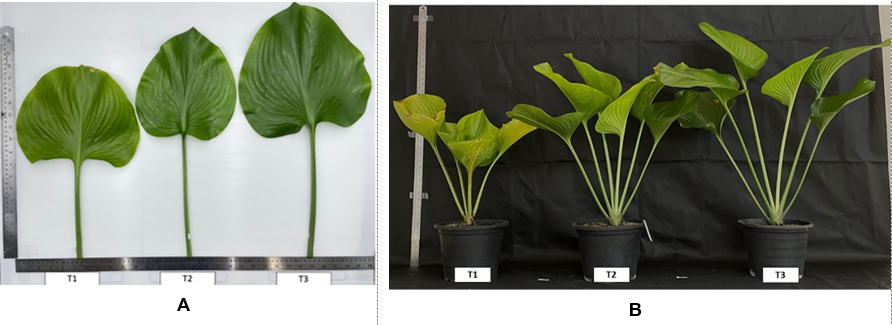
P. amboinensis is a bulbous ornamental plant valued for its white flowers, long scapes, and broad dark-green leaves, making it suitable for use as cut flowers and potted plants. However, domestic cultivation often results in stunted leaves and leaf scorch due to excessive sunlight, which limits photosynthesis and reduces bulb size. This study hypothesized that regulating light intensity through shading could enhance plant growth and nutrient accumulation in the bulbs. The experiment evaluated the effects of three shading levels—full sun (no shading), 50% shading, and 70% shading – using a Completely Randomized Design (CRD). The study was conducted from March to December 2024 at the Agricultural Technology Research Institute, Rajamangala University of Technology Lanna, Lampang. Shading significantly improved vegetative growth. Both 50% and 70% shading increased petiole length, leaf length, and leaf width compared with full sun, with petiole length increasing by 1.52 and 1.35 times (p < 0.01), leaf length by 1.17 and 1.18 times (p < 0.05), and leaf width by 1.12 and 1.16 times (p < 0.05), respectively. The 70% shading treatment produced the most vigorous growth, showing significant increases in leaf greenness (1.37×), bulb fresh weight (2.76×), and bulb diameter (2.10×) relative to full sun. In contrast, bulbs grown under full sun accumulated significantly higher concentrations of phosphorus, potassium, and magnesium than those under 50% and 70% shading, exceeding the 70% shading treatment by 1.76×, 1.65×, and 1.41× (p < 0.01), respectively. Overall, the results indicate that 70% shading is the optimal level for promoting growth and bulb quality in P. amboinensis. Further studies should examine long-term shading effects on flowering performance to support efficient commercial production.
References
Department of Trade Negotiations. The trade situation of flowers, ornamental plants, and plant varieties in Thailand [Internet]. Bangkok: Department of Trade Negotiations; 2025 [cited 2025 Sep 5]. Available from: https://www.dtn.go.th/th/content/category/detail/id/1541/cid/1566/iid/2798 (in Thai).
Puangkaew W, Suwanthada C. Growth cycle of P. amboinensis. Kasetsart J. 2002;16(3):231-5. (in Thai).
Techaphinyawat S. Plant physiology. 1st ed. Bangkok: Kasetsart University; 2001. (in Thai).
Ruamrungsee S. Physiology of ornamental plants. 1st ed. Bangkok: Odeanstore; 2001. (in Thai).
Kasemsap S. Flower cultivation. 2nd ed. Bangkok: Faculty of Agriculture, Kasetsart University; 1982. p. 455. (in Thai).
Manabaramikul S, Kampata P, Changjeraja R. Effects of shading on growth, flowering, nitrogen content, and non-structural carbohydrates of Eucrosia bicolor. J Agric Res Dev. 2013;30(2):1-8. (in Thai).
Payuyong S, Boonkaokaew P, Techasilpitak T, Yangkhamman P. Effects of shading and net color on growth and flowering of Globba williamsiana. In: The 49th Kasetsart University Annual Conference; 2011 Feb 1-4; Bangkok. Bangkok: Kasetsart University; 2011. p. 450-7. (in Thai).
Wu W, Chen L, Liang R, Huang S, Li X, Huang B, et al. The role of light in regulating plant growth, development and sugar metabolism: a review. Front Plant Sci. 2025;15:1507628. doi: 10.3389/fpls.2024.1507628.
Novozamsky I, van Eck R, van Schouwenburg JC, Walinga I. Total nitrogen determination in plant material by means of the indophenol blue method. Neth J Agric Sci. 1974;22:3-5.
Walinga I, van der Lee JJ, Houba VJG, van Vark W, Novozamsky I. Plant analysis manual. Dordrecht: Springer; 1995. p. 275.
Kalra YP. Handbook of reference methods for plant analysis. Boca Raton: CRC Press; 1998. p. 300.
Taiz L, Zeiger E, Moller IM, Murphy A. Plant physiology and development. 6th ed. Sunderland (MA): Sinauer Associates; 2015.
Suksamran C, Sukpraser P. Effect of shading conditions on growth and product qualities of curcuma (Curcuma alismatifolia Gagnep.) in southern Thailand. Thai J Sci Technol. 2018;8(2):147-55. doi: 10.14456/tjst.2019.24. (in Thai).
Sasidharan R, Pierik R. Cell wall modification involving XTHs controls phytochrome-mediated petiole elongation in Arabidopsis thaliana. Plant Signal Behav. 2010;5(11):1491-2. doi: 10.4161/psb.5.11.13643.
Srilert N, Diloksumpun S. Growth performance and physiological characteristics of four clones of eucalypt seedlings under different light intensities. Thai J For. 2011;30(2):15-26. (in Thai).
Datpiratmongkol S, Yoosukyingsataporn S. Effects of shading and plant spacing on growth and yield of barbed grass (Centotheca lappacea (L.) Desv.) [Internet]. Bangkok: Agricultural Research Development Agency (Public Organization); 2018 [cited 2026 Apr 26]. Available from: https://cads.arda.or.th/th/documents/research/4694c7e5-cb1c-435c-b0ae-3fbe5694c292_th-TH. (in Thai).
Shi M, Zhou W, Shi S, Hu K, Shi T, Gao S, et al. Shading alleviates chloroplastic photodamage of forcing cultivated tree peonies in spring management. Sci Hortic. 2025;344:114104.
Chitwood DH, Headland LR, Filiault DL, Kumar R, Jiménez-Gómez JM, Schrager AV, et al. Native environment modulates leaf size and response to simulated foliar shade across wild tomato species. PLoS One. 2012;7(1):e29570. doi: 10.1371/journal.pone.0029570.
Srikrishnah S, Sutharsan S. Effect of different shade levels on growth and tuber yield of turmeric (Curcuma longa L.) in the Batticaloa district of Sri Lanka. Am-Euras J Agric Environ Sci. 2015;15(5):813-6.
Boonyakiat D. Plant physiology. Chiang Mai: Faculty of Agriculture, Chiang Mai University; 2001. p. 230. (in Thai).
Wu Y, Gong W, Yang W. Shade inhibits leaf size by controlling cell proliferation and enlargement in soybean. Sci Rep. 2017;7(1):9259. doi: 10.1038/s41598-017-10026-5.
Hussain S, Nanda S, Zhang J, Rehmani MIA, Suleman M, Li G, et al. Auxin and cytokinin interplay during leaf morphogenesis and phyllotaxy. Plants. 2021;10(8):1732. doi: 10.3390/plants10081732.
Xiong Y, Jiao Y. The diverse roles of auxin in regulating leaf development. Plants (Basel). 2019;8(7):243. doi: 10.3390/plants8070243.
Xue T, Zhang H, Zhang Y, Wei S, Chao Q, Zhu Y, et al. Full-length transcriptome analysis of shade-induced promotion of tuber production in Pinellia ternata. BMC Plant Biol. 2019;18(19):565. doi: 10.1186/s12870-019-2197-9.
Marschner H. Marschner's mineral nutrition of higher plants. 3rd ed. London: Academic Press; 2012. doi: 10.1016/C2009-0-63043-9.
Evans JR. Photosynthesis and nitrogen relationships in leaves of C3 plants. Oecol. 1989;78(1):9-19. doi: 10.1007/BF00377192.
Downloads
Published
How to Cite
Issue
Section
License
Copyright (c) 2026 University of Phayao

This work is licensed under a Creative Commons Attribution-NonCommercial-NoDerivatives 4.0 International License.
ผู้นิพนธ์ต้องรับผิดชอบข้อความในบทนิพนธ์ของตน มหาวิทยาลัยพะเยาไม่จำเป็นต้องเห็นด้วยกับบทความที่ตีพิมพ์เสมอไป ผู้สนใจสามารถคัดลอก และนำไปใช้ได้ แต่จะต้องขออนุมัติเจ้าของ และได้รับการอนุมัติเป็นลายลักษณ์อักษรก่อน พร้อมกับมีการอ้างอิงและกล่าวคำขอบคุณให้ถูกต้องด้วย
The authors are themselves responsible for their contents. Signed articles may not always reflect the opinion of University of Phayao. The articles can be reproduced and reprinted, provided that permission is given by the authors and acknowledgement must be given.