ผลของการพรางแสงต่อการเจริญเติบโตและปริมาณธาตุอาหารในหัวว่านนางคุ้ม
คำสำคัญ:
ว่านนางคุ้ม, การพรางแสง, ธาตุอาหาร, การเจริญเติบโต, หัวบทคัดย่อ
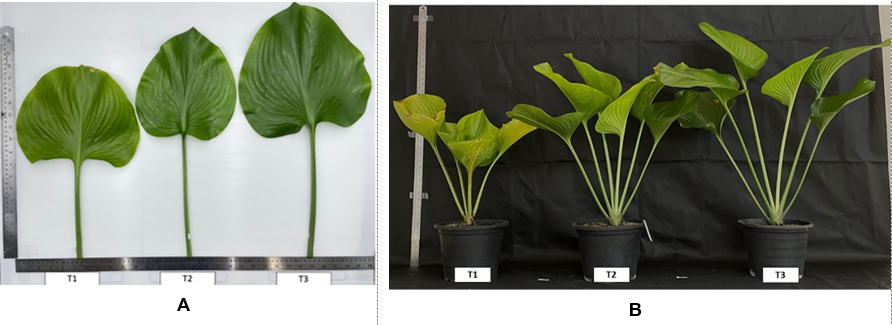
ว่านนางคุ้ม เป็นไม้ดอกหัวที่มีดอกสีขาว ก้านดอกยาว และใบใหญ่สีเขียวเข้ม เหมาะสำหรับเป็นไม้ตัดดอกหรือไม้กระถาง แต่การปลูกตามบ้านมักพบปัญหาใบเล็กแคระและขอบใบไหม้จากแสงแดดจัด ส่งผลให้การสังเคราะห์อาหารไม่สมบูรณ์ และหัวมีขนาดเล็ก ผู้ศึกษาจึงคาดว่าการจัดการความเข้มแสงอาจช่วยเพิ่มการเจริญเติบโตและการสะสมธาตุอาหารในหัว งานวิจัยนี้ศึกษาผลของการพรางแสงต่อการเจริญเติบโตและปริมาณธาตุอาหารในหัวว่านนางคุ้ม โดยออกแบบการทดลองแบบสุ่มสมบูรณ์ มี 3 ทรีตเมนต์ ได้แก่ ไม่พรางแสง พรางแสง 50 และ 70% ดำเนินการตั้งแต่เดือนมีนาคมถึงธันวาคม 2667 ณ สถาบันวิจัยเทคโนโลยีเกษตร มทร.ล้านนา (ลำปาง) ผลการทดลองพบว่า การพรางแสง 50 และ 70% ส่งผลให้ความยาวก้านใบ ความยาวใบ และความกว้างใบเพิ่มขึ้นเมื่อเทียบกับไม่พรางแสง
โดยความยาวก้านใบเพิ่มขึ้น คือ 1.52 และ 1.35 เท่า (p<0.01) ความยาวใบ 1.17 และ 1.18 เท่า (p<0.05) และความกว้างใบ 1.12 และ 1.16 เท่า (p<0.05) ตามลำดับ การพรางแสง 70% ยังช่วยเพิ่มความเขียวของใบ น้ำหนักหัว และเส้นผ่านศูนย์กลางหัว โดยเพิ่มขึ้นเมื่อเทียบกับการไม่กรางแสง คือ 1.37 เท่า (p<0.01) 2.76 เท่า (p<0.01) และ 2.10 เท่า (p<0.05) ตามลำดับ ในทางตรงกันข้าม การไม่พรางแสงส่งผลให้ปริมาณฟอสฟอรัส (P) โพแทสเซียม (K) และแมกนีเซียม (Mg) สูงกว่าการพรางแสง 50 และ 70% โดยมีค่าเฉลี่ยมากกว่าการพรางแสง 70% คือ 1.76 เท่า (p<0.01) 1.65 เท่า (p<0.01) และ 1.41 เท่า (p<0.01) ตามลำดับ จากการทดลองในครั้งนี้สรุปได้ว่าการพรางแสง 70% เป็นระดับที่เหมาะสมที่สุดสำหรับส่งเสริมการเจริญเติบโตและคุณภาพของหัวว่านนางคุ้ม ในอนาคตควรทำการศึกษาผลระยะยาวของการพรางแสงต่อคุณภาพดอกและลักษณะการออกดอก เพื่อรองรับการพัฒนาระบบการผลิตในเชิงการค้าอย่างมีประสิทธิภาพ
เอกสารอ้างอิง
Department of Trade Negotiations. The trade situation of flowers, ornamental plants, and plant varieties in Thailand [Internet]. Bangkok: Department of Trade Negotiations; 2025 [cited 2025 Sep 5]. Available from: https://www.dtn.go.th/th/content/category/detail/id/1541/cid/1566/iid/2798 (in Thai).
Puangkaew W, Suwanthada C. Growth cycle of P. amboinensis. Kasetsart J. 2002;16(3):231-5. (in Thai).
Techaphinyawat S. Plant physiology. 1st ed. Bangkok: Kasetsart University; 2001. (in Thai).
Ruamrungsee S. Physiology of ornamental plants. 1st ed. Bangkok: Odeanstore; 2001. (in Thai).
Kasemsap S. Flower cultivation. 2nd ed. Bangkok: Faculty of Agriculture, Kasetsart University; 1982. p. 455. (in Thai).
Manabaramikul S, Kampata P, Changjeraja R. Effects of shading on growth, flowering, nitrogen content, and non-structural carbohydrates of Eucrosia bicolor. J Agric Res Dev. 2013;30(2):1-8. (in Thai).
Payuyong S, Boonkaokaew P, Techasilpitak T, Yangkhamman P. Effects of shading and net color on growth and flowering of Globba williamsiana. In: The 49th Kasetsart University Annual Conference; 2011 Feb 1-4; Bangkok. Bangkok: Kasetsart University; 2011. p. 450-7. (in Thai).
Wu W, Chen L, Liang R, Huang S, Li X, Huang B, et al. The role of light in regulating plant growth, development and sugar metabolism: a review. Front Plant Sci. 2025;15:1507628. doi: 10.3389/fpls.2024.1507628.
Novozamsky I, van Eck R, van Schouwenburg JC, Walinga I. Total nitrogen determination in plant material by means of the indophenol blue method. Neth J Agric Sci. 1974;22:3-5.
Walinga I, van der Lee JJ, Houba VJG, van Vark W, Novozamsky I. Plant analysis manual. Dordrecht: Springer; 1995. p. 275.
Kalra YP. Handbook of reference methods for plant analysis. Boca Raton: CRC Press; 1998. p. 300.
Taiz L, Zeiger E, Moller IM, Murphy A. Plant physiology and development. 6th ed. Sunderland (MA): Sinauer Associates; 2015.
Suksamran C, Sukpraser P. Effect of shading conditions on growth and product qualities of curcuma (Curcuma alismatifolia Gagnep.) in southern Thailand. Thai J Sci Technol. 2018;8(2):147-55. doi: 10.14456/tjst.2019.24. (in Thai).
Sasidharan R, Pierik R. Cell wall modification involving XTHs controls phytochrome-mediated petiole elongation in Arabidopsis thaliana. Plant Signal Behav. 2010;5(11):1491-2. doi: 10.4161/psb.5.11.13643.
Srilert N, Diloksumpun S. Growth performance and physiological characteristics of four clones of eucalypt seedlings under different light intensities. Thai J For. 2011;30(2):15-26. (in Thai).
Datpiratmongkol S, Yoosukyingsataporn S. Effects of shading and plant spacing on growth and yield of barbed grass (Centotheca lappacea (L.) Desv.) [Internet]. Bangkok: Agricultural Research Development Agency (Public Organization); 2018 [cited 2026 Apr 26]. Available from: https://cads.arda.or.th/th/documents/research/4694c7e5-cb1c-435c-b0ae-3fbe5694c292_th-TH. (in Thai).
Shi M, Zhou W, Shi S, Hu K, Shi T, Gao S, et al. Shading alleviates chloroplastic photodamage of forcing cultivated tree peonies in spring management. Sci Hortic. 2025;344:114104.
Chitwood DH, Headland LR, Filiault DL, Kumar R, Jiménez-Gómez JM, Schrager AV, et al. Native environment modulates leaf size and response to simulated foliar shade across wild tomato species. PLoS One. 2012;7(1):e29570. doi: 10.1371/journal.pone.0029570.
Srikrishnah S, Sutharsan S. Effect of different shade levels on growth and tuber yield of turmeric (Curcuma longa L.) in the Batticaloa district of Sri Lanka. Am-Euras J Agric Environ Sci. 2015;15(5):813-6.
Boonyakiat D. Plant physiology. Chiang Mai: Faculty of Agriculture, Chiang Mai University; 2001. p. 230. (in Thai).
Wu Y, Gong W, Yang W. Shade inhibits leaf size by controlling cell proliferation and enlargement in soybean. Sci Rep. 2017;7(1):9259. doi: 10.1038/s41598-017-10026-5.
Hussain S, Nanda S, Zhang J, Rehmani MIA, Suleman M, Li G, et al. Auxin and cytokinin interplay during leaf morphogenesis and phyllotaxy. Plants. 2021;10(8):1732. doi: 10.3390/plants10081732.
Xiong Y, Jiao Y. The diverse roles of auxin in regulating leaf development. Plants (Basel). 2019;8(7):243. doi: 10.3390/plants8070243.
Xue T, Zhang H, Zhang Y, Wei S, Chao Q, Zhu Y, et al. Full-length transcriptome analysis of shade-induced promotion of tuber production in Pinellia ternata. BMC Plant Biol. 2019;18(19):565. doi: 10.1186/s12870-019-2197-9.
Marschner H. Marschner's mineral nutrition of higher plants. 3rd ed. London: Academic Press; 2012. doi: 10.1016/C2009-0-63043-9.
Evans JR. Photosynthesis and nitrogen relationships in leaves of C3 plants. Oecol. 1989;78(1):9-19. doi: 10.1007/BF00377192.
ดาวน์โหลด
เผยแพร่แล้ว
รูปแบบการอ้างอิง
ฉบับ
ประเภทบทความ
สัญญาอนุญาต
ลิขสิทธิ์ (c) 2026 มหาวิทยาลัยพะเยา

อนุญาตภายใต้เงื่อนไข Creative Commons Attribution-NonCommercial-NoDerivatives 4.0 International License.
ผู้นิพนธ์ต้องรับผิดชอบข้อความในบทนิพนธ์ของตน มหาวิทยาลัยพะเยา ไม่จำเป็นต้องเห็นด้วยกับบทความที่ตีพิมพ์เสมอไป ผู้สนใจสามารถคัดลอก และนำไปใช้ได้ แต่จะต้องขออนุมัติเจ้าของ และได้รับการอนุมัติเป็นลายลักษณ์อักษรก่อน พร้อมกับมีการอ้างอิงและกล่าวคำขอบคุณให้ถูกต้องด้วย