Development of an integrated model for enhancing digital-age psychological resilience among at-risk adolescents: A mixed-methods research study
Keywords:
Psychological resilience, At-risk adolescents, Digital age, Integrated model, Mental healthAbstract
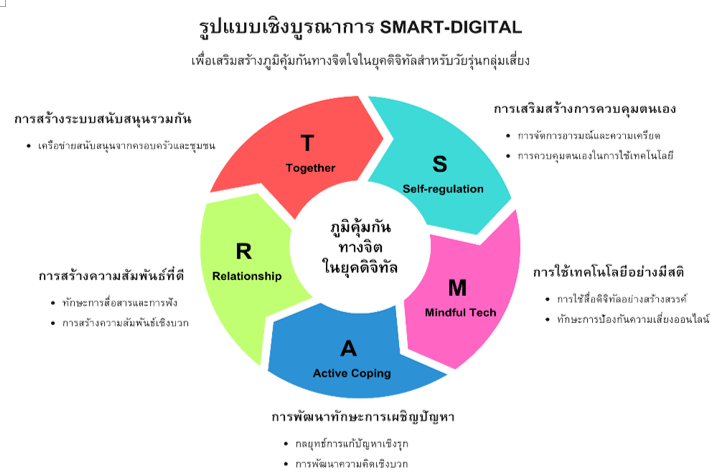
This study aimed to develop and test the effectiveness of an integrated model for enhancing digital-age psychological resilience among at-risk adolescents. A sequential explanatory mixed-methods design was employed across three phases. Phase 1 explored problems and needs through in-depth interviews and focus group discussions with 45 stakeholders, comprising 15 at-risk adolescents aged 13-18 years, 12 parents/guardians, 10 teachers and educational personnel, 5 public health workers, and 3 community leaders. Phase 2 developed an integrated model based on qualitative findings from Phase 1, which revealed five main risk factors and the need for multi-dimensional intervention, combined with literature review by integrating insights from interviews and focus group discussions regarding digital media use problems, needs for emotional management skills, and support system requirements, together with empirical evidence from literature on psychological resilience and technology use. Phase 3 tested effectiveness through a quasi-experimental trial with 80 at-risk adolescents who had at least 2 risk factors including broken families, low economic status, poor academic performance, risk behaviors, or bullying experiences. Using simple random sampling, participants were divided into an experimental group (n=40) and a control group (n=40). The experimental group received the SMART-Digital Program over 8 weeks, twice per week, 90 minutes per session, totaling 16 sessions. The control group received standard school and community care without any special intervention and would receive the full program after study completion to ensure fairness. During the study, 3 participants withdrew, resulting in 77 participants for final analysis (experimental group n=39, control group n=38).
References
Boucher EM, Ward HE, Henry RD, Miles CJ, Stoeckl SE. Effects of a digital mental health intervention on perceived stress, rumination, and loneliness in adolescents: randomized controlled trial. J Med Internet Res. 2024;26:e54282. doi: 10.2196/54282.
Peake E, Phillips R, Goldin J, Craske MG. Preliminary efficacy of a digital intervention for adolescent depression: randomized clinical trial. J Med Internet Res. 2024;26:e48467. doi: 10.2196/48467.
Chen Q, Lo CKM, Yip PSF, Chan KL. Global prevalence of cyberbullying in adolescents and its association with mental health: systematic review and meta-analysis. Eur Child Adolesc Psychiatry. 2023;32:1107-23. doi: 10.1007/s00787-022-02128-x.
Mei Z, Jiang W, Zhang Y, Luo S, Luo S. Mind-body therapies for resilience in adolescents: a systematic review of randomized controlled trials. Gen Hosp Psychiatry. 2024;91:43-51.
doi: 10.1016/j.genhosppsych.2024.08.014.
Monaghan M, Sanders M, Patel N, Kingsley C, Arslanian S, Cogen FR, et al. Resilience-based stress management for adolescents with type 1 diabetes: a randomized clinical trial. JAMA Netw Open. 2024;7(6):e2428287. doi: 10.1001/jamanetworkopen.2024.28287.
Walsh C, McMahon EM, Herring MP. The effects of school-based suicide prevention programs on suicidal ideation and behaviors in adolescents: systematic review and meta-analysis. J Child Psychol Psychiatry. 2022;63(11):1197-207. doi: 10.1111/jcpp.13598.
Danpho K, Umesh P, Jones S, Chaisricharoen R, Watts P. Digital behavior and mental health
among Thai adolescents in Bangkok: cross-sectional study. BMJ Paediatr Open. 2025;9(1):e003238.
doi: 10.1136/bmjpo-2024-003238.
Hosiri T, Rattarittamrong R, Charoensook R, Tovar A, Sirilert P. Adverse childhood experiences, behavior problems, and resilience among adolescents in Southern Thailand. Siriraj Med J. 2024;76(5):282-92. doi: 10.33192/smj.v76i5.267232.
Kulikov VN, Crosthwaite PC, Hall SA, Flannery JE, Strauss GS, Vierra EM, et al. A CBT-based mobile intervention as an adjunct treatment for adolescents with symptoms of depression: a virtual randomized controlled feasibility trial. Front Digit Health. 2023;5:1062471. doi: 10.3389/fdgth.2023.1062471.
Wani C, Purnawarman W, Ibrahim F, Iyamu I, Bah S. Digital mental health interventions for adolescents in low- and middle-income countries: systematic review. J Med Internet Res. 2024;26:e51376.
doi: 10.2196/51376.
Llistosella M, Ramos-Sánchez N, Conte-Berruga B, et al. A school-based multicomponent program to strengthen resilience in at-risk adolescents: randomized controlled trial. Front Psychol. 2024;15:1478424. doi: 10.3389/fpsyg.2024.1478424.
Schäfer SK, Kellermann L, Abdelaziz A, Schneider R, Zernikow B, Görlitz R, et al. Digital interventions to promote psychological resilience: scoping review. NPJ Digit Med. 2024;7:17. doi: 10.1038/s41746-024-01017-8.
Nochaiwong S, Ruengorn C, Awiphan R, et al. Transcultural adaptation and psychometric validation of the Thai Brief Resilient Coping Scale (BRCS) among general population and college students. Sci Rep. 2022;12:21611. doi: 10.1038/s41598-022-26063-8.
OECD. OECD digital education outlook 2021: pushing the frontiers with artificial intelligence, blockchain and robots. Paris: OECD Publishing; 2021. doi: 10.1787/589b283f-en.
Sun H, Yuan C, Qian Q, He S, Luo Q. Digital resilience among individuals in school education
settings: a concept analysis based on a scoping review. Front Psychiatry. 2022;13:858515.
doi: 10.3389/fpsyt.2022.858515.
Downloads
Published
How to Cite
Issue
Section
License
Copyright (c) 2026 University of Phayao

This work is licensed under a Creative Commons Attribution-NonCommercial-NoDerivatives 4.0 International License.
ผู้นิพนธ์ต้องรับผิดชอบข้อความในบทนิพนธ์ของตน มหาวิทยาลัยพะเยาไม่จำเป็นต้องเห็นด้วยกับบทความที่ตีพิมพ์เสมอไป ผู้สนใจสามารถคัดลอก และนำไปใช้ได้ แต่จะต้องขออนุมัติเจ้าของ และได้รับการอนุมัติเป็นลายลักษณ์อักษรก่อน พร้อมกับมีการอ้างอิงและกล่าวคำขอบคุณให้ถูกต้องด้วย
The authors are themselves responsible for their contents. Signed articles may not always reflect the opinion of University of Phayao. The articles can be reproduced and reprinted, provided that permission is given by the authors and acknowledgement must be given.