การพัฒนารูปแบบเชิงบูรณาการเพื่อเสริมสร้างภูมิคุ้มกันทางจิตในยุคดิจิทัลสำหรับวัยรุ่นกลุ่มเสี่ยง: การวิจัยแบบผสมผสาน
คำสำคัญ:
ภูมิคุ้มกันทางจิต, วัยรุ่นกลุ่มเสี่ยง, ยุคดิจิทัล, รูปแบบเชิงบูรณาการบทคัดย่อ
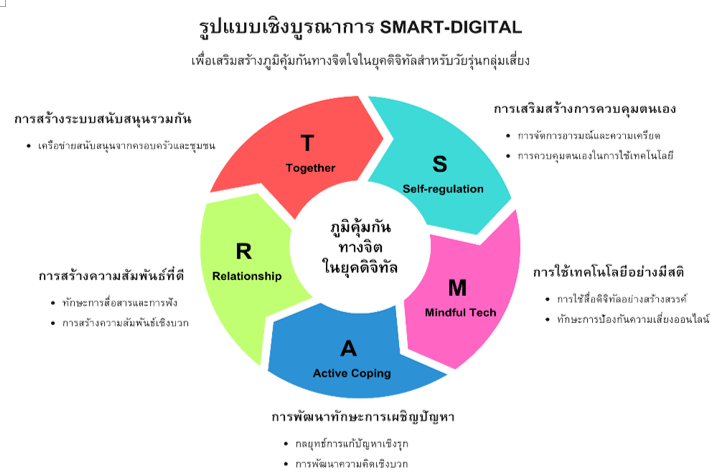
การศึกษานี้มีวัตถุประสงค์เพื่อพัฒนาและทดสอบประสิทธิผลของรูปแบบเชิงบูรณาการสำหรับเสริมสร้างภูมิคุ้มกันทางจิตในยุคดิจิทัลสำหรับวัยรุ่นกลุ่มเสี่ยง การวิจัยใช้รูปแบบผสมผสานแบบต่อเนื่องเชิงอธิบาย แบ่งเป็น 3 ระยะ ระยะที่ 1 ศึกษาสภาพปัญหาและความต้องการผ่านการสัมภาษณ์เชิงลึกและการสนทนากลุ่มกับผู้มีส่วนเกี่ยวข้อง 45 คน ประกอบด้วย วัยรุ่นกลุ่มเสี่ยงอายุ 13-18 ปี 15 คน ผู้ปกครอง 12 คน ครูและบุคลากรทางการศึกษา 10 คน บุคลากรสาธารณสุข 5 คน และผู้นำชุมชน 3 คน ระยะที่ 2 พัฒนารูปแบบเชิงบูรณาการจากข้อมูลเชิงคุณภาพในระยะที่ 1 ซึ่งพบปัจจัยเสี่ยงหลัก 5 ประการและความต้องการการแทรกแซงแบบหลายมิติ ร่วมกับการทบทวนวรรณกรรม โดยบูรณาการข้อค้นพบจากการสัมภาษณ์และการสนทนากลุ่มเกี่ยวกับปัญหาการใช้สื่อดิจิทัล ความต้องการทักษะการจัดการอารมณ์ และความต้องการระบบสนับสนุน ร่วมกับหลักฐานเชิงประจักษ์จากวรรณกรรมด้านภูมิคุ้มกันทางจิตและการใช้เทคโนโลยี ระยะที่ 3 ทดสอบประสิทธิผลด้วยการวิจัยเชิงทดลองแบบกึ่งควบคุมในวัยรุ่นกลุ่มเสี่ยง ที่มีปัจจัยเสี่ยงอย่างน้อย 2 ปัจจัยจากครอบครัวแตกแยก ฐานะเศรษฐกิจต่ำ ผลการเรียนต่ำ มีพฤติกรรมเสี่ยง หรือถูกรังแก จำนวน 80 คน โดยใช้ simple random sampling แบ่งเป็นกลุ่มทดลอง 40 คน และกลุ่มควบคุม 40 คน กลุ่มทดลองได้รับโปรแกรม SMART-Digital ระยะเวลา 8 สัปดาห์ สัปดาห์ละ 2 ครั้ง ครั้งละ 90 นาที รวม 16 ครั้ง ส่วนกลุ่มควบคุมได้รับการดูแลตามปกติของโรงเรียนและชุมชน โดยไม่มีการแทรกแซงพิเศษ และจะได้รับโปรแกรมเต็มรูปแบบหลังการศึกษาเสร็จสิ้นเพื่อความเป็นธรรม ในระหว่างการศึกษามีผู้ถอนตัว 3 คน ทำให้เหลือกลุ่มตัวอย่างที่วิเคราะห์ได้จริง 77 คน (กลุ่มทดลอง 39 คน กลุ่มควบคุม 38 คน) รูปแบบที่พัฒนาขึ้นชื่อ "โปรแกรม SMART-Digital" ประกอบด้วย 4 องค์ประกอบหลัก ได้แก่ การเสริมสร้างการควบคุมตนเอง (Self-regulation) การใช้เทคโนโลยีอย่างมีสติ (Mindful technology use) การพัฒนาทักษะการเผชิญปัญหา (Active coping) การสร้างความสัมพันธ์ที่ดี (Relationship building) และการสร้างระบบสนับสนุนร่วมกัน (Together support) ผลการทดสอบประสิทธิผลแสดงให้เห็นว่า
กลุ่มทดลองมีคะแนนภูมิคุ้มกันทางจิตเพิ่มขึ้นจาก 58.4 เป็น 72.8 คะแนน ปรับปรุงพฤติกรรมการใช้สื่อดิจิทัล และมีสุขภาพจิตที่ดีขึ้นอย่างมีนัยสำคัญทางสถิติ (p<0.001) เมื่อเปรียบเทียบกับกลุ่มควบคุม ผลการติดตามหลังการทดลอง 4 สัปดาห์แสดงความยั่งยืนของการเปลี่ยนแปลง รูปแบบเชิงบูรณาการนี้สามารถนำไปประยุกต์ใช้ในการพัฒนาโปรแกรมส่งเสริมสุขภาพจิตสำหรับวัยรุ่นไทยในยุคดิจิทัล
เอกสารอ้างอิง
Boucher EM, Ward HE, Henry RD, Miles CJ, Stoeckl SE. Effects of a digital mental health intervention on perceived stress, rumination, and loneliness in adolescents: randomized controlled trial. J Med Internet Res. 2024;26:e54282. doi: 10.2196/54282.
Peake E, Phillips R, Goldin J, Craske MG. Preliminary efficacy of a digital intervention for adolescent depression: randomized clinical trial. J Med Internet Res. 2024;26:e48467. doi: 10.2196/48467.
Chen Q, Lo CKM, Yip PSF, Chan KL. Global prevalence of cyberbullying in adolescents and its association with mental health: systematic review and meta-analysis. Eur Child Adolesc Psychiatry. 2023;32:1107-23. doi: 10.1007/s00787-022-02128-x.
Mei Z, Jiang W, Zhang Y, Luo S, Luo S. Mind-body therapies for resilience in adolescents: a systematic review of randomized controlled trials. Gen Hosp Psychiatry. 2024;91:43-51.
doi: 10.1016/j.genhosppsych.2024.08.014.
Monaghan M, Sanders M, Patel N, Kingsley C, Arslanian S, Cogen FR, et al. Resilience-based stress management for adolescents with type 1 diabetes: a randomized clinical trial. JAMA Netw Open. 2024;7(6):e2428287. doi: 10.1001/jamanetworkopen.2024.28287.
Walsh C, McMahon EM, Herring MP. The effects of school-based suicide prevention programs on suicidal ideation and behaviors in adolescents: systematic review and meta-analysis. J Child Psychol Psychiatry. 2022;63(11):1197-207. doi: 10.1111/jcpp.13598.
Danpho K, Umesh P, Jones S, Chaisricharoen R, Watts P. Digital behavior and mental health
among Thai adolescents in Bangkok: cross-sectional study. BMJ Paediatr Open. 2025;9(1):e003238.
doi: 10.1136/bmjpo-2024-003238.
Hosiri T, Rattarittamrong R, Charoensook R, Tovar A, Sirilert P. Adverse childhood experiences, behavior problems, and resilience among adolescents in Southern Thailand. Siriraj Med J. 2024;76(5):282-92. doi: 10.33192/smj.v76i5.267232.
Kulikov VN, Crosthwaite PC, Hall SA, Flannery JE, Strauss GS, Vierra EM, et al. A CBT-based mobile intervention as an adjunct treatment for adolescents with symptoms of depression: a virtual randomized controlled feasibility trial. Front Digit Health. 2023;5:1062471. doi: 10.3389/fdgth.2023.1062471.
Wani C, Purnawarman W, Ibrahim F, Iyamu I, Bah S. Digital mental health interventions for adolescents in low- and middle-income countries: systematic review. J Med Internet Res. 2024;26:e51376.
doi: 10.2196/51376.
Llistosella M, Ramos-Sánchez N, Conte-Berruga B, et al. A school-based multicomponent program to strengthen resilience in at-risk adolescents: randomized controlled trial. Front Psychol. 2024;15:1478424. doi: 10.3389/fpsyg.2024.1478424.
Schäfer SK, Kellermann L, Abdelaziz A, Schneider R, Zernikow B, Görlitz R, et al. Digital interventions to promote psychological resilience: scoping review. NPJ Digit Med. 2024;7:17. doi: 10.1038/s41746-024-01017-8.
Nochaiwong S, Ruengorn C, Awiphan R, et al. Transcultural adaptation and psychometric validation of the Thai Brief Resilient Coping Scale (BRCS) among general population and college students. Sci Rep. 2022;12:21611. doi: 10.1038/s41598-022-26063-8.
OECD. OECD digital education outlook 2021: pushing the frontiers with artificial intelligence, blockchain and robots. Paris: OECD Publishing; 2021. doi: 10.1787/589b283f-en.
Sun H, Yuan C, Qian Q, He S, Luo Q. Digital resilience among individuals in school education
settings: a concept analysis based on a scoping review. Front Psychiatry. 2022;13:858515.
doi: 10.3389/fpsyt.2022.858515.
ดาวน์โหลด
เผยแพร่แล้ว
รูปแบบการอ้างอิง
ฉบับ
ประเภทบทความ
สัญญาอนุญาต
ลิขสิทธิ์ (c) 2026 มหาวิทยาลัยพะเยา

อนุญาตภายใต้เงื่อนไข Creative Commons Attribution-NonCommercial-NoDerivatives 4.0 International License.
ผู้นิพนธ์ต้องรับผิดชอบข้อความในบทนิพนธ์ของตน มหาวิทยาลัยพะเยา ไม่จำเป็นต้องเห็นด้วยกับบทความที่ตีพิมพ์เสมอไป ผู้สนใจสามารถคัดลอก และนำไปใช้ได้ แต่จะต้องขออนุมัติเจ้าของ และได้รับการอนุมัติเป็นลายลักษณ์อักษรก่อน พร้อมกับมีการอ้างอิงและกล่าวคำขอบคุณให้ถูกต้องด้วย