Needs and need fulfillment of caregivers of stroke patients in the stroke intensive care unit, Tertiary hospital
Keywords:
Needs, Needs fulfillment, Stroke patient caregivers, StrokeAbstract
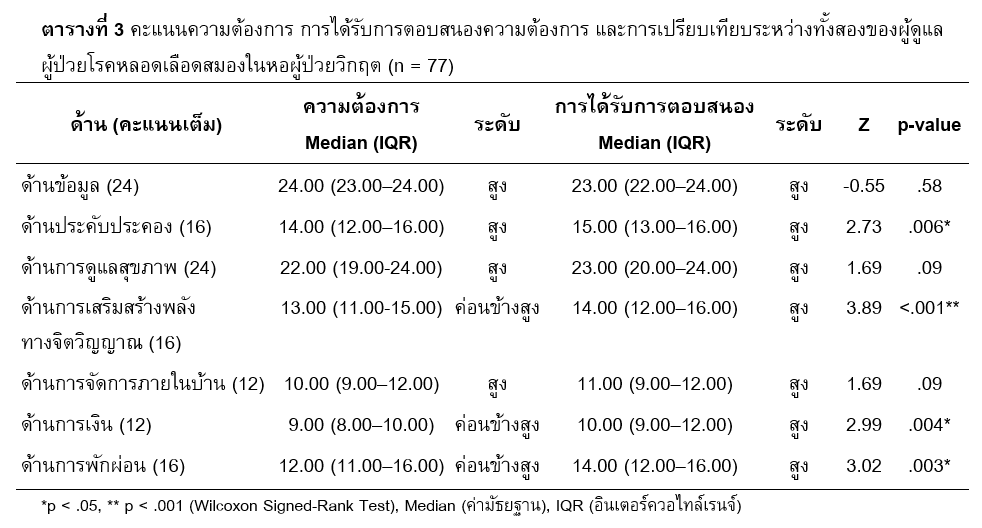
This study aimed to examine the needs and need fulfillment of caregivers of stroke patients in the in the stroke intensive care unit of a tertiary hospital, and to compare the differences between their needs and need fulfillment. The sample consisted of 77 primary caregivers of stroke patients aged 20 years or older who were literate, able to communicate in Thai, and had been providing care for at least three days. The research instruments were two-part questionnaires that demonstrated good content validity and reliability, with consistency indices of 0.99 and 0.97, respectively. Data were analyzed using descriptive statistics and the Wilcoxon signed-rank test, with the level of statistical significance set at .05. The results showed that most participants were female (68.83%), with a median age of 49 years, and the majority were married or cohabiting (58.44%). Caregivers reported moderately high to high needs across all domains. The three domains with the highest needs were information, health care, and emotional support. Need fulfillment was high in all domains except for financial needs, which were moderately high. The comparison revealed that caregivers received significantly higher need fulfillment than their perceived needs in four domains: emotional support (Z = 2.73, p = .006), spiritual enhancement (Z = 3.89, p < .001), financial (Z = 2.99, p = .004), and rest (Z = 3.02, p = .003). In conclusion, caregivers of stroke patients have needs in multiple domains, particularly information, health care, and emotional support, while the level of need fulfillment was generally high and higher than the perceived needs in several domains. This reflects the effective quality of care provided. Therefore, it is necessary to maintain care standards and continuously adjust service models to align with the specific needs of caregivers, especially in high-need areas, to promote long-term health outcomes and quality of life for both patients and caregivers.
References
Prasat Neurological Institute, Department of Medical Services, Ministry of Public Health. Clinical practice guidelines for acute ischemic stroke. Bangkok: Prasat Neurological Institute; 2024. (In Thai)
Greenberg SM, Ziai WC, Cordonnier C, Dowlatshahi D, Goldstein JN, Kondziolka D, et al. 2022 Guideline for the management of patients with spontaneous intracerebral hemorrhage: a guideline from the American Heart Association/American Stroke Association. Stroke. 2022;53(7):e282-e361.
Department of Medical Services, Ministry of Public Health. Clinical practice guidelines for stroke. Nonthaburi: Department of Medical Services; 2024. (In Thai)
Feigin VL, Brainin M, Norrving B, Martins SO, Pandian J, Lindsay P, et al. World Stroke Organization (WSO): Global Stroke Fact Sheet 2025. Int J Stroke. 2025;20(2):132-44. doi: 10.1177/17474930241308142.
Tu WJ, Hua Y, Yan F, Bian H, Yang Y, Lou M, et al. Prevalence of stroke in China, 2013-2019: a population-based study. Lancet Reg Health West Pac. 2022;28:100550. doi: 10.1016/j.lanwpc.2022.100550.
Martin SS, Aday AW, Almarzooq ZI, Anderson CAM, Arora P, Avery CL, et al. 2024 heart disease and stroke statistics: a report of US and global data from the American Heart Association. Circulation. 2024;149(8):e347-e913. doi: 10.1161/CIR.0000000000001209.
Strategy and Planning Division, Office of the Permanent Secretary, Ministry of Public Health. Public health statistics [Internet]. 2022 [cited 2026 Apr 14]. Available from: https://spd.moph.go.th/public-health-statistics. (In Thai)
Maharaj Nakorn Chiang Mai Hospital. Patient statistics. Chiang Mai: Maharaj Nakorn Chiang Mai Hospital; 2023. (In Thai)
Tartarisco G, Chillemi G, De Francesco M, De Cola MC, De Luca R, Manuli A, et al. Understanding the family burden and caregiver role in stroke rehabilitation: insights from a retrospective study. Neurol Sci. 2024 [Epub ahead of print]. doi: 10.1007/s10072-024-07668-5.
Stiexs A, Chayati N. Study of physical, psychological, and spiritual impact of family caregiver in home-based stroke treatment: a systematic review. Open Access Maced J Med Sci. 2021;9:236-9. doi: 10.3889/oamjms.2021.5795.
Jaracz K, Grabowska-Fudala B, Jaracz J, Moczko J, Kleka P, Pawlicka A, et al. Caregiver burden after stroke: a 10-year follow-up study of Polish caregivers for stroke patients. BMC Nurs. 2024;23(1):589. doi: 10.1186/s12912-024-02251-x.
Elton H, Lobo E. Information, involvement, self-care and support: the needs of caregivers of people with stroke: a grounded theory approach. PLoS One. 2023;18(1):e0281198. doi: 10.1371/journal.pone.0281198.
Sritumsuk W, Jaipong S, Setchoduk K, Teerawongsa N, Nilnet N. Factors predicting the needs of caregivers of patients with new-onset subacute stroke. Thai Red Cross Nurs J. 2020;13(2):144-58. (In Thai)
Wingate AL, Lackey NR. A description of the needs of noninstitutionalized cancer patients and their primary caregiver. Cancer Nurs. 1989;12(4):216-24.
Ito Y, Hamaguchi T, Suzuki M, Otaka Y, Asai M, Sakaguchi Y, et al. Identification of unmet information needs among families of critically ill patients and their association with post-intensive care syndrome-family: protocol for a single-center cross-sectional study. BMC Palliat Care. 2025;24:15. doi: 10.1186/s12904-025-01345-w.
Kelle Dikbaş Ş, Kalyoncu Aslan I. Factors affecting length of stay in a stroke unit after intravenous thrombolytic therapy: a retrospective study. Bosphorus Med J. 2024;11(1):15-22.
Wichittrakunthawon S, Imsanguan K, Sukamwang K. Needs and needs responses of elderly patients and their families in the surgical intensive care unit, Maharaj Nakorn Chiang Mai Hospital. Nurs J. 2013;40(Suppl):35-46. (In Thai)
Jue-u-patham R. Needs of family caregivers of stroke patients at home [master's thesis]. Nakhon Pathom: Christian University of Thailand; 2010. (In Thai)
Srihabandit W. Needs of stroke patient caregivers and factors predicting the needs of stroke patient caregivers [master's thesis]. Pathum Thani: Rangsit University; 2017. (In Thai)
Best JW. Research in education. 3rd ed. Englewood Cliffs, NJ: Prentice Hall; 1997.
Mohd Zawawi NS, Abd Aziz NA, Fisher R, Ahmad K, Omar MA, Walker MF. The unmet needs of caregiving skills, support, emotions, and finances of stroke caregivers: a multicenter study. Cureus. 2023;15(8):e44346. doi: 10.7759/cureus.44346.
Mehdipanah R, Morgenstern LB, Kwicklis M, Smith MA, Case E, Lisabeth LD. Stroke caregiver needs in a population-based study. J Am Heart Assoc. 2025;14(19):e038434. doi: 10.1161/JAHA.124.038434.
Pratama S, Pangastuti HS, Maria R. Hubungan ketergantungan activity daily living penderita stroke dengan beban family caregiver di Puskesmas Kasihan II. J Keperawatan Klinis dan Komunitas. 2023;7(1):29-38. doi: 10.22146/jkkk.83043.
Sánchez Silverio V, Abuín Porras V, Rodríguez Costa I. Caregiver burden in relation to cognitive status and dependence on activities of daily living in stroke patients: a cross-sectional study in the Dominican Republic. Rev Esp Dot Investig Enferm. 2021. doi: 10.1016/j.sedeng.2021.05.001.
Lutz BJ, Jones A, Zahuranec D, Creutzfeldt C. Views from the frontlines: perspectives of young adult caregivers on unmet needs after severe stroke. Stroke. 2025;56(Suppl 1):A121.
Ambrosca R, Bolgeo T, Zeffiro V, Alvaro R, Vellone E, Pucciarelli G. The role of spirituality in stroke survivors and their caregivers: a systematic review. J Relig Health. 2024;63(5):3501-31. doi: 10.1007/s10943-024-02029-0.
Damaiyanti M, Amir H, Cahyani DD, Alhidayat NS, Afrianti N, Rahmiati C, et al. Improving caregiver preparedness in the care transition of stroke patients: a scoping review. J Med Life. 2023;16(12):1723-31. doi: 10.25122/jml-2023-0142.
Kumar A, Yadav AK, Singh VK, Pathak A, Chaurasia RN, Mishra VN, et al. Caregiver burden in caregivers of stroke survivors: a hospital-based study. Ann Indian Acad Neurol. 2022;25(6):1092-8. doi: 10.4103/aian.aian_318_22.
Downloads
Published
How to Cite
Issue
Section
License
Copyright (c) 2026 University of Phayao

This work is licensed under a Creative Commons Attribution-NonCommercial-NoDerivatives 4.0 International License.
ผู้นิพนธ์ต้องรับผิดชอบข้อความในบทนิพนธ์ของตน มหาวิทยาลัยพะเยาไม่จำเป็นต้องเห็นด้วยกับบทความที่ตีพิมพ์เสมอไป ผู้สนใจสามารถคัดลอก และนำไปใช้ได้ แต่จะต้องขออนุมัติเจ้าของ และได้รับการอนุมัติเป็นลายลักษณ์อักษรก่อน พร้อมกับมีการอ้างอิงและกล่าวคำขอบคุณให้ถูกต้องด้วย
The authors are themselves responsible for their contents. Signed articles may not always reflect the opinion of University of Phayao. The articles can be reproduced and reprinted, provided that permission is given by the authors and acknowledgement must be given.