ความต้องการและการได้รับการตอบสนองความต้องการของผู้ดูแลผู้ป่วยโรคหลอดเลือดสมอง หอผู้ป่วยวิกฤตโรคหลอดเลือดสมอง โรงพยาบาลระดับตติยภูมิแห่งหนึ่ง
คำสำคัญ:
ความต้องการ, การได้รับการตอบสนองความต้องการ, ผู้ดูแลผู้ป่วยโรคหลอดเลือดสมอง, โรคหลอดเลือดสมองบทคัดย่อ
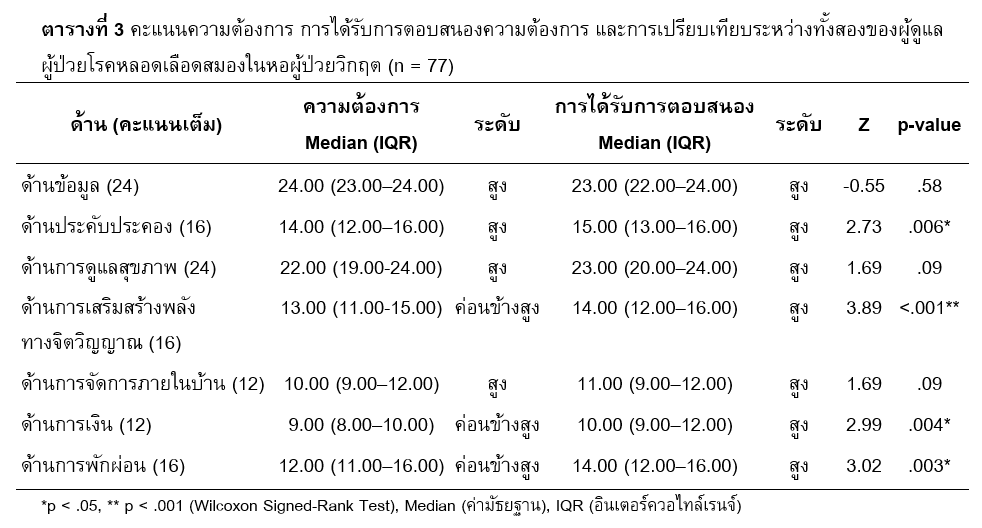
การวิจัยนี้มีวัตถุประสงค์เพื่อ ศึกษาความต้องการและการได้รับการตอบสนองความต้องการของผู้ดูแลผู้ป่วยโรคหลอดเลือดสมองในหอผู้ป่วยวิกฤตโรคหลอดเลือดสมอง โรงพยาบาลตติยภูมิแห่งหนึ่ง และเปรียบเทียบความแตกต่างระหว่างความต้องการและการตอบสนอง กลุ่มตัวอย่างเป็นผู้ดูแลหลักจำนวน 77 คน ที่มีอายุตั้งแต่ 20 ปีขึ้นไป อ่านออกเขียนได้ สื่อสารภาษาไทยได้ และดูแลผู้ป่วยมาแล้วอย่างน้อย 3 วัน เครื่องมือเป็นแบบสอบถาม 2 ตอน ที่ผ่านการตรวจสอบความตรงเชิงเนื้อหาและความเชื่อมั่นโดยมีค่าดัชนีความสอดคล้องเท่ากับ 0.99 และ 0.97 ตามลำดับ วิเคราะห์ข้อมูลโดยใช้สถิติเชิงพรรณนาและสถิติทดสอบวิลคอกซัน กำหนดระดับนัยสำคัญทางสถิติที่ .05 ผลการศึกษาพบว่า กลุ่มตัวอย่างส่วนใหญ่เป็นเพศหญิง ร้อยละ 68.83 ค่ามัธยฐานอายุ 49 ปี สถานภาพสมรสอยู่ด้วยกัน ร้อยละ 58.44 ผู้ดูแลมีความต้องการในระดับค่อนข้างสูงถึงสูงทุกด้าน โดยด้านที่มีความต้องการสูงสุด 3 อันดับแรก ได้แก่
ด้านข้อมูล ด้านการดูแลสุขภาพ และด้านประคับประคอง การได้รับการตอบสนองอยู่ในระดับสูงทุกด้าน ยกเว้นด้านการเงินที่อยู่ในระดับค่อนข้างสูง เมื่อเปรียบเทียบพบว่า ผู้ดูแลได้รับการตอบสนองสูงกว่าความต้องการอย่างมีนัยสำคัญทางสถิติใน 4 ด้าน ได้แก่ ด้านประคับประคอง (Z = 2.73, p = .006) ด้านการเสริมสร้างพลังทางจิตวิญญาณ (Z = 3.89, p < .001) ด้านการเงิน (Z = 2.99, p = .004) และด้านการพักผ่อน (Z = 3.02, p = .003) สรุปได้ว่า ผู้ดูแลผู้ป่วยโรคหลอดเลือดสมองมีความต้องการในหลายด้าน โดยเฉพาะด้านข้อมูล ด้านการดูแลสุขภาพ และด้านการประคับประคอง ขณะที่การได้รับการตอบสนองความต้องการอยู่ในระดับสูงและสูงกว่าความต้องการในหลายด้าน สะท้อนถึงคุณภาพการดูแลที่มีประสิทธิภาพ ดังนั้นจึงจำเป็นต้องคงไว้ซึ่งมาตรฐานการดูแล และปรับรูปแบบการให้บริการให้สอดคล้องกับความต้องการเฉพาะด้านของผู้ดูแลอย่างต่อเนื่อง โดยเฉพาะในประเด็นที่มีระดับความต้องการสูง เพื่อส่งเสริมผลลัพธ์ทางสุขภาพและคุณภาพชีวิตของผู้ป่วยและผู้ดูแลในระยะยาว
เอกสารอ้างอิง
Prasat Neurological Institute, Department of Medical Services, Ministry of Public Health. Clinical practice guidelines for acute ischemic stroke. Bangkok: Prasat Neurological Institute; 2024. (In Thai)
Greenberg SM, Ziai WC, Cordonnier C, Dowlatshahi D, Goldstein JN, Kondziolka D, et al. 2022 Guideline for the management of patients with spontaneous intracerebral hemorrhage: a guideline from the American Heart Association/American Stroke Association. Stroke. 2022;53(7):e282-e361.
Department of Medical Services, Ministry of Public Health. Clinical practice guidelines for stroke. Nonthaburi: Department of Medical Services; 2024. (In Thai)
Feigin VL, Brainin M, Norrving B, Martins SO, Pandian J, Lindsay P, et al. World Stroke Organization (WSO): Global Stroke Fact Sheet 2025. Int J Stroke. 2025;20(2):132-44. doi: 10.1177/17474930241308142.
Tu WJ, Hua Y, Yan F, Bian H, Yang Y, Lou M, et al. Prevalence of stroke in China, 2013-2019: a population-based study. Lancet Reg Health West Pac. 2022;28:100550. doi: 10.1016/j.lanwpc.2022.100550.
Martin SS, Aday AW, Almarzooq ZI, Anderson CAM, Arora P, Avery CL, et al. 2024 heart disease and stroke statistics: a report of US and global data from the American Heart Association. Circulation. 2024;149(8):e347-e913. doi: 10.1161/CIR.0000000000001209.
Strategy and Planning Division, Office of the Permanent Secretary, Ministry of Public Health. Public health statistics [Internet]. 2022 [cited 2026 Apr 14]. Available from: https://spd.moph.go.th/public-health-statistics. (In Thai)
Maharaj Nakorn Chiang Mai Hospital. Patient statistics. Chiang Mai: Maharaj Nakorn Chiang Mai Hospital; 2023. (In Thai)
Tartarisco G, Chillemi G, De Francesco M, De Cola MC, De Luca R, Manuli A, et al. Understanding the family burden and caregiver role in stroke rehabilitation: insights from a retrospective study. Neurol Sci. 2024 [Epub ahead of print]. doi: 10.1007/s10072-024-07668-5.
Stiexs A, Chayati N. Study of physical, psychological, and spiritual impact of family caregiver in home-based stroke treatment: a systematic review. Open Access Maced J Med Sci. 2021;9:236-9. doi: 10.3889/oamjms.2021.5795.
Jaracz K, Grabowska-Fudala B, Jaracz J, Moczko J, Kleka P, Pawlicka A, et al. Caregiver burden after stroke: a 10-year follow-up study of Polish caregivers for stroke patients. BMC Nurs. 2024;23(1):589. doi: 10.1186/s12912-024-02251-x.
Elton H, Lobo E. Information, involvement, self-care and support: the needs of caregivers of people with stroke: a grounded theory approach. PLoS One. 2023;18(1):e0281198. doi: 10.1371/journal.pone.0281198.
Sritumsuk W, Jaipong S, Setchoduk K, Teerawongsa N, Nilnet N. Factors predicting the needs of caregivers of patients with new-onset subacute stroke. Thai Red Cross Nurs J. 2020;13(2):144-58. (In Thai)
Wingate AL, Lackey NR. A description of the needs of noninstitutionalized cancer patients and their primary caregiver. Cancer Nurs. 1989;12(4):216-24.
Ito Y, Hamaguchi T, Suzuki M, Otaka Y, Asai M, Sakaguchi Y, et al. Identification of unmet information needs among families of critically ill patients and their association with post-intensive care syndrome-family: protocol for a single-center cross-sectional study. BMC Palliat Care. 2025;24:15. doi: 10.1186/s12904-025-01345-w.
Kelle Dikbaş Ş, Kalyoncu Aslan I. Factors affecting length of stay in a stroke unit after intravenous thrombolytic therapy: a retrospective study. Bosphorus Med J. 2024;11(1):15-22.
Wichittrakunthawon S, Imsanguan K, Sukamwang K. Needs and needs responses of elderly patients and their families in the surgical intensive care unit, Maharaj Nakorn Chiang Mai Hospital. Nurs J. 2013;40(Suppl):35-46. (In Thai)
Jue-u-patham R. Needs of family caregivers of stroke patients at home [master's thesis]. Nakhon Pathom: Christian University of Thailand; 2010. (In Thai)
Srihabandit W. Needs of stroke patient caregivers and factors predicting the needs of stroke patient caregivers [master's thesis]. Pathum Thani: Rangsit University; 2017. (In Thai)
Best JW. Research in education. 3rd ed. Englewood Cliffs, NJ: Prentice Hall; 1997.
Mohd Zawawi NS, Abd Aziz NA, Fisher R, Ahmad K, Omar MA, Walker MF. The unmet needs of caregiving skills, support, emotions, and finances of stroke caregivers: a multicenter study. Cureus. 2023;15(8):e44346. doi: 10.7759/cureus.44346.
Mehdipanah R, Morgenstern LB, Kwicklis M, Smith MA, Case E, Lisabeth LD. Stroke caregiver needs in a population-based study. J Am Heart Assoc. 2025;14(19):e038434. doi: 10.1161/JAHA.124.038434.
Pratama S, Pangastuti HS, Maria R. Hubungan ketergantungan activity daily living penderita stroke dengan beban family caregiver di Puskesmas Kasihan II. J Keperawatan Klinis dan Komunitas. 2023;7(1):29-38. doi: 10.22146/jkkk.83043.
Sánchez Silverio V, Abuín Porras V, Rodríguez Costa I. Caregiver burden in relation to cognitive status and dependence on activities of daily living in stroke patients: a cross-sectional study in the Dominican Republic. Rev Esp Dot Investig Enferm. 2021. doi: 10.1016/j.sedeng.2021.05.001.
Lutz BJ, Jones A, Zahuranec D, Creutzfeldt C. Views from the frontlines: perspectives of young adult caregivers on unmet needs after severe stroke. Stroke. 2025;56(Suppl 1):A121.
Ambrosca R, Bolgeo T, Zeffiro V, Alvaro R, Vellone E, Pucciarelli G. The role of spirituality in stroke survivors and their caregivers: a systematic review. J Relig Health. 2024;63(5):3501-31. doi: 10.1007/s10943-024-02029-0.
Damaiyanti M, Amir H, Cahyani DD, Alhidayat NS, Afrianti N, Rahmiati C, et al. Improving caregiver preparedness in the care transition of stroke patients: a scoping review. J Med Life. 2023;16(12):1723-31. doi: 10.25122/jml-2023-0142.
Kumar A, Yadav AK, Singh VK, Pathak A, Chaurasia RN, Mishra VN, et al. Caregiver burden in caregivers of stroke survivors: a hospital-based study. Ann Indian Acad Neurol. 2022;25(6):1092-8. doi: 10.4103/aian.aian_318_22.
ดาวน์โหลด
เผยแพร่แล้ว
รูปแบบการอ้างอิง
ฉบับ
ประเภทบทความ
สัญญาอนุญาต
ลิขสิทธิ์ (c) 2026 มหาวิทยาลัยพะเยา

อนุญาตภายใต้เงื่อนไข Creative Commons Attribution-NonCommercial-NoDerivatives 4.0 International License.
ผู้นิพนธ์ต้องรับผิดชอบข้อความในบทนิพนธ์ของตน มหาวิทยาลัยพะเยา ไม่จำเป็นต้องเห็นด้วยกับบทความที่ตีพิมพ์เสมอไป ผู้สนใจสามารถคัดลอก และนำไปใช้ได้ แต่จะต้องขออนุมัติเจ้าของ และได้รับการอนุมัติเป็นลายลักษณ์อักษรก่อน พร้อมกับมีการอ้างอิงและกล่าวคำขอบคุณให้ถูกต้องด้วย