Effects of a feeding promotion program on feeding intolerance and weight change in preterm infants
Keywords:
Weight change, Preterm infants, Feeding promotion program, Feeding intoleranceAbstract
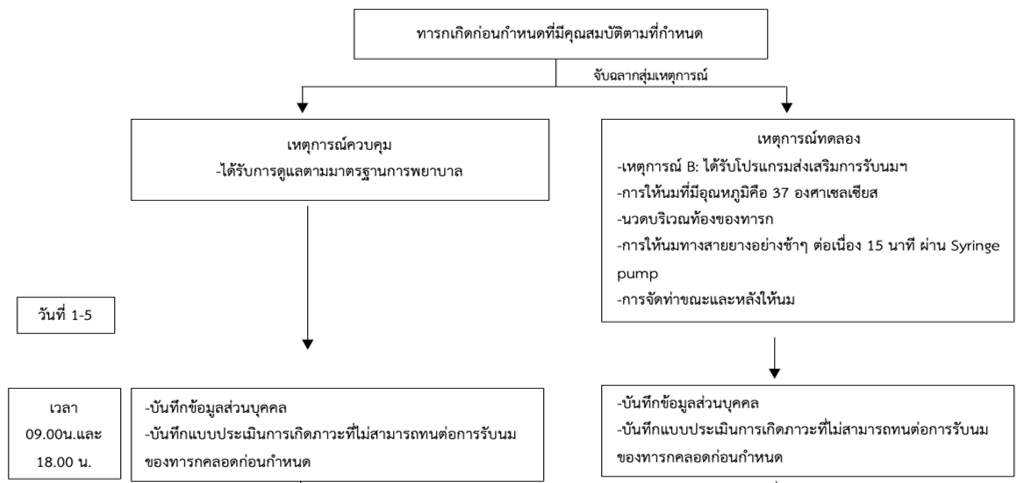
This quasi-experimental study aimed to compare the number of preterm infants with feeding intolerance between the intervention and control groups, and to compare the number of preterm infants with weight gain between the two groups. The sample included preterm infants aged 28-36+6 weeks at the time of the study, who were receiving care in the neonatal intensive care unit of a tertiary hospital in northern Thailand. Forty-six infants were selected using simple random sampling, with 23 infants in the intervention group and 23 in the control group. The intervention group received the feeding promotion program while the control group received standard nursing care. The research intervention utilized was the Program for Promoting Milk Intake to Address Feeding Intolerance, with preterm infant weight measured as a key outcome variable. The data collection instruments consisted of: 1) a Premature Infant Personal Data Record Form, and 2) a Feeding Intolerance Assessment Form, which had a content validity index (CVI) of 0.90 and an inter-rater reliability coefficient of 1. Data were analyzed using descriptive statistics, Independent T-Test and chi-square tests.
The findings indicated that none of the infants in the experimental group developed feeding intolerance, whereas infants in the control group did experience feeding intolerance, suggesting that the incidence of feeding intolerance differed significantly between the experimental and control groups (p < .001). Moreover, the preterm infants in the experimental group showed a significantly greater increase in body weight than those in the control group (p < .05), with the experimental group demonstrating a mean change in weight of 11.87 (S.D. = 3.69), compared with 6.06 (S.D. = 12.47) in the control group. These findings indicate that the feeding promotion program effectively helped prevent feeding intolerance and promoted weight gain among preterm infants.
References
Albraik RK, Shatla E, Abdulla YM, Ahmed EH. Neonatal feeding intolerance and its characteristics: a descriptive study. Cureus. 2022;14(9):e29291. doi:10.7759/cureus.29291.
Çamur Z, Erdogan C. The effect of breast milk temperature on feeding intolerance in tube-fed preterm infants: a randomized controlled study. J Neonatal Nurs. 2022;29(4):675-80. doi:10.1016/j.jnn.2022.12.004.
Department of Medical Services. Clinical practice guideline for the prevention of preterm labor in Thailand. Ministry of Public Health; 2023. Available from: https://www.dms.go.th. (In Thai)
Diego MA, Field T, Hernandez-Reif M, Deeds O, Ascencio A, Begert G. Preterm infant massage elicits consistent increases in vagal activity and gastric motility that are associated with greater weight gain. Acta Paediatr. 2007;96:1588-91. doi:10.1111/j.1651-2227.2007.00476.x.
Elmoneim MA, Mohamed HA, Awad A, El-Hawary A, Salem N, El Helaly R, et al. Effect of tactile/kinesthetic massage therapy on growth and body composition of preterm infants. Eur J Pediatr. 2021;180(1):207-15. doi:10.1007/s00431-020-03738-w.
Fanaro S. Feeding intolerance in the preterm infant. Early Hum Dev. 2013;89 Suppl:S13-20.
Fatma A, Abo Zaid DE, Hassan RA. Effect of abdominal massage on feeding intolerance and weight of preterm neonates. Egypt J Health Care. 2022;13(4):1725-36. doi:10.21608/ejhc.2022.284291.
Field T, Diego M, Hernandez-Reif M. Preterm infant massage therapy research: a review. Infant Behav Dev. 2010;33(2):115-24. doi:10.1016/j.infbeh.2009.12.004.
Field T, Diego M, Hernandez-Reif M, J NI, Kumar AM, Schanberg S, et al. Insulin and insulin-like growth factor 1 (IGF-1) increased in preterm neonates. J Dev Behav Pediatr. 2008;29(6):463-6. doi:10.1097/DBP.0b013e3181856d3d.
Gonzalez AP, Vasquez-Mendoza G, García-Vela A, Guzmán-Ramirez A, Salazar-Torres M, Romero-Gutierrez G. Weight gain in preterm infants following parent-administered vimala massage: a randomized controlled trial. J Perinatol. 2009;26(4):247-52. doi:10.1055/s-0028-1103151.
Janjira J, Jutamas C, Patcharee W. Effect of abdominal massage on feeding intolerance condition in preterm infant. J Nurs Health Sci. 2024;18(1):113-22. (In Thai)
Mohamed FZ, Ahmed ES. Efficacy of abdominal massage on feeding intolerance of preterm neonates. Am J Nurs Res. 2018;6(6):371-9. doi:10.12691/ajnr-6-6-4.
Mora J, Phanthaametharuth B, Wattanasit P. Effect of positioning on gastric residual volume in preterm infants. Songklanagarind J Nurs. 2017;37(4):35-46. (In Thai)
Morgan J, Bombell S, McGuire W. Early trophic feeding versus enteral fasting for very preterm or very low birth weight infants. Cochrane Database Syst Rev. 2013;3:CD000504. doi:10.1002/14651858.CD000504.pub3.
Murray SS, McKinney ES. Foundations of maternal-newborn and women's health nursing. 5th ed. Saunders; 2010.
Nitikul H. Effect of feeding position during and after tube feeding on sucking ability in low birth weight preterm infants. Thai J Nurs Council. 2014;29(4):32-44. (In Thai)
Ortigoza EB. Feeding intolerance. Early Hum Dev. 2022;171:105601. doi:10.1016/j.earlhumdev.2022.105601.
Phengpaen K, Siriboonpipattana P. Nursing care for preterm infants receiving enteral feeding. Reg Health Promot Cent 9 J [Internet]. 2021;15(36):15-30. Available from:
https://he02.tci-thaijo.org/index.php/RHPC9Journal/article/view/243738. (In Thai)
Pirunnet T. Feeding preterm infants. In: Punnahitananda S, editor. Practice points and updates in neonate care. 1st ed. Active Print; 2019. p. 275-308. (In Thai)
World Health Organization. Survive and thrive: transforming care for every small and sick newborn. Geneva: World Health Organization; 2023. Available
from: https://www.who.int/publications/i/item/9789241515887.
Downloads
Published
How to Cite
Issue
Section
License
Copyright (c) 2026 University of Phayao

This work is licensed under a Creative Commons Attribution-NonCommercial-NoDerivatives 4.0 International License.
ผู้นิพนธ์ต้องรับผิดชอบข้อความในบทนิพนธ์ของตน มหาวิทยาลัยพะเยาไม่จำเป็นต้องเห็นด้วยกับบทความที่ตีพิมพ์เสมอไป ผู้สนใจสามารถคัดลอก และนำไปใช้ได้ แต่จะต้องขออนุมัติเจ้าของ และได้รับการอนุมัติเป็นลายลักษณ์อักษรก่อน พร้อมกับมีการอ้างอิงและกล่าวคำขอบคุณให้ถูกต้องด้วย
The authors are themselves responsible for their contents. Signed articles may not always reflect the opinion of University of Phayao. The articles can be reproduced and reprinted, provided that permission is given by the authors and acknowledgement must be given.