Effects of the readiness for hospital discharge program on knowledge and practice among caregivers of infants with acyanotic congenital heart disease
Keywords:
Readiness for hospital discharge, Knowledge, Practices, Caregivers, Infants with acyanotic congenital heart diseaseAbstract
This quasi-experimental study aimed to examine the effects of a hospital discharge preparation program on the knowledge and practices of caregivers of infants with acyanotic congenital heart disease. The sample consisted of 42 caregivers of infants aged 0–1 year with acyanotic congenital heart disease who were admitted to the neonatal intensive care units and general pediatric wards of Maharaj Nakorn Chiang- Mai Hospital, Nakornping Hospital, and Chiangrai Prachanukroh Hospital. Participants were selected by simple random sampling, into an experimental group (n = 21) and a control group (n = 21). The experimental group received the hospital discharge preparation program, whereas the control group received routine nursing care. Data were analyzed using descriptive statistics, chi-square tests, Fisher’s exact test, t-tests, the Mann–Whitney U test, and the Friedman test.
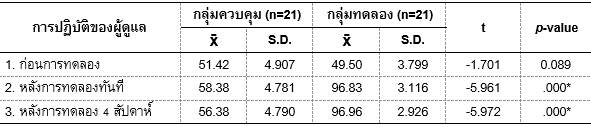
The research findings revealed that after receiving the program, the experimental group’s mean scores for knowledge and practice were significantly higher than their pre-test levels. Knowledge scores increased from 5.54 (SD = 1.414) to 24.13 (SD = 1.191), while practice scores rose from 49.50 (SD = 3.799) to 96.83 (SD = 3.116) (p < .001). Compared to the control group, the experimental group demonstrated significantly higher mean scores for both knowledge and practice immediately after receiving the program and at the 4-week follow-up (p < .001). These results suggest that the discharge preparation program is effective in enhancing the knowledge and caregiving practices of caregivers for infants with acyanotic congenital heart disease. Consequently, this program should be integrated into discharge planning to ensure infants are healthy, reduce complications, and be ready for surgery and readiness for surgery according to the doctor’s treatment plan.
References
Siriboonpipattana P, Pengpan K. Caring for premature infants with enteral feeding. Reg Health Promot Cent 9 J. 2021;15(36):15–30. (in Thai)
Wu W, He J, Shao X. Incidence and mortality trend of congenital heart disease at the global, regional, and national level, 1990–2017. Medicine (Baltimore). 2020;99(23):e20593. doi:10.1097/MD.0000000- 000020593.
Liu Y, Chen S, Zühlke L, Black GC, Choy MK, Li N, et al. Global birth prevalence of congenital heart defects 1970–2017: updated systematic review and meta-analysis of 260 studies. Int J Epidemiol. 2019;48(2):455–63. doi:10.1093/ije/dyz009.
Jaisomkom A, Wangsawat T. Children with congenital heart disease in primary care unit: a continuing care at home (CCaH) program and its effects on motivation, hygiene factors, as well as satisfaction of nurses. Sth Coll Netw J Nurs Public Health. 2022;9(1):310–24. (in Thai)
Intaranarong K, Klunklin P, Namprom N. Health literacy and caring for children with congenital heart disease after cardiac surgery of caregivers. Sth Coll Netw J Nurs Public Health. 2023;10(1):182–95. (in Thai)
Nayeri ND, Roddehghan Z, Mahmoodi F, Mahmoodi P. Being parent of a child with congenital heart disease: what does it mean? A qualitative research. BMC Psychol. 2021;9(1):33. doi:10.1186/s40359- 021-00539-0.
Sumatchaya K, Chotibang J, Niyomkar S. Factors influencing readiness for hospital discharge among mothers of infants with acyanotic congenital heart disease. Nurs J. 2020;47(4):1–14. (in Thai)
Al-Dabbagh H, Al-Hassani A. Barriers to effective discharge planning for parents of children with congenital heart disease: a qualitative study. J Pediatr Nurs. 2023;37(4):382–90. doi:10.1016/j.pedhc.- 2023.01.002.
Tinnuch S, Jirapaet V. The effect of discharge planning program on caregiver’s caring behavior for children with congenital heart disease after heart surgery at home. J R Thai Army Nurses. 2020;21(1) :397–405. (in Thai)
Weiss ME, Johnson NL, Malin S, Jerofke T, Lang C, Sherburne E. Readiness for discharge for parents of hospitalized children. J Pediatr Nurs. 2008;23(4):282–95. doi:10.1016/j.pedn.2008.01.006.
Meleis AI, Sawyer LM, Im EO, Messias DK, Schumacher K. Experiencing transitions: an emerging middle-range theory. Adv Nurs Sci. 2000;23(1):12–28.
Gray JR, Grove SK, Sutherland S. Burns and Grove's the practice of nursing research: appraisal, synthesis, and generation of evidence. 8th ed. St. Louis (MO): Elsevier; 2017.
Gupta KK, Attri JP, Singh A, Kaur H, Kaur G. Basic concepts for sample size calculation: critical step for any clinical trials. Saudi J Anaesth. 2016;10(3):328–31.
Srisatidnarakul B. Research methodology in nursing science. 2nd ed. Bangkok: U&I Inter Media; 2007. (in Thai)
Bloom SB. Human characteristics and school learning. New York (NY): McGraw-Hill; 1976.
Tantishiriwat K, Kittithawornrat W, Pongsiripornkul S. The effect of a discharge planning program combined with video-assisted education on knowledge and caring behaviors among caregivers of infants with acyanotic congenital heart disease. Thai J Cardio-Thorac Nurs. 2022;33(1):145–59. (in Thai)
Phongsiri P. Development of a discharge planning model for caregivers of children with chronic illness using home ventilators: an application of the transitions theory. Thai Red Cross Nurs J. 2022;15(2):190–205. (in Thai)
Alzahrani S, Al-Otaibi MS, Al-Amri SA. The impact of teach-back-based discharge education on parental readiness and readmission rates in pediatric cardiac care: a quasi-experimental study. J Pediatr Nurs. 2024;75(1):112–19.
Pikulngam J, Teerarungsikul N, Sananreangsak S. Effects of a preparation program for mothers during the transition on infant care behaviors and preterm infants' body weight. J Bamrasnaradura Infect Dis Inst. 2024;18(2):69–80. (in Thai)
Apichutboonchock S. Effects of maternal preparation program on self-efficacy to prevent infection in preterm infants before discharge and readmission rates before follow-up appointments. J Health Sci BCNSP. 2022;6(1):59–71. (in Thai)
Downloads
Published
How to Cite
Issue
Section
License
Copyright (c) 2026 University of Phayao

This work is licensed under a Creative Commons Attribution-NonCommercial-NoDerivatives 4.0 International License.
ผู้นิพนธ์ต้องรับผิดชอบข้อความในบทนิพนธ์ของตน มหาวิทยาลัยพะเยาไม่จำเป็นต้องเห็นด้วยกับบทความที่ตีพิมพ์เสมอไป ผู้สนใจสามารถคัดลอก และนำไปใช้ได้ แต่จะต้องขออนุมัติเจ้าของ และได้รับการอนุมัติเป็นลายลักษณ์อักษรก่อน พร้อมกับมีการอ้างอิงและกล่าวคำขอบคุณให้ถูกต้องด้วย
The authors are themselves responsible for their contents. Signed articles may not always reflect the opinion of University of Phayao. The articles can be reproduced and reprinted, provided that permission is given by the authors and acknowledgement must be given.