Antiproliferative activity of pomegranate peel extracts against colorectal cancer cells
Keywords:
Pomegranate peel extract, Cytotoxicity, Colorectal cancer cellsAbstract
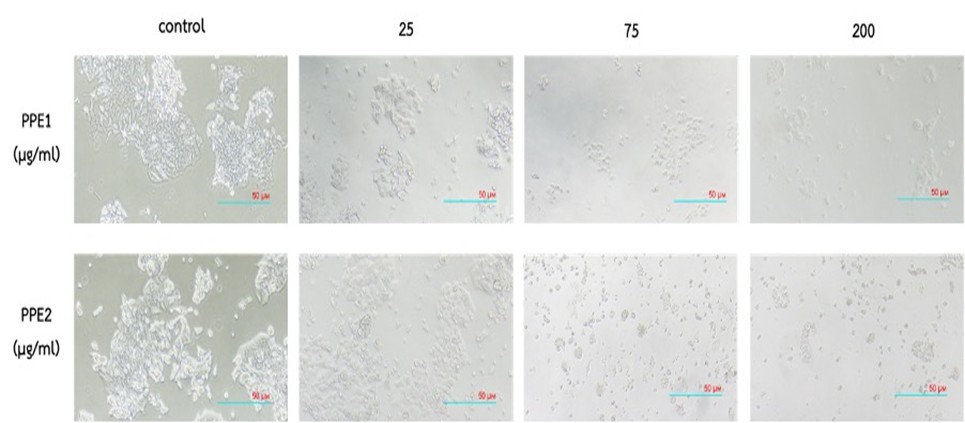
Pomegranate peel (Punica granatum) exhibits diverse biological activities including antioxidant anti-inflammatory and anti-cancer properties. In Traditional Chinese Medicine, pomegranate peel has been reported as a potential treatment for cancer. This study aimed to evaluate the cytotoxicity and anti-cancer effects of two pomegranate peel extracts (ethanolic extract; PPE1 and commercial extract; PPE2) on HCT116 colorectal cancer cell line. The cell viability was assessed using the trypan blue exclusion assay. The results demonstrated that both PPE1 and PPE2 exhibited cytotoxic effects against HCT116 cells at increasing concentrations (25-200 µg/ml) and times dependent manners (24-48 h). At 24 hours, there was 50% cell death at concentrations more than 200 µg/ml. Additionally, at 48 hours, both PPE1 and PPE2 extracts at 200 µg/ml exhibited approximately 50% cell viability. We evaluated cell-proliferation and self-renewal abilities using the MTS and clonogenic assays. The result revealed that treatment of HCT116 with PPE1 (25-100 µg/ml) caused a statistically significant reduction in cell number (p<0.05) compared to the untreated control group. Treatment with PPE2 also resulted in a decrease of the cell number (p<0.05). Interestingly, both PPE1 and PPE2 significantly decreased the number and size of cellular colonies. These findings demonstrate that pomegranate peel extracts exhibit cytotoxicity and effectively inhibit the proliferation of colorectal cancer cells (HCT116). Pomegranate peel extract has promising potential for future development as a natural anticancer agent.
References
World Health Organization. Cancer [Internet]. Geneva: World Health Organization; [cited 2025 Apr 4]. Available from: https://www.who.int/news-room/fact-sheets/detail/cancer.
Sawicki T, Ruszkowska M, Danielewicz A, Niedzwiedz E, Arlukowicz T, Przybylowicz KE. A Review of Colorectal Cancer inTerms of Epidemiology, Risk Factors, Development, Symptoms and Diagnosis. Cancers (Basel). 2021;13(9):2025.
Hanahan D. Hallmarks of cancer: new dimensions. Cancer Discov. 2022;12(1):31–46.
Esmeeta A, Adhikary S, Dharshnaa V, Swarnamughi P, Ummul Maqsummiya Z, Banerjee A, et al. Plant-derived bioactive compounds in colon cancer treatment: An updated review. Biomed Pharmacother. 2022;153:113384.
Engstrand J, Nilsson H, Strömberg C, Jonas E, Freedman J. Colorectal cancer liver metastases – a population-based study on incidence, management and survival. BMC Cancer. 2018;18(1):78.
Yang B, Zhong G. Traditional Chinese pharmacology. 3rd ed. Beijing: China Traditional Chinese Medicine Press; 2021. (In Chinese)
Faculty of Pharmaceutical Sciences, Ubon Ratchathani University. Thai herbal database [Internet]. Ubon Ratchathani: UBU Herb Garden; [cited 2025 Apr 5]. Available from: https://phar.ubu.ac.th/herb-DetailPhargarden/230. (In Thai)
Mendes PM, Gomes Fontoura GM, Rodrigues LDS, Souza AS, Viana JPM, Fernandes Pereira AL, et al. Therapeutic Potential of Punica granatum and Isolated Compounds: Evidence-Based Advances to Treat Bacterial Infections. Int J Microbiol. 2023;2023:4026440.
Pengkumsri N, Kaewdoo K, Leeprechanon W, Sundaram Sivamaruthi B. Influence of Extraction Methods on Total Phenolic Content and Antioxidant Properties of Some of the Commonly Used Plants in Thailand. Pak J Biol Sci. 2019;22(3):117–26.
Teniente SL, Flores-Gallegos AC, Esparza-González SC, Campos-Múzquiz LG, Nery-Flores SD, Rodríguez-Herrera R. Anticancer Effect of Pomegranate Peel Polyphenols against Cervical Cancer. Antioxidants (Basel). 2023;12(1):127.
Elbakry MMM, ElBakary NM, Hagag SA, Hemida EHA. Pomegranate Peel Extract Sensitizes Hepatocellular Carcinoma Cells to Ionizing Radiation, Induces Apoptosis and Inhibits MAPK, JAK/STAT3, β-Catenin/NOTCH, and SOCS3 Signaling. Integr Cancer Ther. 2023;22:15347354221151021.
Tamborlin L, Sumere BR, de Souza MC, Pestana NF, Aguiar AC, Eberlin MN, et al. Characterization of pomegranate peel extracts obtained using different solvents and their effects on cell cycle and apoptosis in leukemia cells. Food Sci Nutr. 2020;8(10):5483–96.
Huang T, Zhang X, Wang H. Punicalagin inhibited proliferation, invasion and angiogenesis of osteosarcoma through suppression of NF κB signaling. Mol Med Rep. 2020;22(3):2386–94.
Subkorn P, Norkaew C, Deesrisak K, Tanyong D. Punicalagin, a pomegranate compound, induces apoptosis and autophagy in acute leukemia. PeerJ. 2021;9:e12303.
Sharma K, Kesharwani P, Prajapati SK, Jain A, Jain D, Mody N, et al. An Insight into Anticancer Bioactives from Punica granatum (Pomegranate). Anticancer Agents Med Chem. 2022;22(4):694–702.
Sayed S, Alotaibi SS, El-Shehawi AM, Hassan MM, Shukry M, Alkafafy M, et al. The Anti-Inflammatory, Anti-Apoptotic, and Antioxidant Effects of a Pomegranate-Peel Extract against Acrylamide-Induced Hepatotoxicity in Rats. Life (Basel). 2022;12(2):224.
Huang D, Qiu H, Luo W, Xu G, Liang Q, Deng H. Research on separation, purification and antioxidation of polyphenols from pomegranate peel. Bot Res. 2018;7(5):514–22. (In Chinese)
Strober W. Trypan Blue Exclusion Test of Cell Viability. Curr Protoc Immunol. 2015;111:A3.B.1-A3.B.3.
Ratanabunyong S, Siriwaseree J, Wanaragthai P, Krobthong S, Yingchutrakul Y, Kuaprasert B, et al. Exploring the apoptotic effects of sericin on HCT116 cells through comprehensive nanostring transcriptomics and proteomics analysis. Sci Rep. 2024;14(1):2366.
Riss TL, Moravec RA, Niles AL, Duellman S, Benink HA, Worzella TJ, et al. Cell viability assays. In: Markossian S, Grossman A, Arkin M, Auld D, Austin C, Baell J, et al., editors. Assay Guidance Manual, 1st ed. Bethesda (MD): Eli Lilly & Company and the National Center for Advancing Translational
Sciences; 2004. [Internet]. [cited 2025 Apr 5]. Available from: http://www.ncbi.nlm.nih.gov/books/NBK144065.
Ratsada P, Hijiya N, Hidano S, Tsukamoto Y, Nakada C, Uchida T, et al. DUSP4 is involved in the enhanced proliferation and survival of DUSP4-overexpressing cancer cells. Biochem Biophys Res Commun. 2020;528(3):586–93.
Praphasawat R, Thakaew S, Rawangkan A, Thongboontho R, Sooksaen P, Laovittayangkoon S, et al. Anticancer and Antimutagenic Properties of Pogonatherum paniceum on Colorectal Cancer Cells. World J Oncol. 2023;14(4):266–76.
Shirode AB, Kovvuru P, Chittur SV, Henning SM, Heber D, Reliene R. Antiproliferative effects of pomegranate extract in MCF-7 breast cancer cells are associated with reduced DNA repair gene expression and induction of double strand breaks. Mol Carcinog. 2014;53(6):458–70.
Manasatian J, Woraratphoka J. Pomegranate peel water extract induces apoptosis in breast cancer cells. Health Sci Tech Rev. 2022;15(2):42–58. (In Thai)
Waly MI, Ali A, Guizani N, Al-Rawahi AS, Farooq SA, Rahman MS. Pomegranate (Punica granatum) peel extract efficacy as a dietary antioxidant against azoxymethane-induced colon cancer in rat. Asian Pac J Cancer Prev. 2012;13(8):4051–5.
Guo H, Zhang D, Fu Q. Inhibition of Cervical Cancer by Promoting IGFBP7 Expression Using Ellagic Acid from Pomegranate Peel. Med Sci Monit. 2016;22:4881–6.
Ni X, Shang FS, Wang TF, Wu DJ, Chen DG, Zhuang B. Ellagic acid induces apoptosis and autophagy in colon cancer through the AMPK/mTOR pathway. Tissue Cell. 2023;81:102032.
Downloads
Published
How to Cite
Issue
Section
License
Copyright (c) 2025 University of Phayao

This work is licensed under a Creative Commons Attribution-NonCommercial-NoDerivatives 4.0 International License.
ผู้นิพนธ์ต้องรับผิดชอบข้อความในบทนิพนธ์ของตน มหาวิทยาลัยพะเยาไม่จำเป็นต้องเห็นด้วยกับบทความที่ตีพิมพ์เสมอไป ผู้สนใจสามารถคัดลอก และนำไปใช้ได้ แต่จะต้องขออนุมัติเจ้าของ และได้รับการอนุมัติเป็นลายลักษณ์อักษรก่อน พร้อมกับมีการอ้างอิงและกล่าวคำขอบคุณให้ถูกต้องด้วย
The authors are themselves responsible for their contents. Signed articles may not always reflect the opinion of University of Phayao. The articles can be reproduced and reprinted, provided that permission is given by the authors and acknowledgement must be given.