The use of simple muscle strength tests to reflect body compositions in elderly
Keywords:
Muscle mass, Bone mass, Push-up test, Grip strength, Older adultAbstract
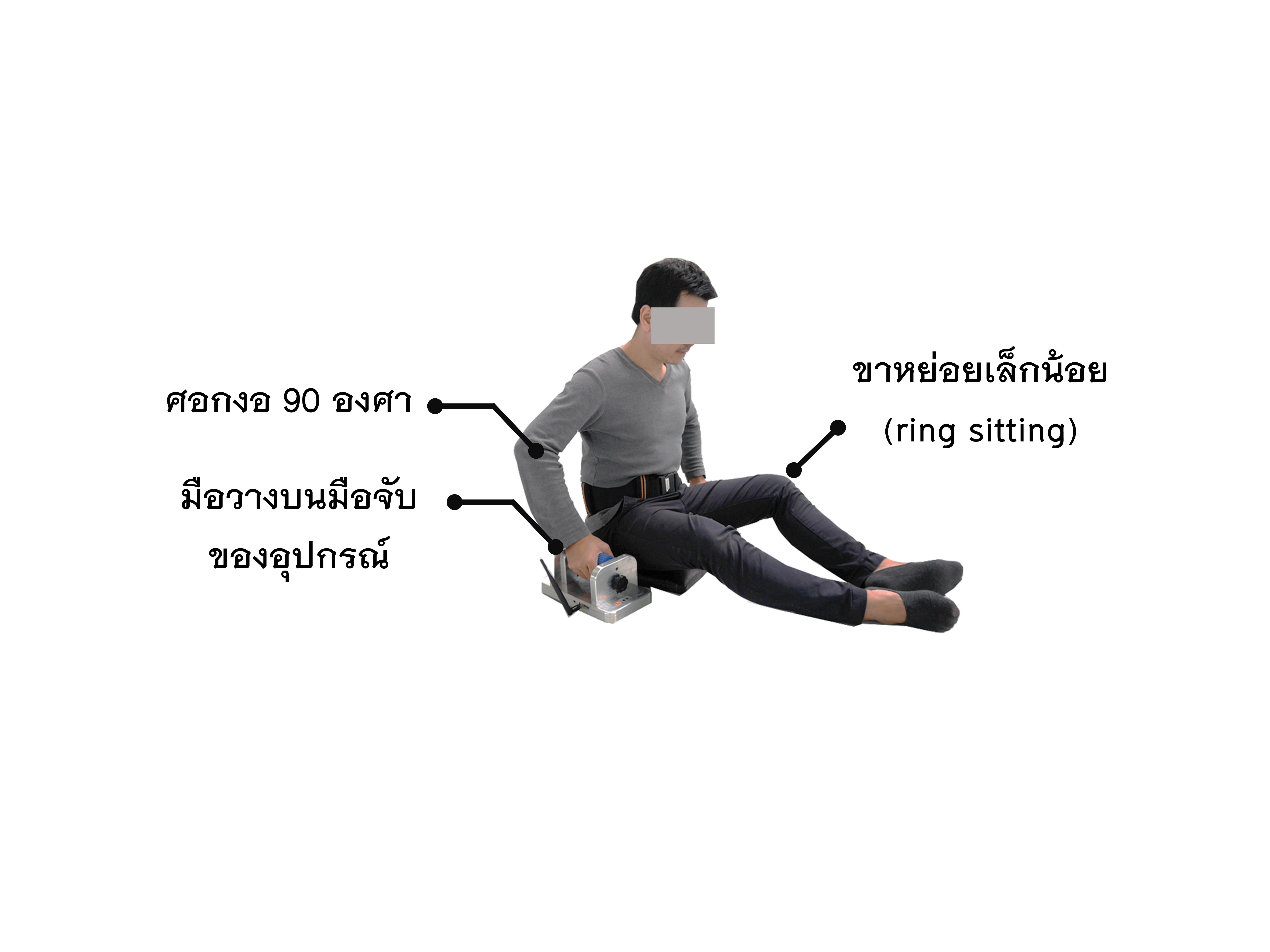
The study explored the correlation of three simple muscle strength tests (including grip strength test, five times sit-to-stand test, and upper limb loading during seated push-up test) and body compositions (including total skeletal muscle mass, bone mass, and fat mass) in 30 participants, aged 65 years and over. Participants were assessed using the three methods of muscle strength tests in a random order. Then, within 7 days, they were appointed to assess for their body compositions at a hospital. The correlation between outcomes of muscle strength tests and body compositions was analyzed using Pearson correlation coefficients and Spearman's correlation coefficient according to the data distribution. The findings indicated that grip strength test was significantly correlated with total muscle mass and bone mass (r=0.585-0.699, p<0.001). Five times sit-to-stand test significantly associated with the body fat mass (ρ= 0.471, p= 0.009), whereas the upper limb loading during seated push-up test was significantly related to all three body compositions (r=0.597-0.762, p<0.001). With their crucial roles for many bodily functions but the assessments for body compositions require a complex and costly machine, the present findings suggest the use of upper limb loading during a seated push-up test as a simple measure to assess and periodic monitor body compositions in elderly.
References
Frontera WR, Ochala J. Skeletal muscle: a brief review of structure and function. Calcif Tissue Int. 2015 96(3), 183–95.
Kim KM, Jang HC, Lim S. Differences among skeletal muscle mass indices derived from height-, weight-, and body mass index-adjusted models in assessing sarcopenia. Korean J Intern Med. 2016; 31(4): 643-50.
Lee K, Shin Y, Huh J, Sung YS, Lee IS, Yoon KH, et al. Recent issues on body composition imaging for sarcopenia evaluation. Korean J Radiol. 2019; 20(2): 205-17.
Tsekoura M, Billis E, Gliatis J, Matzaroglou C, Koutsojannis C, Tsepis E, et al. Assessment of muscle mass in the elderly in clinical practice. Athens Medical Society. 2017; 34(6): 745-753.
Müller MJ, Baracos V, Bosy-Westphal A, Dulloo A, Eckel J. Functional body composition and related aspects in research on obesity and cachexia. Obes Rev. 2014; 15(8), 640–656.
St-Onge MP, Gallagher D. Body composition changes with aging: the cause or the result of alterations in metabolic rate and macronutrient oxidation?. Nutrition. 2010; 26(2),152–155.
Kim TN, Choi KM. Sarcopenia: definition, epidemiology, and pathophysiology. J Bone Metab. 2013; 20(1) :1-10.
Guerri S, Mercatelli D, Aparisi Gómez MP, Napoli A, Battista G, Guglielmi G, et al. Quantitative imaging techniques for the assessment of osteoporosis and sarcopenia. Quant Imaging Med Surg. 2018; 8(1): 60-85.
Yoon BH, Lee JK, Choi DS, Han SH. Prevalence and associated risk factors of sarcopenia in female patients with osteoporotic fracture. J Bone Metab. 2018;25 (1), 59-62.
Beaudart C, Rolland Y, Cruz-Jentoft AJ, Bauer JM, Sieber C, Cooper C, et al. Assessment of muscle function and physical performance in daily clinical practice: a position paper endorsed by the European society for Clinical and Economic Aspects of Osteoporosis, Osteoarthritis and Musculoskeletal Diseases (ESCEO). Calcif Tissue Int. 2019; 105(1): 1-14.
Cruz-Jentoft AJ, Bahat G, Bauer J, Boirie Y, Bruyère O, Cederholm T, et al. Sarcopenia: revised European consensus on definition and diagnosis. Age Ageing. 2019; 48(1): 16-31.
Tramontano A, Veronese N, Sergi G, Manzato E, Rodriguez-Hurtado D, Maggi S, et al. Prevalence of sarcopenia and associated factors in the healthy older adults of the Peruvian Andes. Arch Gerontol Geriatr. 2017; 68: 49-54.
Sherk VD, Palmer IJ, Bemben MG, Bemben DA. Relationships between body composition, muscular strength, and bone mineral density in estrogen-deficient postmenopausal women. J Clin Densitom. 2009; 12(3): 292–8.
Verschueren S, Gielen E, O’Neill TW, Pye SR, Adams JE, Ward KA, et al. Sarcopenia and its relationship with bone mineral density in middle-aged and elderly European men. Osteoporos Int. 2013; 24(1): 87-98.
Mehmet H, Yang AWH, Robinson SR. Measurement of hand grip strength in the elderly: A scoping review with recommendations. J Bodyw Mov Ther. 2019; 24(2020) 235-43.
Siriyakul C, Kosura N. Possibility of using a seated push up test to determine skeletal muscle mass in older adults. [term paper of Bachelor of Science (Physical Therapy)]. Khon Kaen: faculty of associated medical sciences, Khon Kaen University; 2019.
The Centers for Medicare & Medicaid Services. The inpatient rehabilitation facility-patient assessment instrument (IRF-PAI) training manual: effective 10/01/2014. [n.p.]; 2014.
Srisim K, Saengsuwan J, Amatachaya S. Functional assessments for predicting a risk of multiple falls in independent ambulatory patients with spinal cord injury. J Spinal Cord Med. 2015; 38(4), 439-45.
Su Y, Hirayama K, Han T-F, Izutsu M, Yuki M. Sarcopenia prevalence and risk factors among Japanese community dwelling older adults living in a snow-covered City according to EWGSOP2. J Clin Med. 2019; 8(3): 1-13.
Chirawatkul A. Statistics for health science research. 3rd ed. Bangkok: Wittayapat; 2013.
Bujang MA, Baharum N. Sample size guideline for correlation analysis. World J Soc Sci Res. 2016; 3(1): 37-46.
Reuter SE, Massy-Westropp N, Evans AM. Reliability and validity of indices of hand-grip strength and endurance. Aust Occup Ther J. 2011; 58(2): 82-7.
Kwon I, Kim JS, Shin CH, Park Y, Kim JH. Associations between skeletal muscle mass, grip strength, and physical and cognitive functions in elderly women: effect of exercise with resistive Theraband. J Exerc Nutrition Biochem. 2019; 23(3): 50-5.
Alonso AC, Ribeiro SM, Luna NMS, Peterson MD, Bocalini DS, Serra MM, et al. Association between handgrip strength, balance, and knee flexion/extension strength in older adults. PLOS ONE. 2018; 13(6): e0198185.
Wiraguna A, Setiati S. Correlation of handgrip strength with quality of life in elderly patients. J Phys Conf. Ser 2018; 1073: 042033.
Roberts HC, Denison HJ, Martin HJ, Patel HP, Syddall H, Cooper C, et al. A review of the measurement of grip strength in clinical and epidemiological studies: towards a standardised approach. Age Ageing. 2011;40 (4): 423-9.
Vetrano DL, Landi F, Volpato S, Corsonello A, Meloni E, Bernabei R, et al. Association of sarcopenia with short- and long-term mortality in older adults admitted to acute care wards: results from the CRIME study. J Gerontol A Biol Sci Med Sci. 2014; 69(9): 1154-61.
Bohannon RW, Bubela DJ, Magasi SR, Wang YC, Gershon RC. Sit-to-stand test: performance and determinants across the age-span. Isokinet Exerc Sci. 2010;18(4): 235-40.
Goldberg A, Chavis M, Watkins J, Wilson T. The five-times-sit-to-stand test: validity, reliability and detectable change in older females. Aging Clin Exp Res. 2012; 24(4): 339-44.
Short F, Winnick J. Test items and standards related to muscle strength and endurance on the brockport physical fitness test. Adapt Phys Activ Q. 2005; 22: 371-400.
Chen Z, Wang Z, Lohman T, Heymsfield SB, Outwater E, Nicholas JS, et al. Dual-Eenergy X-ray absorptiometry is a valid tool for assessing skeletal muscle mass in older women. J Nutr. 2007; 137(12): 2775-80.
Moreira OC, Oliveira CEP de, De Paz JA. Dual energy X-ray absorptiometry (DXA) reliability and intraobserver reproducibility for segmental body composition measuring. Nutr Hosp. 2018; 35(2): 340-5.
Lorente Ramos RM, Azpeitia Armán J, Arévalo Galeano N, Muñoz Hernández A, García Gómez JM, Gredilla Molinero J. Dual energy X-ray absorptimetry: fundamentals, methodology, and clinical applications. Radiologia. 2012; 54(5): 410-23.
Scott W, Stevens J, Binder–Macleod SA. Human skeletal muscle fiber type classifications. Phys Ther. 2001; 81(11): 1810-6.
Talbot J, Maves L. Skeletal muscle fiber type: using insights from muscle developmental biology to dissect targets for susceptibility and resistance to muscle disease. Wiley Interdiscip Rev Dev Biol. 2016; 5(4): 518-34.
Eksakulkla S, Siriphorn A, Chamonchant D. Five-times-sit-to-stand test time in adults with normal weight, overweight and obesity. Thai Journal of Physical Therapy. 2018; 40(3): 95-103.
Ingrová P, Králík M, Bártová V. Relationships between the hand grip strength and body composition in Czech and Slovak students. Slov Antropol. 2017; 20(1): 30-43.
Dahmane R, Djordjevic S, Simunic B, Valencic V. Spatial fiber type distribution in normal human muscle Histochemical and tensiomyographical evaluation. J Biomech. 2005; 38(12): 2451–9.
Bohannona RW, Shovea ME, Barrecab SR, Mastersd LM, Sigouinc CS. Five-repetition sit-to-stand test performance by community-dwelling adults: a preliminary investigation of times, determinants, and relationship with self-reported physical performance. IES. 2007; 15(2007): 77–81.
Kotani Y, Tokuhiro A. Kinesiological study of the push-up motion in spinal cord injury patients: involving measurement of hand pressure applied to a force plate. Acta Med Okayama. 2002; 56(2): 75-82.
Downloads
Published
How to Cite
Issue
Section
License
Copyright (c) 2021 Naresuan Phayao Journal

This work is licensed under a Creative Commons Attribution-NonCommercial-NoDerivatives 4.0 International License.
ผู้นิพนธ์ต้องรับผิดชอบข้อความในบทนิพนธ์ของตน มหาวิทยาลัยพะเยาไม่จำเป็นต้องเห็นด้วยกับบทความที่ตีพิมพ์เสมอไป ผู้สนใจสามารถคัดลอก และนำไปใช้ได้ แต่จะต้องขออนุมัติเจ้าของ และได้รับการอนุมัติเป็นลายลักษณ์อักษรก่อน พร้อมกับมีการอ้างอิงและกล่าวคำขอบคุณให้ถูกต้องด้วย
The authors are themselves responsible for their contents. Signed articles may not always reflect the opinion of University of Phayao. The articles can be reproduced and reprinted, provided that permission is given by the authors and acknowledgement must be given.