ผลของระดับโปรตีนในอาหารข้นต่อสมรรถภาพการเจริญเติบโตและการใช้ประโยชน์ได้ของโภชนะของแพะพื้นเมืองเพศผู้ระยะเจริญเติบโต
คำสำคัญ:
ระดับโปรตีนในอาหาร, แพะพื้นเมืองเพศผู้, สมรรถภาพการเจริญเติบโต, การใช้ประโยชน์ได้ของโภชนะบทคัดย่อ
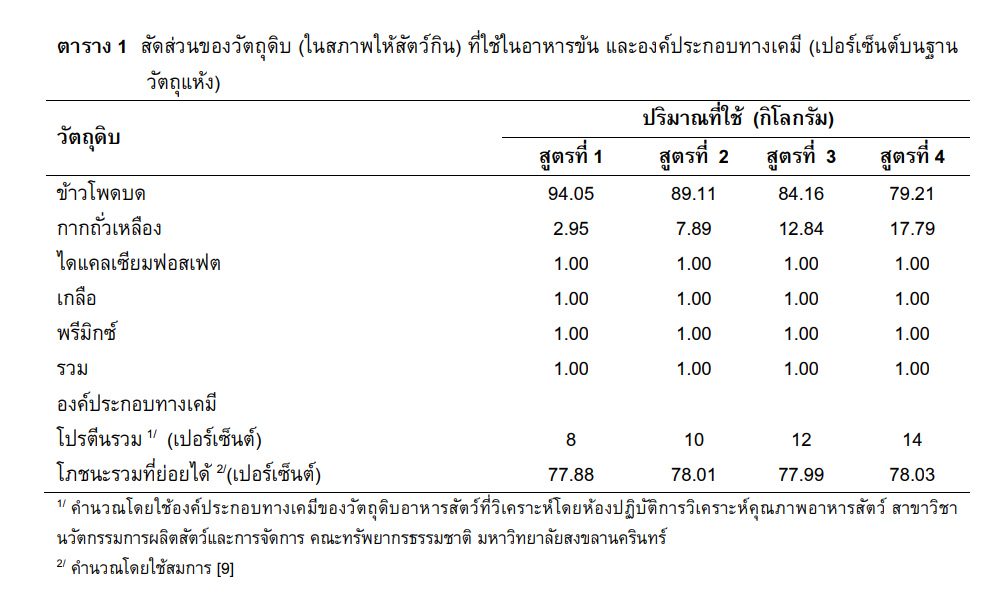
ผลของระดับโปรตีนในอาหารข้นต่อการเจริญเติบโตและการใช้ประโยชน์ของโภชนะของแพะพื้นเมืองไทยเพศผู้ ระยะเจริญเติบโต โดยใช้แพะพื้นเมืองไทย เพศผู้ อายุ 5.81 ± 0.40 เดือน น้ำหนักเฉลี่ย 11.5 ± 2.1 กิโลกรัม จำนวน 16 ตัว ทำการสุ่มแบ่งแพะเป็น 4 กลุ่ม กลุ่มละ 4 ตัว ตามแผนการทดลองแบบสุ่มสมบูรณ์ ให้แพะได้รับหญ้าแพงโกล่าแห้งเสริมอาหารข้นที่ระดับโปรตีน 8, 10, 12, และ 14 เปอร์เซ็นต์ ในระดับ 2 เปอร์เซ็นต์ของน้ำหนักตัวบนฐานของวัตถุแห้ง ใช้ระยะเวลาทดลอง 180 วัน พบว่า แพะทั้ง 4 กลุ่ม มีปริมาณหญ้าแห้งที่กินได้ไม่แตกต่างกันทางสถิติ (P>0.05) ในขณะที่ปริมาณอาหารข้นที่กินได้ (40.39, 41.89, 42.67 และ 43.12 กรัมต่อกิโลกรัมน้ำหนักเมแทบอลิก) เพิ่มขึ้นในรูปแบบของเส้นตรงตามระดับโปรตีนที่เพิ่มขึ้นในอาหารข้น อย่างไรก็ตาม ปริมาณอาหารทั้งหมด (หญ้าแห้ง+อาหารข้น) ที่แพะทั้ง 4 กลุ่มกินได้ ไม่แตกต่างกันในทางสถิติ (P>0.05) ในทำนองเดียวกันอัตราการเจริญเติบโตเฉลี่ยต่อวัน (37.96, 51.74, 50.00 และ 56.25 กรัมต่อวัน) เพิ่มขึ้นในรูปแบบของเส้นตรงตามระดับโปรตีนที่เพิ่มขึ้นในอาหารข้น ระดับโปรตีนที่เพิ่มขึ้นในอาหารข้น ไม่ทำให้สัมประสิทธิ์การย่อยได้ของโภชนะและสมดุลไนโตรเจนต่างกันทางสถิติ (P>0.05) แต่ทำให้ปริมาณไนโตรเจนที่แพะได้รับ (5.36, 7.38, 8.73 และ 9.35 กรัมต่อวัน) และระดับยูเรีย-ไนโตรเจนในเลือด (7.78, 11.45, 16.38 และ 21.16 มิลลิกรัมเปอร์เซ็นต์) เพิ่มขึ้นอย่างมีนัยสำคัญทางสถิติ (P<0.05) ดังนั้น จากการศึกษาครั้งนี้ พบว่า แพะพื้นเมืองไทยเพศผู้ระยะเจริญเติบโตที่ได้รับหญ้าแพงโกล่าแห้งควรได้รับอาหารข้นที่มีโปรตีน 14 เปอร์เซ็นต์
เอกสารอ้างอิง
Monteiro A, Costa JM, Lima MJ. Goat System Productions: Advantages and Disadvantages to the Animal, Environment and Farmer. London: IntechOpen Limited; 2017. 366 p.
Department of Livestock Development [Internet]. Accessed 2020 February 1. Available from: http://ict.dld.go.th/webnew/index.php/th/service-ict/report/247-reportthailand-livestock.
Chobtang J, Intharak K, Isuwan A. Effects of dietary crude protein levels on nutrient digestibility and growth performance of Thai indigenous male goats. SJST 2009;31(6): 591-6.
Mohsin I, Shahid MQ, Haque MN, Ahmad N, Mustafa H. Effect of dietary protein level on growth and body condition score of male Beetal goats during summer. S. Afr. J. Anim. Sci. 2019; 49(5):898-901.
Pralomkarn W, Kochapakdee S, Saithanoo S. Energy and protein utilization for maintenance and growth of Thai native and Anglo-Nubian X Thai native male weaner goats. Small Rumin. Res. 1995; 16:13-20.
Choi SH, Kim SW, Park BY, Sang BD, Kim YK, Myung JH, Hur SN. Effects of dietary crude protein level on growth and meat quality of Korean native goats. J. Anim. Sci. Technol (kor) 2005; 47(5):783-8.
NRC. Nutrient Requirements of Goat: Angora, Dairy and Meat Goats in Temperate and Tropical Countries. Washington D.C: National Academy Press; 1981. 91 p.
Negesse T, Rodehutscord M, Pfeffer E. The effect of dietary crude protein level on intake, growth, protein retention and utilization of growth male Saanen kids. Small Rumin. Res. 2001; 39:243-51.
Kearl LC. Nutrient Requirements of Ruminants in Developing Countries. Utah: International Feed Stuffs Institue, Utah Agricuture Experiment Station Utha State University; 1982. 381 p.
AOAC. Official Methods of Analysis. 15th edition. Washington D.C: Association Official Analytical Chemists; 1990. 656 p.
Van Soest PJ, Robertson JB, Lewis BA. Methods for dietary fiber, neutral detergent fiber and non starch polysaccharides in relation to animal nutrition. J. Dairy Sci. 1991; 74(10):3583–97.
Steel RGD, Torrie JH. Principles and Procedures of Statistics (A Biometrics Approach). 2nd edition. New York: McGraw-Hill; 1980. 633 p.
Isuwan A, Chobtang J and Chankot T. Nutritive value evaluation of Digitaria eriantha hay and pellets at different regrowth intervals consumed in goats. Proceeding of the 9th National Kasetsart University Kamphaeng Saen Conference (KU-KPS); 2012 December 6-7; Kamphaeng Saen, Thailand. 2012.
National Bureau of Agricultural Commodity and Food Standards [Internet]. Accessed 2019 May 27. Available from: https://www.acfs.go.th/standard/download/eng/std%20_pangola_hay.pdf.
Manitoba Goat Association [Internet]. Accessed 2019 May 27. Available from: https://www.gov.mb.ca/agriculture/livestock/goat/pubs/goats-andtheirnutrition.pdf.
AFRC. The Nutrition of Goat. New York: CAB International; 1988. 118 p.
Suankool S, Boonruangkao A and Chobtang J. Effects of dietary protein levels on growth performance of Thai indigenous goats during 3 months to one year old. In: Animal Nutrition Division Annual Research Report. Surat Thani: Department of Livstock Development; 2009 p. 44-54.
Park JH, Kim SJ, Jang SY, Lee JW, Yun YS, Moon SH. Effects of dietary crude protein levels on intake, digestibility, and crude protein balance of growing Korean native goats (Capra Hircus Coreanae). J. Anim. Plant. Sci. 2018; 28(4):981-88.
Prieto I, Goetsh AL, Banskalieva V, Cameron M, Puchala R, Sahlu T, Dawson LJ, Coleman SW. Effects of dietary protein concentration on postweaning growth of Boer crossbred and Spanish goat wethers. J. Anim. Sci. 2000; 78:2275-81.
Wanapat M Ruminant Nutrition. Bangkok: Funny Publishing Limited Partnership: 1990. 437 p.
Lloyd S. Blood characteristics and the nutrition of ruminants. Br. Vet. J. 1982; 138(9):70-85.
ดาวน์โหลด
เผยแพร่แล้ว
รูปแบบการอ้างอิง
ฉบับ
ประเภทบทความ
สัญญาอนุญาต
ลิขสิทธิ์ (c) 2021 วารสารนเรศวรพะเยา

อนุญาตภายใต้เงื่อนไข Creative Commons Attribution-NonCommercial-NoDerivatives 4.0 International License.
ผู้นิพนธ์ต้องรับผิดชอบข้อความในบทนิพนธ์ของตน มหาวิทยาลัยพะเยา ไม่จำเป็นต้องเห็นด้วยกับบทความที่ตีพิมพ์เสมอไป ผู้สนใจสามารถคัดลอก และนำไปใช้ได้ แต่จะต้องขออนุมัติเจ้าของ และได้รับการอนุมัติเป็นลายลักษณ์อักษรก่อน พร้อมกับมีการอ้างอิงและกล่าวคำขอบคุณให้ถูกต้องด้วย