ผลของ Spirulina (Arthrospira) platensis ต่อการรอดตายและการเจริญเติบโตของกบนา (Hoplobatrachus rugulosus)
คำสำคัญ:
กบนา, สไปรูลินา, การรอดตาย, การเจริญเติบโต, ค่าโลหิตวิทยาบทคัดย่อ
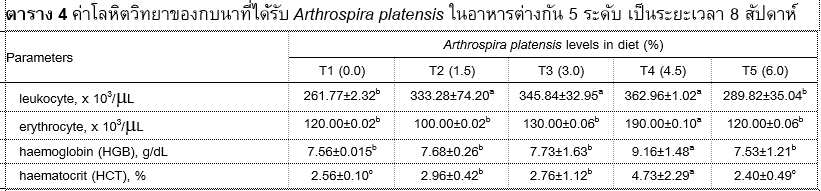
กบนา (Hoplobatrachus rugulosus) เป็นสัตว์เศรษฐกิจที่มีการเพาะเลี้ยงอย่างแพร่หลายเนื่องจากเป็นสัตว์ที่ใช้ระยะเวลาและพื้นที่ในการเลี้ยงน้อย ให้ผลผลิตสูง และเป็นที่ต้องการของตลาดทั้งในและต่างประเทศ ปัญหาที่สำคัญระหว่างการเลี้ยง คือ การเจริญเติบโตไม่เท่ากันเนื่องจากการเลี้ยงในความหนาแน่นสูงและ/หรือให้อาหารไม่เพียงพอ ทำให้เกิดการกัดกินกันเองของกบ ส่งผลทำให้ผลผลิตลดลง แม้ว่ามีการคัดขนาดกบระหว่างการเลี้ยงก็ยังไม่สามารถแก้ไขปัญหาดังกล่าวได้ ดังนั้นการงานวิจัยนี้มีวัตถุประสงค์เพื่อศึกษาผลของ Spirulina (Arthrospira platensis) ที่ผสมในสูตรอาหารในระดับที่แตกต่างกัน 5 ระดับ คือ 0.0 (กลุ่มควบคุม), 1.5, 3.0, 4.5 และ 6.0 เปอร์เซ็นต์ ต่อการรอดตาย การเจริญเติบโต และค่าโลหิตวิทยาของกบนาที่เลี้ยงในบ่อซีเมนต์ โดยวางแผนการทดลองแบบสุ่มสมบูรณ์ 5 ชุดการทดลองๆ ละ 3 ซ้ำ เมื่อสิ้นสุดการทดลอง 8 สัปดาห์ พบว่า อัตราการรอดตาย น้ำหนักตัวสุดท้าย น้ำหนักตัวที่เพิ่ม อัตราการเจริญเติบโตเฉลี่ยต่อวัน อัตราการเจริญเติบโตจำเพาะ และอัตราการแลกเนื้อของกบที่ได้รับ A. platensis และกบในกลุ่มควบคุมไม่มีความแตกต่างกันทางสถิติ (P>0.05) แต่กบที่ได้รับ A. platensis ระดับ 4.5 เปอร์เซ็นต์มีค่าดีที่สุด นอกจากนั้นกบที่ได้รับ A. platensis ระดับ 4.5 เปอร์เซ็นต์ มีปริมาณเม็ดเลือดขาวและเม็ดเลือดแดง haemoglobin และ haematocrit สูงที่สุด และมีความแตกต่างทางสถิติอย่างมีนัยสำคัญ (P<0.05) เมื่อเปรียบเทียบกลุ่มควบคุม ผลจากการศึกษาครั้งนี้แสดงให้เห็นว่าการใช้ A. platensis ที่ระดับ 4.5 เปอร์เซ็นต์ ในสูตรอาหารทำให้กบนาที่เลี้ยงในบ่อซีเมนต์มีแนวโน้มการรอดตาย และการเจริญเติบโตดีขึ้น ซึ่งเกษตรกรสามารถใช้เป็นข้อมูลในการปรับใช้ประโยชน์ในการเลี้ยงกบนาได้
เอกสารอ้างอิง
Fishery Statistics Analysis and Research Group. Statistics of Freshwater Aquaculture Production 2018. Bangkok: Fisheries Development Policy and Strategy Division. Department of Fisheries, Ministry of Agriculture and Cooperatives; 2020.
Glorioso JC, Amborski RL, Amborski GF, Culley DC. Microbiological studies on septicemic bullfrogs (Rana catesbeiana). Am J Vet Res. 1974; 35: 1241-1245.
Hird DJ, Diesch SL, McKinnell RG, Gorham E, Martin FB, Kurtz SW, et al. Aeromonas hydrophila in wild-caught frogs and tadpoles (Rana pipiens) in Minnesota. Lab Anim Sci. 1981; 31: 166-169.
Nyman S. Mass mortality in larval Rana sylvatica attributable to the bacterium, Aeromonas hydrophila. J Herpetol. 1986; 20: 196-201.
Taylor SK, Green DE, Wright KM, Whitaker BR. Bacterial Diseases. In: Wright KM, Whitaker BR, editors. Amphibian Medicine and Captive Husbandry, Original ed. Florida: Krieger Publishing Company; 2001. p. 159-179.
Chinabut S, Areekij S. Comparative study on the integumentary system of tadpole and adult frog (Rana tigerina). Proceeding of the Department of Fisheries of Thailand Annual Seminar; 1995; Bangkok, Thailand.
Ibrahem MD, Mohamed MF, Ibrahim MA. The role of Spirulina platensis (Arthrospira platensis) in growth and immunity of Nile tilapia (Oreochromis niloticus) and its resistance to bacterial infection. J Agric Sci. 2013; 5(6): 109-117.
Patchanee N, Arunkamol S. Effects of Spirulina platensis supplemented diets on growth of green catfish (Hemibagrus filamentus Fang & Chaux, 1949). J Fish Tech Res. 2017; 11(2): 1-10.
Limhang K, Lounsiri B, Horsiwalai P, Wuttiwichayanan W, Silarudee K. Effect of Spirulina platensis on growth performance and survival rates of long-whiskered catfish (Mystus gulio). Khon Kaen Agr J. 2016; 44 (Suppl. 1): 656-661.
Kiriratnikom S, Zaau R, Suwanpugdee, A. Effects of various levels of Spirulina on growth performance and pigmentation in goldfish (Carassius auratus). Songklanakarin J Sci Technol. 2005; 27(Suppl. 1): 133-139.
Teimouri M, Amirkolaie AK, Yeganeh S. The effects of Spirulina platensis meal as a feed supplement on growth performance and pigmentation of rainbow trout (Oncorhynchus mykiss). Aquaculture. 2013; 369-399: 14-19.
Boonta T, Chitmanut C, Promya J. Effects of Spirulina platensis, Cladophora sp. and Allium sativum supplementary diets on growth performance, reproductive maturity, and phagocytic activity in common lowland frog (Rana rugulosa). J Fish Tech Res. 2012; 6(1): 23-35.
Liao WL, Nur-E-Borhan SA, Okada S, Matsui T, Yamaguchi K. Pigmentation of culture black tiger prawn by feeding with a Spirulina-supplemented diet. Nippon Suisan Gakk. 1993; 59(1): 159-165.
Chen YY, Chen JC, Tayag CM, Li HF, Putra DF, Kuo YH, Bai JC, Chan YH. Spirulina elicits the activation of innate immunity and increases resistance against Vibrio alginolyticus in shrimp. Fish Shellfish Immunol. 2016; 55: 690-698.
Wongrat L. Phytoplankton, 1st ed. Bangkok: Kasetsart University Press; 1999.
Phang SM, Chu WL. Catalogue of Strains, University of Malaya Algae Culture Collection (UMACC). Institute of Postgraduate Studies and Research. Kuala Lumpur: University of Malaya; 1999.
Soheili M, Khosravi-Darani K. The potential health benefits of algae and micro algae in medicine: a review on Spirulina platensis. Curr Nutr Food Sci. 2011; 27: 279-285.
Gutiérrez-Salmeán G, Fabila-Castillo L, Chamorro-Cevallos G. Nutritional and toxicological aspects of Spirulina (Arthrospira). Nutr Hosp. 2015; 32 (1): 34-40.
Mathur M. Bioactive Molecules of Spirulina: A Food Supplement. In: Mérillon JM, Ramawat K, editors. Bioactive Molecules in Food. Reference Series in Phytochemistry. Cham: Springer Nature Switzerland AG; 2018. p. 1621-1642.
Menegotto AL, Souza LE, Colla LM, Costa JA, Sehn E, Bittencourt PR, et al. Investigation of techno-functional and physicochemical properties of Spirulina platensis protein concentrate for food enrichment. LWT-Food Sci Technol. 2019; 114: 108267.
Brito AdF, Silva AS, de Oliveira CVC, de Souza AA, Ferreira PB, de Souza ILL, et al. Spirulina platensis prevents oxidative stress and inflammation promoted by strength training in rats: dose-response relation study. Sci Rep. 2020; 10: 6382.
Somsueb P, Boonyaratpalin M. Optimum protein and energy levels for the Thai native frog, Rana rugulosa Weigmann. Aquac Res. 2001; 32(1): 33-38.
AOAC (Association of Official Analytical Chemists). Official Methods of Analysis, 15th ed. Washington, DC: The Association of Official Analytical Chemists; 1990.
NRC (National Research Council). Nutrition Requirement of Fish. Washington, DC: National Academy Press; 1993.
Mansano CF, Vanzela LS, Américo-Pinheiro JH, Macente BI, Khan KU, Fernandes, JB. Importance of Optimum Water Quality Indices in Successful Frog Culture Practices. In: Gökçe D, editor. Limnology: Some New Aspects of Inland Water Ecology. London: IntechOpen Ltd. 2018. p. 133-154.
APHA, AWWA, and WEF (American Public Health Association, American Water Works Association, and Water Environment Federation). Standard Methods for examination of water and wastewater. 22nd ed. Washington, DC: American Public Health Association; 2012.
Smith JM, Stump KC. Isoflurane anesthesia in the African clawed frog (Xenopus laevis). Contemp Top Lab Anim Sci. 2000; 39(6): 39-42.
Heatley JJ, Johnson M. Clinical technique: Amphibian hematology: A practitioner's guide. J Exotic Pet Med. 2009; 18(1): 14-19.
Dernekbasi S, Una H, Karayucel I, Aral O. Effect of dietary supplementation of different rates of Spirulina (Spirulina platensis) on growth and feed conversion in Guppy (Poecilia reticulata Peters, 1860). J Anim Vet Adv. 2010; 9(9): 1395-1399.
Abdel-Tawwab M, Ahmad MH. Live Spirulina (Arthrospira platensis) as a growth and immunity promoter for Nile tilapia, Oreochromis niloticus (L.), challenged with pathogenic Aeromonas hydrophila. Aquac Res. 2009; 40: 1037-1046.
Khalil SR, Reda RM, Awad A. Efficacy of Spirulina platensis diet supplements on disease resistance and immune-related gene expression in Cyprinus carpio L. exposed to herbicide atrazine. Fish Shellfish Immunol. 2017; 67: 119-128.
Adel M, Yeganeh S, Dadar M, Sakai M, Dawood MAO. Effects of dietary Spirulina platensis on growth performance, humoral and mucosal immune responses and disease resistance in juvenile great sturgeon (Huso huso Linnaeus,1754). Fish Shellfish Immunol. 2016; 56: 436-444.
Cao S, Zhang P, Zou T, Fei S, Han D, Jin J, Liu H, Yang Y, Zhu X, Xie S. Replacement of fishmeal by Spirulina Arthrospira platensis affects growth, immune related-gene expression in gibel carp (Carassius auratus gibelio var. CAS III), and its challenge against Aeromonas hydrophila infection. Fish Shellfish Immunol. 2018; 79: 265-273.
ดาวน์โหลด
เผยแพร่แล้ว
รูปแบบการอ้างอิง
ฉบับ
ประเภทบทความ
สัญญาอนุญาต
ลิขสิทธิ์ (c) 2021 วารสารนเรศวรพะเยา

อนุญาตภายใต้เงื่อนไข Creative Commons Attribution-NonCommercial-NoDerivatives 4.0 International License.
ผู้นิพนธ์ต้องรับผิดชอบข้อความในบทนิพนธ์ของตน มหาวิทยาลัยพะเยา ไม่จำเป็นต้องเห็นด้วยกับบทความที่ตีพิมพ์เสมอไป ผู้สนใจสามารถคัดลอก และนำไปใช้ได้ แต่จะต้องขออนุมัติเจ้าของ และได้รับการอนุมัติเป็นลายลักษณ์อักษรก่อน พร้อมกับมีการอ้างอิงและกล่าวคำขอบคุณให้ถูกต้องด้วย