การเปรียบเทียบผลของการออกกำลังกายด้วยลูกบอลและอุปกรณ์แขวนต่อความมั่นคงของหลัง และการทรงท่าในผู้ป่วยที่มีอาการปวดหลังส่วนล่างเรื้อรังแบบไม่จำเพาะ
คำสำคัญ:
ปวดหลังส่วนล่างเรื้อรัง, ออกกำลังกายเพิ่มความมั่นคงของหลัง, การควบคุมการทรงท่า, ระดับความมั่นคงของหลังบทคัดย่อ
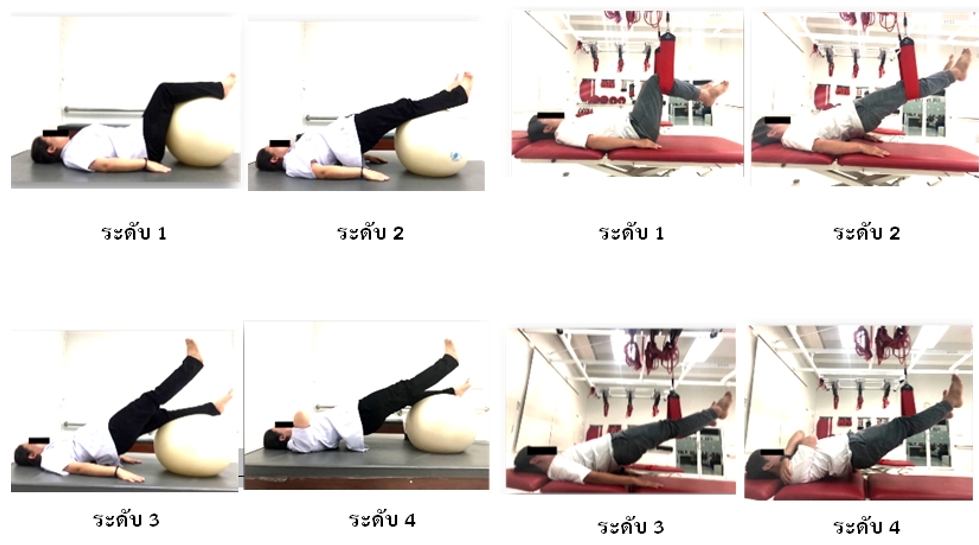
อาการปวดหลังส่วนล่างเรื้อรังเป็นเวลานานส่งผลให้หลังเกิดความไม่มั่นคง การออกกำลังกายโดยใช้อุปกรณ์แขวนและลูกบอลช่วยกระตุ้นการควบคุมของระบบกล้ามเนื้อและประสาท ทำให้เพิ่มความมั่นคงและการทรงท่าได้ดีขึ้น วัตถุประสงค์เพื่อเปรียบเทียบผลของการออกกำลังกายโดยใช้ลูกบอลและอุปกรณ์แขวนต่อความมั่นคงของหลังและการควบคุมการทรงท่า ในผู้ป่วยที่มีอาการปวดหลังส่วนล่างเรื้อรังแบบไม่จำเพาะเจาะจง ผู้เข้าร่วมวิจัยจำนวน 32 คน ถูกแบ่งออกเป็น 2 กลุ่มคือ กลุ่มออกกำลังกายด้วยลูกบอล 16 คน และ กลุ่มออกกำลังกายด้วยอุปกรณ์แขวน 16 คน ทั้งสองกลุ่มจะได้รับการออกกำลังกาย 2 ครั้งต่อสัปดาห์ เป็นเวลา 4 สัปดาห์ และวัดระดับความเจ็บปวดโดยใช้ Visual Analog Scale (VAS), ความบกพร่องในการทำกิจกรรม โดยใช้แบบประเมิน Modified Oswestry Disability Questionnaire (modified ODQ), ระดับความมั่นคงของหลังโดย Modified Isometric Stability Test (modified IST) และ ความสามารถในการทรงท่า โดยวัดค่า sway area และ sway velocity หลังการรักษา ทั้ง 2 กลุ่ม มีอาการปวดหลังและความบกพร่องในการทำกิจกรรมลดลง ความมั่นคงของหลัง และการควบคุมการทรงท่าเพิ่มขึ้นอย่างมีนัยสำคัญทางสถิติ (p<0.05) และเมื่อเปรียบเทียบระหว่างกลุ่มพบว่าทั้งสองกลุ่มมีระดับความเจ็บปวด ความบกพร่องในการทำกิจกรรม และ ความมั่นคงของหลัง แตกต่างกันอย่างมีนัยสำคัญทางสถิติ (p<0.05) โดยกลุ่มที่ออกกำลังกายด้วยลูกบอลมีแนวโน้มว่าอาการปวดหลังและ ความบกพร่องในการทำกิจกรรมลดลง ความมั่นคงของหลังเพิ่มขึ้นมากกว่ากลุ่มที่ออกกำลังกายด้วยอุปกรณ์แขวนอย่างมีนัยสำคัญทางสถิติ (p<0.05) แต่การควบคุมการทรงท่าพบว่าทั้งสองกลุ่มไม่มีความแตกต่างกัน โดยการออกกำลังกายด้วยลูกบอลมีแนวโน้มที่จะช่วยลดอาการปวดและความบกพร่องในการทำกิจกรรม ช่วยเพิ่มความมั่นคงของหลังได้มากกว่าการออกกำลังกายโดยใช้อุปกรณ์แขวน
เอกสารอ้างอิง
Pochana K, Kaewnoul A, Lohapoontagoon B. Prevalence of Work-related Musculoskeletal Disorders in various occupations. PHJBUU. 2017;12(2):53-64. Thai.
Nachemson AL, Andersson GB. Classification of low-back pain. Scand. J. Work Environ. Health. 1982:134-6.
Atlas SJ, Deyo RA. Evaluating and managing acute low back pain in the primary care setting. J. Gen. Intern. Med. 2001;16(2):120-31.
Kim JH, Kim YE, Bae SH, Kim KY. The effect of the neurac sling exercise on postural balance adjustment and muscular response patterns in chronic low back pain patients. J. Phys. Ther. Sci. 2013;25(8):1015-9.
Richardson C, Jull G, Hides J. Therapeutic exercise for spinal segmental stabilization in low back pain: Scientific basis and clinical approach. edinburgh, London: Churchill Livingstone; 1999. J Bodyw Mov Ther. 2009;13(1):98-103.
McGill SM. Low back stability: from formal description to issues for performance and rehabilitation. Exerc. Sport Sci. Rev. 2001;29(1):26-31.
Panjabi MM. The stabilizing system of the spine. Part I. Function, dysfunction, adaptation, and enhancement. J. Spinal Disord. 1992;5:383.
Panjabi MM. The stabilizing system of the spine. Part II. Neutral zone and instability hypothesis. J. Spinal Disord. 1992;5:390.
Vasseljen O, Fladmark AM. Abdominal muscle contraction thickness and function after specific and general exercises: a randomized controlled trial in chronic low back pain patients. Man. Ther. 2010;15(5):482-9.
Wong AY, Parent EC, Funabashi M, Stanton TR, Kawchuk GN. Do various baseline characteristics of transversus abdominis and lumbar multifidus predict clinical outcomes in nonspecific low back pain? A systematic review. Pain. 2013;154(12):2589-602.
Mueller J, Hadzic M, Mugele H, Stoll J, Mueller S, Mayer F. Effect of high-intensity perturbations during core-specific sensorimotor exercises on trunk muscle activation. J. Biomech. 2018;70:212-8.
Kang H, Jung J, Yu J. Comparison of trunk muscle activity during bridging exercises using a sling in patients with low back pain. J. Sports Sci. Med. 2012;11(3):510.
Park J, Lee S, Hwangbo G. The effects of a bridge exercise with vibration training and an unstable base of support on lumbar stabilization. J. Phys. Ther. Sci. 2015;27(1):63-5.
Wohlfahrt D, Jull G, Richardson C. The relationship between the dynamic and static function of abdominal muscles. Aust J Physiother. 1993;39(1):9-13.
Hagins M, Adler K, Cash M, Daugherty J, Mitrani G. Effects of practice on the ability to perform lumbar stabilization exercises. J. Orthop. Sports Phys. Ther. 1999;29(9):546-55.
Martinez-Mendez R, Sekine M, Tamura T. Postural sway parameters using a triaxial accelerometer: comparing elderly and young healthy adults. Comput Methods Biomech Biomed Eng. 2012;15(9):899-910.
Sun R, Moon Y, McGinnis RS, Seagers K, Motl RW, Sheth N, et al. Assessment of postural sway in individuals with multiple sclerosis using a novel wearable inertial sensor. Digit. Biomark. 2018;2(1):1-10.
França FR, Burke TN, Hanada ES, Marques AP. Segmental stabilization and muscular strengthening in chronic low back pain: a comparative study. Clinics. 2010;65(10):1013-7.
Kang H, Jung J, Yu J. Comparison of trunk muscle activity during bridging exercises using a sling in patients with low back pain. J. Sports Sci. Med. 2012;11(3):510.
Saliba SA, Croy T, Guthrie R, Grooms D, Weltman A, Grindstaff TL. Differences in transverse abdominis activation with stable and unstable bridging exercises in individuals with low back pain. N Am J Sports Phys Ther. 2010;5(2):63.
Rajan Balakrishnan EY, Mahat MFB. Effectiveness of the core stabilisation exercise on floor and Swiss ball on individual with non-Specific low back pain. Int. j. phys. educ. sports health. 2016;3(1):347-56.
Kim G-Y, Kim S-H. Effects of push-ups plus sling exercise on muscle activation and cross-sectional area of the multifidus muscle in patients with low back pain. J. Phys. Ther. Sci. 2013;25(12):1575-8.
Saal J. Dynamic muscular stabilization in the nonoperative treatment of lumbar pain syndromes. Orthop Rev. 1990;19(8):691-700.
Oh B-H, Kim H-H, Kim C-Y, Nam C-W. Comparison of physical function according to the lumbar movement method of stabilizing a patient with chronic low back pain. J. Phys. Ther. Sci. 2015;27(12):3655-8.
You Y-L, Su T-K, Liaw L-J, Wu W-L, Chu I-H, Guo L-Y. The effect of six weeks of sling exercise training on trunk muscular strength and endurance for clients with low back pain. J. Phys. Ther. Sci. 2015;27(8):2591-6.
Carpes FP, Reinehr FB, Mota CB. Effects of a program for trunk strength and stability on pain, low back and pelvis kinematics, and body balance: a pilot study. J Bodyw Mov Ther. 2008;12(1):22-30.
Kim D-H, Kim T-H. Comparison of the effects of stability exercise and balance exercise on muscle activity in female patients with chronic low back pain. J. Exerc. Rehabil. 2018;14(6):1053.
ดาวน์โหลด
เผยแพร่แล้ว
รูปแบบการอ้างอิง
ฉบับ
ประเภทบทความ
สัญญาอนุญาต
ลิขสิทธิ์ (c) 2022 วารสารนเรศวรพะเยา

อนุญาตภายใต้เงื่อนไข Creative Commons Attribution-NonCommercial-NoDerivatives 4.0 International License.
ผู้นิพนธ์ต้องรับผิดชอบข้อความในบทนิพนธ์ของตน มหาวิทยาลัยพะเยา ไม่จำเป็นต้องเห็นด้วยกับบทความที่ตีพิมพ์เสมอไป ผู้สนใจสามารถคัดลอก และนำไปใช้ได้ แต่จะต้องขออนุมัติเจ้าของ และได้รับการอนุมัติเป็นลายลักษณ์อักษรก่อน พร้อมกับมีการอ้างอิงและกล่าวคำขอบคุณให้ถูกต้องด้วย