ผลของกระบวนการให้ความร้อนต่อค่าไลโคปีน วิตามินซี สารประกอบฟีนอลิก และการต้านอนุมูลอิสระในน้ำมะเขือเทศ
คำสำคัญ:
มะเขือเทศ, ไลโคปีน, วิตามินซี, สารประกอบฟีนอลิก, การต้านอนุมูลอิสระบทคัดย่อ
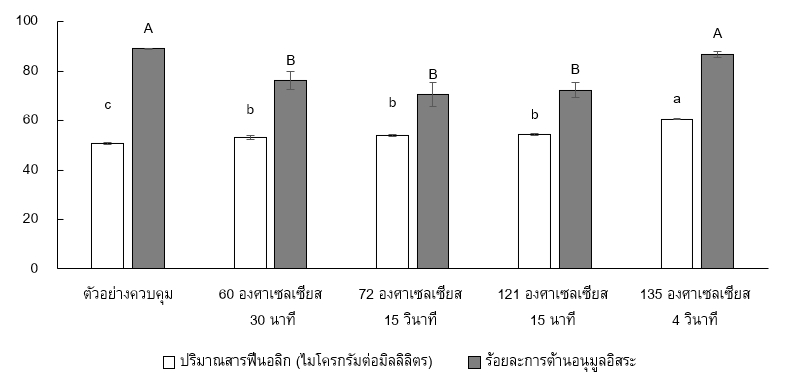
การให้ความร้อนมีประโยชน์อย่างมากในการยืดอายุการเก็บรักษาอาหาร อย่างไรก็ตามสภาวะในการให้ความร้อนมีผลต่อสารสำคัญและการต้านอนุมูลอิสระของอาหารที่ผ่านการแปรรูป การศึกษานี้จึงมีวัตถุประสงค์เพื่อศึกษาผลของสภาวะการให้ความร้อนต่อปริมาณสารสำคัญและการต้านอนุมูลอิสระในน้ำมะเขือเทศ โดยการนำน้ำมะเขือเทศสด และน้ำมะเขือเทศที่ผ่านกระบวนการให้ความร้อนที่อุณหภูมิ 60 องศาเซลเซียส เป็นเวลา 30 นาที อุณหภูมิ 72 องศาเซลเซียส เป็นเวลา 15 วินาที อุณหภูมิ 121 องศาเซลเซียส เป็นเวลา 15 นาที และอุณหภูมิ 135 องศาเซลเซียส เป็นเวลา 4 วินาที มาทำการวิเคราะห์สมบัติทางเคมีและสมบัติทางกายภาพ ผลการทดลองแสดงให้เห็นว่าปริมาณไลโคปีน วิตามินซี สารประกอบฟีนอลิก และร้อยละการต้านอนุมูลอิสระของตัวอย่างที่ผ่านการให้ความร้อนด้วยสภาวะที่แตกต่างกันมีความแตกต่างกัน (p<0.05) โดยสารประกอบฟีนอลิกมีปริมาณเพิ่มขึ้นมากที่สุดหลังจากให้ความร้อนที่อุณหภูมิ 135 องศาเซลเซียส เป็นเวลา 4 วินาที โดยมีค่า 60.65 ไมโครกรัมต่อมิลลิลิตร นอกจากนี้ค่าการต้านอนุมูลอิสระของตัวอย่างที่ผ่านการให้ความร้อนที่อุณหภูมิ 135 องศาเซลเซียสยังมีค่าไม่ต่างกับตัวอย่างน้ำมะเขือเทศสด (p>0.05) อย่างไรก็ตามวิตามินซีมีปริมาณลดลงเมื่อได้รับความร้อนที่สูงขึ้น และตรวจไม่พบวิตามินซีในตัวอย่างที่ผ่านการให้ความร้อนที่อุณหภูมิ 135 องศาเซลเซียส สำหรับไลโคปีนมีปริมาณเพิ่มขึ้นสูงที่สุดหลังจากให้ความร้อนที่อุณหภูมิ 72 องศาเซลเซียส โดยมีค่า 39.04 ไมโครกรัมต่อมิลลิลิตร สำหรับค่าสีพบว่าตัวอย่างที่ผ่านการให้ความร้อนมีค่าเฉดสีเพิ่มขึ้น โดยตัวอย่างที่ผ่านการให้ความร้อนที่อุณหภูมิ 135 องศาเซลเซียสมีค่าเฉดสีและค่าความแตกต่างของสีมากที่สุดเมื่อเทียบกับตัวอย่างน้ำมะเขือเทศสด ในขณะที่ตัวอย่างที่ผ่านการให้ความร้อนที่อุณหภูมิ 72 องศาเซลเซียสมีค่าเฉดสีไม่แตกต่างจากตัวอย่างน้ำมะเขือเทศสด (p>0.05) ดังนั้นการให้ความร้อนที่อุณหภูมิ 72 องศาเซลเซียส เวลา 15 วินาที เป็นสภาวะในการให้ความร้อนที่เหมาะสมที่สุดในการแปรรูปน้ำมะเขือเทศ เนื่องจากสภาวะการให้ความร้อนนี้ส่งผลให้น้ำมะเขือเทศมีปริมาณไลโคปีนเพิ่มขึ้นมากที่สุดและยังคงมีสีใกล้เคียงกับน้ำมะเขือเทศสด
เอกสารอ้างอิง
Sutin S. Vitamins and free radicals. Huachiew Chalermprakiet Sci Technol J. 2016; 2(1): 80-92.
Lia N, Wub X, Zhuangb W, Xiab L, Chenb Y, Wuc C, et al. Tomato and lycopene and multiple health outcomes: Umbrella review. Food Chem. 2021; 343: 128396.
Pukrushpan T. Thermal food preservation. In: The faculty members of food science and technology department, Department of Food Science and Technology, Food science & technology. 6th. Bangkok: Kasetsart University Press; 2009. p. 137-153.
Dewanto V,Wu X, Adom KK, Liu RH. Thermal processing enhances the nutritional value of tomatoes by increasing total antioxidant activity. J. Agric. Food Chem. 2002; 50: 3010-3014.
D’Evoli L, Lombardi-Boccia G, Lucarini M. Influence of heat treatments on carotenoid content of cherry tomatoes. Foods. 2013; 2: 352-363.
Luterotti S, Bicanic D, Markovi K, Franko M. Carotenes in processed tomato after thermal treatment. Food Control. 2015; 48: 67-74.
Manzo N, Santini A, Pizzolongo F, Aiello A, Romano R. Degradation kinetic (D100) of lycopene during the thermal treatment of concentrated tomato paste. Nat Prod Res. 2019; 33 (13): 1835-1841.
Rubio-Diaz DE, SANTOS A, FRANCIS DM, RODRIGUEZ-SAONA LE. Carotenoid stability during production and storage of tomato juice made from tomatoes with diverse pigment profiles measured by infrared spectroscopy J Agric Food Chem. 2010; 58: 8692–8698.
Saini RK, Bekhit AEDA., Roohinejad S, Rengasamy KRR, Keum YS. Chemical stability of lycopene in processed products: A review of the effects of processing methods and modern preservation strategies. J Agric Food Chem. 2020; 68: 712-726.
Anthon G, Barett DM. Standardization of a rapid spectrophotometric method for lycopene analysis. Acta Hort. 2007; 758: 111-127.
Demiray E, Tuley Y, Yilmaz Y. Degradation kinetics of lycopene, -carotene and ascorbic acid in tomatoes during hot air drying. LWT– Food Sci Technol. 2013; 50: 172-176.
Vinha AF, Alves RC, Barreira SVP, Castro A, Costa ASG, Oliveira MBPP. Effect of peel and seed removal on the nutritional value and antioxidant activity of tomato (Lycopersicon esculentum L.) fruits. LWT– Food Sci Technol. 2014; 197-202.
Argyropoulos D, Muller J. Effect of convective drying on quality of lemon balm (Melissa officinalis L.). Procedia Food Sci. 2011; 1: 1932-1939.
Shi, J, Le Maguer M, Bryan M, Kakuda Y. Kinetics of lycopene degradation in tomato puree by heat and light irradiation. J Food Process Eng. 2003; 25(6): 485-498.
Honda M, Watanabe Y, Murakami K, Takemura R, Fukaya T, Wahyudiono, et al. Thermal isomerization pre-treatment to improve lycopene extraction from tomato pulp. LWT– Food Sci Technol. 2017; 86: 69-75.
Knockaert G, Pulissery SK, Colle I, Buggenhout SV, Hendrickx M, Loey AV. Lycopene degradation, isomerization and in vitro bioaccessibility in high pressure homogenized tomato puree containing oil: Effect of additional thermal and high pressure processing. Food Chem. 2012; 135: 1290 – 1297.
Tchuenchieu A, Ngang JJE, Servais M, Dermience M, Kamdem SS, Etoa FX, et al. Effect of low thermal pasteurization in combination with carvacrol on color, antioxidant capacity, phenolic and vitamin C contents of fruit juices. Food Sci Nutr. 2018; 6: 736–746.
Vallverdu´-Queralt A, Medina-Remo´n A, Andres-Lacuva C, Lamuela-Raventos RM. Changes in phenolic profile and antioxidant activity during production of diced tomatoes. Food Chem. 2011; 126: 1700-1707.
Sripakdee T, Sriwicha A, Jansam N, Mahachai R, Chanthai S. Determination of total phenolics and ascorbic acid related to an antioxidant activity and thermal stability of the Mao fruit juice. Int Food Res J. 2015; 22(2): 618-624.
Rattanapanone N. Food Chemistry. 5th. Bangkok: Odeonstore; 2014. 487 p.
ดาวน์โหลด
เผยแพร่แล้ว
รูปแบบการอ้างอิง
ฉบับ
ประเภทบทความ
สัญญาอนุญาต
ลิขสิทธิ์ (c) 2022 วารสารนเรศวรพะเยา

อนุญาตภายใต้เงื่อนไข Creative Commons Attribution-NonCommercial-NoDerivatives 4.0 International License.
ผู้นิพนธ์ต้องรับผิดชอบข้อความในบทนิพนธ์ของตน มหาวิทยาลัยพะเยา ไม่จำเป็นต้องเห็นด้วยกับบทความที่ตีพิมพ์เสมอไป ผู้สนใจสามารถคัดลอก และนำไปใช้ได้ แต่จะต้องขออนุมัติเจ้าของ และได้รับการอนุมัติเป็นลายลักษณ์อักษรก่อน พร้อมกับมีการอ้างอิงและกล่าวคำขอบคุณให้ถูกต้องด้วย