การลดการปนเปื้อนของแคดเมียมในดินสำหรับการปลูกข้าวนาดำ
คำสำคัญ:
แคดเมียม, สารชีวภัณฑ์, จุลินทรีย์ในดิน, ปลูกข้าวขังน้ำ, ดินปนเปื้อนสังเคราะห์บทคัดย่อ
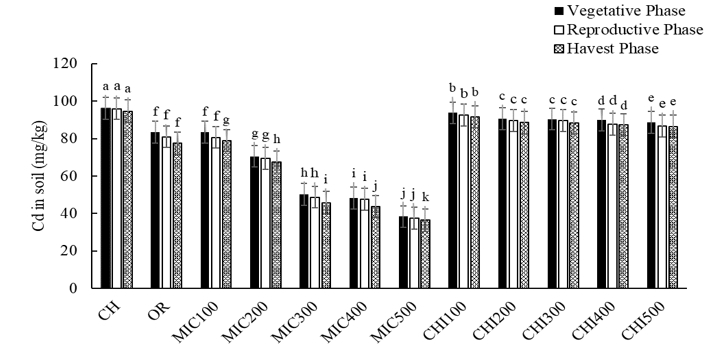
งานวิจัยนี้มีวัตถุประสงค์เพื่อปรับปรุงสมบัติทางเคมีของดิน และลดการปนเปื้อนของแคดเมียมในดิน ด้วยสารชีวภัณฑ์ที่ประกอบด้วยเชื้อผสมของ Achormobacter sp., Azoto bacter sp., Bacillus sp.และ Nitrobactor sp. และไคโตซานโดยออกแบบการทดลอง ดังนี้ 1) การทดลองที่ใส่ปุ๋ยเคมีสูตร 16-20-0 (CH) 2) การทดลองที่ใส่ปุ๋ยอินทรีย์ (OR) 3 ) การทดลองที่ใส่สารชีวภัณฑ์ ในอัตราส่วนมีความเข้มข้น 100-500 มิลลิลิตรต่อไร่ (MIC) และ 4)การทดลองที่ใส่สารไคโตซาน 100-500 มิลลิลิตรต่อไร่ (CHI) โดยในแต่ละการทดลองประกอบด้วย 5 กระถาง ซึ่งในแต่ละกระถางบรรจุดินปนเปื้อนสังเคราะห์ มีค่าแคดเมียมเริ่มต้นเท่ากับ 104.20 mg/kg ซึ่งพบว่าแคดเมียมในดินลดลงตามระยะการเจริญ โดยระยะการเจริญ (VP) > ระยะตั้งท้อง (RP) > ระยะเก็บเกี่ยว (HP) และการทดลองที่มีการใช้สารชีวภัณฑ์มีปริมาณแคดเมียมลดลง 20.00-70.00 mg/kg ในขณะที่การทดลองที่ใช้สารละลายไคโตซานมีปริมาณแคดเมียมลดลง 10.00-20.00 mg/kg โดยลดลงมากกว่า CH 2.50-8.00 เท่า และ1.30-2.00 เท่า ตามลำดับ ทั้งนี้ MIC500 เป็นหน่วยการทดลองเดียวที่ในหนึ่งรอบการใช้ดินที่มีปริมาณแคดเมียม ผ่านเกณฑ์มาตรฐานของคุณภาพดินที่ใช้ประโยชน์เพื่อการอยู่อาศัย และเกษตรกรรมที่มีค่าน้อยกว่า 37.00 mg/kg (กรมควบคุมมลพิษ กระทรวงทรัพยากรธรรมชาติและสิ่งแวดล้อม, 2560) ซึ่งสอดคล้องกับปริมาณอินทรียวัตถุที่ลดลง ทั้งนี้ในระยะ VP การทดลอง MIC และ CHI มีปริมาณไนโตรเจนในดินเพิ่มขึ้น 3.79-4.22 g/kg และ 3.79-3.96 g/kg ตามลำดับ ปริมาณฟอสฟอรัสในดินของ การทดลอง OR,MIC และ CHI มีค่าเพิ่มขึ้น 0.82-1.03 เท่า เมื่อเทียบกับ CH นอกจากนี้ ในการทดลอง CH พบว่ามีปริมาณโพแทสเซียมมากที่สุด เท่ากับ 49.04 mg/kg
เอกสารอ้างอิง
Abdus-Salam N,Bello M.O. Kinetics, thermodynamics and competitive adsorption of lead and zinc ions onto termite mound. International Journal of Environmental Science and Technology.2015;12:3417-3426.
Knowledge of disease. [Internet]. Thailand: Office of Occupational and Environmental Diseases. 2019 April [cited 2019 April 3]. Available from: http://envocc.ddc.moph.go.th.
Anongnat S, Pornthiwa K, Kumiko O,Toru M. Current situation of cadmium-polluted paddy soil, rice and soybean in the Mae Sot District, Tak Province, Thailand. Soil Science and Plant Nutrition.2012;270: 349-359.
Wanida N. Effects of heavy metals in organic materials on soil and plant quality. Soil Science Research Group Agricultural Production Research Bureau Department of Agriculture. Thailand. 2010; 1-84.
Sangdaw K, et al. Phytoremediation of Cadmium Contaminated Paddy Soil at Mae Sot District, Tak Province. Kasetsart University. 2013.
Jantra T, et al. Cadmium Distribution and Bioavailability in Cultivated Soil and Crops in the Vicinity of Zinc Mine in Mae Sot. National Research Center for Environmental Management and Hazardous Waste Chulalongkorn University. 2005.
Jurairat O. Biological glyphosate degradation of bacteria isolated from farmland soils. Master thesis . Maejo University. Thailand. 2014.
Robert D, Perry ,Simon S. Cadmium and manganese transport in Staphylococcus aureus membrane vesicles. Journal of Bacteriology. 1982;150:973-976.
Quan Z et .al. The influence of liming on cadmium accumulation in rice grains via iron-reducing bacteria. Science of the Total Environment. 2018; 645:109-118.
Cooper D. G., Macdonald C. R., Duff S. J. B., Kosaric N. Enhanced Production of Surfactin from Bacillus subtilis by Continuous Product Removal and Metal Cation Additions. Biological Sciences. 1981;42:408-412.
Xiaoyan L, et. al. Characterization of cadmium-resistant bacteria and their potential for reducing accumulation of cadmium in rice grains. Science of the Total Environment. 2016;570:97–104.
Wuana R. A., Okieimen F. E., Imborvungu J. A. Removal of heavy metals from
a contaminated soil using organic chelating acids. Environ. Sci. Tech. 2020; 7:485-496.
Wanpen w,Chanida K. Methods of Soil Analysis and Interpretation for Soil Survey and Classification: Physical Properties. Bureau of Science for Land Development. Department of Land Development Ministry of Agriculture and Cooperatives. Thailand. 2016.
Office of Land Development Science. Standard types of agricultural product to Certified by the Land Development Department. 2013.
Good Aquaculture Practice (GAP). Fisheries Product Standard Certification System Development Division, Department of Fisheries, Ministry of Agriculture and Cooperatives. 2018.
Yongbing J, Shimeng J, Zhangbao L,Xinpei Y, Zhixiong Q, Renzhi H. Field scale remediation of Cd and Pb contaminated paddy soil using three mulberry (Morus alba L.) cultivars. Ecological Engineering. 2019; 129:38-44.
Land Classification Division and FAO Project Staff. Soil Interpretation Handbook for Thailand. Department of Land Development, Ministry of Agriculture and Cooperatives, Thailand. 1973; 135 p.
Ponnamperuma, F.N. The Chemistry of Submerged Soils. Advances in Agronomy. 1972; 24, 29-96.
Soil Survey Division Staff. Soil Survey Manual. USDA Handbook No. 18, US Government Printing Office, Washington DC. 1993.
Monteiro OAC Jr,Airold C .Some thermodynamic data on copper-chitin and copper-chitosan biopolymer interactions.J Colloid Interface Sci. 1999; 212:212-219.
Rieuwerts J S, Mighanetara K, Braungardt C B, Rollinson G K, Pirrie D, Azizi F. Geochemistry and mineralogy of arsenic in mine wastes and stream sediments in a historic metal mining area in the UK.Science of The Total Environment. 2014;472:226-234.
Sasaki Ch. Experimental study on the influence of percolation patterns on the removal of soluble elements in stratified alluvial-soil paddy fields for rice . 2006; 4 :89-99.
Bermond A , Bourgeois S. Influence of Soluble Organic Matter on Cadmium Mobility in Model Compounds and in Soils. Analyst, 2015;117 :685-687.
Laanbroek H. J. , Gerards S.Effects of organic manure on nitrification in arable soils. Biology and Fertility of Soils.1991;12:147–153.
Seshadri B. et .al. Phosphorus–cadmium interactions in paddy soil. Geoderma, 2016;270: 43-59.
Meiliang D. et .al. Immobilization of Cadmium by Molecular Sieve and Wollastonite Is Soil pH and Organic Matter Dependent. InternationnalJournal of Environmental Research and Public Health. 2021;18:1-17.
Chuan, M.C., SHU G.Y., LIU J.C. Solubility of heavy metals in a contaminated soil: effects of redox potential and pH. Air and Soil Pollution.1995;90: 543-556.
Xiao Q.H. et .al. Release of cadmium in contaminated paddy soil amended with NPK fertilizer and lime under water management. Ecotoxicology and Environmental Safety, 2018;159:38-45.
Zhi G, Xiang H, Yansong A. Effect of chitosan on the available contents and vertical distribution of Cu2+ and Cd2+ in different textural soils. Journal of Hazardous Materials. 2009;167:1148–1151.
Sara M. A., Abasiyan F. D. ,Gholam R. M.. Chitosan cross-linked with κ-carrageenan to remove cadmium from water and soil systems. Environmental Science and Pollution Research. 2019; 26:26254–26264.
ดาวน์โหลด
เผยแพร่แล้ว
รูปแบบการอ้างอิง
ฉบับ
ประเภทบทความ
สัญญาอนุญาต
ลิขสิทธิ์ (c) 2022 วารสารนเรศวรพะเยา

อนุญาตภายใต้เงื่อนไข Creative Commons Attribution-NonCommercial-NoDerivatives 4.0 International License.
ผู้นิพนธ์ต้องรับผิดชอบข้อความในบทนิพนธ์ของตน มหาวิทยาลัยพะเยา ไม่จำเป็นต้องเห็นด้วยกับบทความที่ตีพิมพ์เสมอไป ผู้สนใจสามารถคัดลอก และนำไปใช้ได้ แต่จะต้องขออนุมัติเจ้าของ และได้รับการอนุมัติเป็นลายลักษณ์อักษรก่อน พร้อมกับมีการอ้างอิงและกล่าวคำขอบคุณให้ถูกต้องด้วย