ผลของ 6-เบนซิลามิโนพิวรีนและกรดอินโดล-3-บิวทิริกต่อการชักนำยอดและรากว่านชักมดลูกในสภาพปลอดเชื้อ
คำสำคัญ:
การเพาะเลี้ยงเนื้อเยื่อพืช, สารควบคุมการเจริญเติบโตของพืช, 6-เบนซิลามิโนพิวรีน, กรดอินโดล-3-บิวทิริกบทคัดย่อ
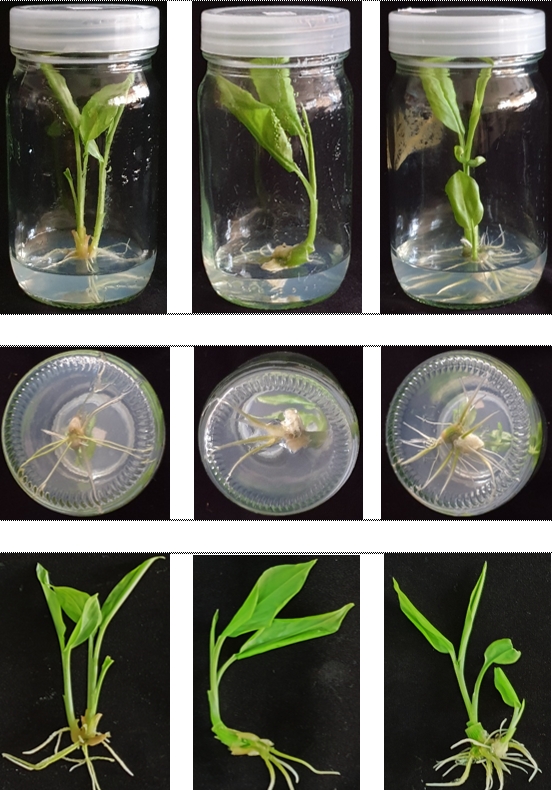
ว่านชักมดลูก (Curcuma comosa Roxb.) จัดอยู่ในวงศ์ Zingiberaceae มีสารออกฤทธิ์ทางชีวภาพที่ใช้ในการบำบัดอาการผิดปกติของมนุษย์ อย่างไรก็ตามว่านชักมดลูกต้องใช้ระยะเวลาในการขยายพันธุ์เป็นเวลานาน ดังนั้นงานวิจัยนี้มีวัตถุประสงค์เพื่อศึกษาผลของ 6-Benzylaminopurine (BAP) และ Indole-3-butyric acid (IBA) ต่อการชักนำยอดและรากว่านชักมดลูกภายใต้สภาพปลอดเชื้อ ในการศึกษาครั้งนี้แบ่งออกเป็น 2 การทดลอง ได้แก่ 1) ผลของความเข้มข้น ของ 6-เบนซิลามิโนพิวรีนที่แตกต่างกัน (0, 1, 2 และ 3 มิลลิกรัมต่อลิตร) ต่อการชักนำยอด และ 2) ผลของความเข้มข้นของกรดอินโดล-3-บิวทิริกที่แตกต่างกัน (0, 0.5 และ 1 มิลลิกรัมต่อลิตร) ต่อการชักนำราก โดยวางแผนการทดลองแบบสุ่มสมบูรณ์ (completely randomized design, CRD) สิ่งทดลองละ 5 ซ้ำ จากการวิจัย พบว่า เนื้อเยื่อว่านชักมดลูกที่เพาะเลี้ยงบนอาหารสูตร Murashige and Skoog (MS) ที่เติม BAP ความเข้มข้น 3 มิลลิกรัมต่อลิตร มีจำนวนยอดมากที่สุด เท่ากับ 2.00±0.00 ยอดต่อต้น แต่ไม่มีความแตกต่างทางสถิติกับอาหารสูตร Murashige and Skoog (MS) ที่เติม BAP ความเข้มข้น 1 และ 2 มิลลิกรัมต่อลิตร ในขณะที่จำนวนใบของเนื้อเยื่อว่านชักมดลูกที่เพาะเลี้ยงบนอาหารสูตร Murashige and Skoog (MS) ที่เติม BAP ความเข้มข้น 3 มิลลิกรัมต่อลิตร มีจำนวนใบมากที่สุด เท่ากับ 3.00±0.00 ใบต่อต้น แต่ไม่มีความแตกต่างทางสถิติกับเนื้อเยื่อว่านชักมดลูกที่เพาะเลี้ยงบนอาหารสูตร Murashige and Skoog (MS) ที่เติม BAP ความเข้มข้น 2 มิลลิกรัมต่อลิตร ในขณะที่เนื้อเยื่อว่านชักมดลูกที่เพาะเลี้ยงบนอาหารสูตร MS ที่ไม่เติม BAP มีความสูงมากที่สุด เท่ากับ 7.50±0.29 เซนติเมตร แต่ไม่มีความแตกต่างทางสถิติกับเนื้อเยื่อว่านชักมดลูกที่เพาะเลี้ยงบนอาหารสูตร Murashige and Skoog (MS) ที่เติม BAP ความเข้มข้น 1 มิลลิกรัมต่อลิตร ในขณะที่เนื้อเยื่อว่านชักมดลูกที่เพาะเลี้ยงบนอาหารสูตร MS ที่ไม่เติม BAP มีความยาวใบมากที่สุด เท่ากับ 7.00±0.58 เซนติเมตร แต่ไม่มีความแตกต่างทางสถิติกับเนื้อเยื่อว่านชักมดลูกที่เพาะเลี้ยงบนอาหารสูตร Murashige and Skoog (MS) ที่เติม BAP ความเข้มข้น 1 และ 2 มิลลิกรัมต่อลิตร ส่วนเนื้อเยื่อว่านชักมดลูกที่เพาะเลี้ยงบนอาหารสูตร MS ที่เติม IBA ความเข้มข้น 0, 0.5 และ 1 มิลลิกรัมต่อลิตร ไม่มีผลต่อจำนวนยอด ความสูง จำนวนราก และความยาวราก โดยมีจำนวนยอดอยู่ระหว่าง 1.21±0.15 - 1.67±0.17 ยอดต่อต้น ความสูงอยู่ระหว่าง 4.17±0.17 - 4.67±0.44 เซนติเมตร จำนวนรากอยู่ระหว่าง 2.33±1.45 - 6.00±0.00 รากต่อต้น และความยาวรากอยู่ระหว่าง 2.33±1.20 -6.33±1.09 เซนติเมตร
เอกสารอ้างอิง
Pongboonrod S. Mai Thet Muang Thai. Kasembanakit Press. Bangkok. 1959.
Kaewamatawong R. Secondary metabolites and biological activities of wan chak mod look distributed in Thai markets. J. Sci. Tech. UBU. 2017;19(1):1-22.
Tricky R. Women, Hormones and the Menstrual Cycle Sydney. 1998, Allen and Unwin, 680 p.
Ab Halim MR, Zabri Tan MSM, Ismail S, Mahmud R. Standardization and phytochemical studies of Curcuma xanthorrhiza Roxb. Int. J. Pharm. Pharm. Sci. 2012;4(3):606-610.
Rukayadi Y, Hwang JK. In vitro activity of xanthorrhizol against Streptococcus mutans biofilms. Lett. Appl. Microbiol. 2006;42(4):400-404.
Rukayadi Y, Yong D, Hwang JK. In vitro anticandidal activity of xanthorrhizol isolated from Curcuma xanthorrhiza Roxb. J. Antimicrob. Chemother. 2006;57(6):1231-1234.
Rukayadi Y, Hwang JK. In vitro anti-malassezia activity of xanthorrhizol isolated from Curcuma xanthorrhiza Roxb. Lett. Appl. Microbiol. 2007a;44(2):126-130.
Rukayadi Y, Hwang JK. In vitro antimycotic activity of xanthorrhizol isolated from Curcuma xanthorrhiza Roxb. against opportunistic filamentous fungi. Phytother. Res. 2007b;21(5):434-438.
Pimmuen P, Saensouk P, Saensouk S. In vitro propagation of Globba marantina L. KKU. Res. J. (GS). 2014;19(4):596-605.
Cardoso J, Sheng L, Teixeira da Silva J. Micropropagation in the twenty-first century. Methods Mol. Biol. 2018;1815:7-46.
Kane M. Micropropagation from pre-existing meristems. In Trigiano RN, Gray DJ (Eds.), Plant tissue culture concepts and laboratory exercises. 1996, CRC Press.
Hameed N, Shabbir A, Ali A, Bajwa R. In vitro micropropagation of disease free rose (Rosa indica L.). Mycopath. 2006;4(2):35-38.
Fernández-Lizarazo JC, Mosquera-Vásquez T. Efficient micropropagation of french tarragon (Artemisia dracunculus L.). Agron. Colomb. 2012;30(3):335-343.
Jala A, Paitoon S. Micropropagation of Dionaea muscipula by tissue culture. TJST. 2013;2(2):134-139.
Prasertsongskun S. In vitro propagation of Etlingera elatior. J. YRU. 2015;10(2):21-28.
Sukkeaw T, Ramasoot S, Parinyapong Chareonsap P. Microprapagation of black bat flower. Wichcha J. NSTRU. 2016;35(2):33-40.
Topoonyanont N, Audtama N, Kaewdam T. Factors affecting micropropagation system of strawberry cv. Praratchatan 80 and cv. 329. TJST. 2019;8(2):176-189.
Rungrueng P, Sungthongwises K, Luangsuwalai, K. Propagation of papaya (Carica papaya L.) cv. Holland in tissue culture. Khon Kaen Agr. J. 2019;47(3):459-466.
Nasirujjaman K, Uddin S, Zaman S, Reza MA. Micropropagation of turmeric (Curcuma longa Linn.) through in vitro rhizome bud culture. J. Biol. Sci. 2005;5(4):490-492.
Koarapatchaikol K, Kanmarangkol S, Klomnara Kaewraksa J. In vitro plant regeneration via callus culture in turmeric (Curcuma longa L.). BUSCIJ. 2017;22(1):1-13.
Sukontharat P, Khawniam T, Te-chato S. Micropropagation of Curcuma longa Linn. by tissue culture from ex vitro sprouted rhizome. Songklanakarin J. Pl. Sci. 2016;3(2):1-5.
Kamoltham M, Phumkonsan S, Chanapan S. Tissue culture of herbal plant, Kaempferia parviflora Wallich. ex Baker. Songklanakarin J. Pl. Sci. 2016;3 (Suppl. III):74-78.
Seran TH. In vitro propagation of ginger (Zingiber officinale Rosc.) through direct organogenesis: A review. 2013;PJBS16(24):1826-1835.
Lo-apirukkul S, Jenjittikul T, Saralamp P, Prathanturarug S. Micropropagation of a Thai medicinal plant for women’s health, Curcuma comosa Roxb., via shoot and microrhizome inductions. J. Nat. Med. 2012;66:265-270.
Lloyd GB, McCown BH. Commercially feasible micropropagation of mountain laurel (Kalmia latifolia) by use of shoot-tip culture. Proc. Int. Plant Propag. Soc. 1981;30:421-437.
Theanphong O, Songsak T, Kirdmanee C. Effect of plant growth regulators on micropropagation of Curcuma aeruginosa Roxb. 2010;TJB2(Special Issue):135-142.
Abdelmageed AHA, Faridah, QZ, Norhana, FMA, Julia AA, Kadir MA. Micropropagation of Etlingera elatior (Zingiberaceae) by using axillary bud explants. J. Med. Plant. Res. 2011;5(18):4465-4469.
Miri SM. Micropropagation, Callus induction and regeneration of ginger (Zingiber officinale Rosc.). Open Agriculture 2020;5:75-84.
Keng CL, Hing TW. In vitro propagation of zingiberaceae species with medicinal properties. J. Plant Biotech. 2004;6(3): 181-188.
Dello IR, Linhares FS, Scacchi E, Casamitjana-Martinez E, Heidstra R, Costantino P. Cytokinins determine Arabidopsis root-meristem size by controlling cell differentiation. Curr. Biol. 2007;17: 678-682.
Kunwanlop W, Boonmee W, Laipasu P, Chareonsap PP, Krajangvuth T, Poeaim A. Effect of plant growth regulators on micropropagation of Vanilla aphylla and Vanilla planifolia sp. Variegate. Int. J. of Agric. Technol. 2018;14(7):1357-1364.
Tudses N, Phungbunhan K, Audta L. Effects of BA and NAA on growth and development of Musa sapientum (ABB group) cv ‘Kluai Hin’ in vitro and effects of substrate on growth in vivo. King Mongkut's Agricultural Journal. 2019;37(2):262-273.
Kachonpadungkitti Y, Jala A. Influence of BA, IAA, 2,4-D and kinetin on micropropagation of Hylocereus undatus from segments of hypocotyl and true leaf. TJST. 2015;4(2):147-154.
Kachonpadungkitti Y, Jala A. Influence of BA and NAA on inducing new shoots and roots in Bacopa monaneiri (L.) Pennel in vitro. TJST. 2014;3(1):7-14.
Martins JP, Schimildt ER, Alexandre RS, Santos BR, Magevski GC. Effect of synthetic auxins on in vitro and ex vitro bromeliad rooting. Pesqui Agropecu Trop. 2013;43(2):138–46.
Ramasoot S, Kongchamnan K, Somboon, B. Micropropagation of green bat flower by organogenesis. PNUJR. 2017;9(3):140-148.
ดาวน์โหลด
เผยแพร่แล้ว
รูปแบบการอ้างอิง
ฉบับ
ประเภทบทความ
สัญญาอนุญาต
ลิขสิทธิ์ (c) 2022 วารสารนเรศวรพะเยา

อนุญาตภายใต้เงื่อนไข Creative Commons Attribution-NonCommercial-NoDerivatives 4.0 International License.
ผู้นิพนธ์ต้องรับผิดชอบข้อความในบทนิพนธ์ของตน มหาวิทยาลัยพะเยา ไม่จำเป็นต้องเห็นด้วยกับบทความที่ตีพิมพ์เสมอไป ผู้สนใจสามารถคัดลอก และนำไปใช้ได้ แต่จะต้องขออนุมัติเจ้าของ และได้รับการอนุมัติเป็นลายลักษณ์อักษรก่อน พร้อมกับมีการอ้างอิงและกล่าวคำขอบคุณให้ถูกต้องด้วย