การเปรียบเทียบตัวแบบการจำแนกการเกิดโรคหลอดเลือดสมองของผู้สูงอายุ: กรณีศึกษาโรงพยาบาลสมเด็จพระปิ่นเกล้า
คำสำคัญ:
โรคหลอดเลือดสมอง, การถดถอยลอจิสติกทวิภาค, ต้นไม้ตัดสินใจ, ข้อมูลไม่สมดุลบทคัดย่อ
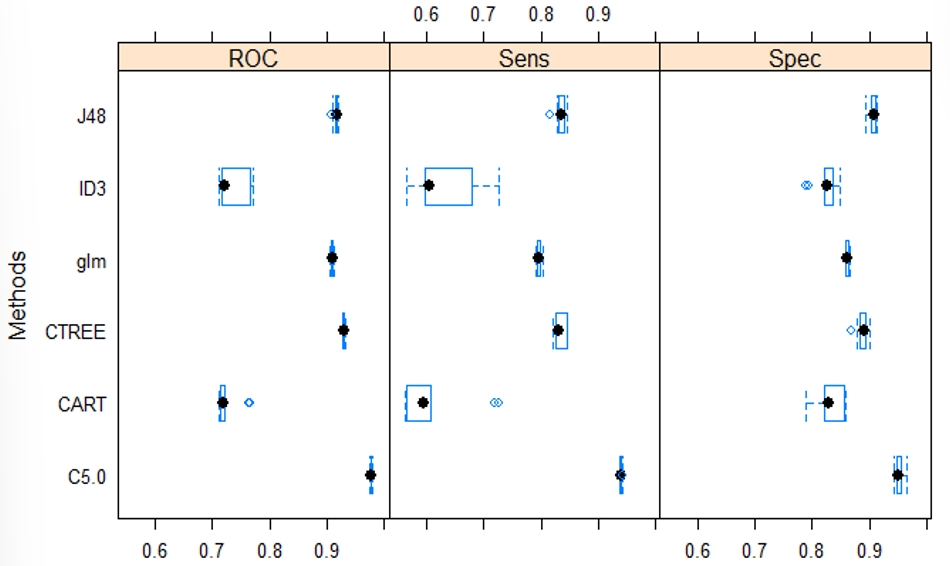
งานวิจัยนี้มีวัตถุประสงค์เพื่อเปรียบเทียบตัวแบบที่เหมาะสมสำหรับการจำแนกและศึกษาปัจจัยที่เกี่ยวข้องกับการเป็นโรคหลอดเลือดสมองในผู้สูงอายุ โรงพยาบาลสมเด็จพระปิ่นเกล้า โดยใช้ข้อมูลเวชระเบียนของผู้สูงอายุที่มีอายุตั้งแต่ 60 ปีขี้นไป และเข้ารับการรักษาในโรงพยาบาลในปีพ.ศ. 2561 จำนวน 28,928 คน และเนื่องจากข้อมูลไม่สมดุลจึงใช้เทคนิคสังเคราะห์ข้อมูลเพิ่ม (SMOTE) เพิ่มข้อมูลให้มีสัดส่วนใกล้เคียงกัน แล้วแบ่งข้อมูลเป็น 2 ชุด ชุดที่ 1 (80%) สำหรับสร้างตัวแบบด้วยวิธีการการถดถอยลอจิสติกทวิภาค (glm) และต้นไม้ตัดสินใจแบบ ID3, CART, J48, CTREE และ C5.0 ร่วมกับ Bootstrap Aggregating (Bagging) และชุดที่ 2 (20%) สำหรับประเมินประสิทธิภาพของตัวแบบ ผลการวิจัยพบว่า อัตราความชุกของผู้ที่เป็นโรคหลอดเลือดสมองเป็น 5.50% (95% CI 5.24% - 5.76%) และตัวแบบที่มีประสิทธิภาพดีที่สุด คือ ตัวแบบต้นไม้ตัดสินใจแบบ C5.0 โดยมีค่าความแม่นยำ ร้อยละ 95.31 ค่าความไว ร้อยละ 94.48 ค่าความจำเพาะ ร้อยละ 96.12 ค่าทำนายผลบวก ร้อยละ 95.93 และค่าทำนายผลลบ ร้อยละ 94.73 และจากตัวแบบต้นไม้ตัดสินใจแบบ C5.0 พบว่าปัจจัยเสี่ยงที่มีผลต่อการเกิดโรคหลอดเลือดสมองของผู้สูงอายุเรียงตามลำดับความสำคัญคือ ภาวะหลอดเลือดสมองครั้งคราว อายุ ภาวะโลหิตจาง โรคลมชัก การสูบบุหรี่ ภาวะแข็งตัวของเลือดผิดปกติและเลือดออก การบาดเจ็บที่ศีรษะ กลุ่มโรคหัวใจ โรคมะเร็ง การดื่มแอลกอฮอล์ โรคไต การมีอุปกรณ์ฝังและปลูกถ่ายของหัวใจและหลอดเลือด เพศ โรคความดันโลหิต โรคเบาหวาน ค่าดัชนีมวลกาย กลุ่มโรคของหลอดเลือดแดง หลอดเลือดแดงย่อย และหลอดเลือดฝอย และโรคลิ่มเลือดอุดตันที่ปอด ส่วนปัจจัยที่ไม่ได้ใช้ในการจำแนกผู้ป่วยโรคหลอดเลือดสมอง คือ กลุ่มโรคอ้วนและภาวะโภชนาการเกิน และภาวะเผาผลาญไขมันผิดปกติ
เอกสารอ้างอิง
International Health Policy Program (IHPP). The study of national burden of diseases and injuries among the Thai population in 2014. Nonthaburi: Graphico Systems; 2017.
Bureau of Non Communicable Diseases. Number and rate of patients in 2016 - 2018 (hypertension, diabetes, coronary heart disease, stroke, COPD); 2019. [Cites 16 June 2021]. Assessed from http://www.thaincd.com/2016/mission/documents-detail.php?id=13684&tid=32&gid=1-020
Strategy and Planning Division, Office of the Permanent Secretary Ministry of Public Health. Public Health Statistics A.D.2019. Nonthaburi: Strategy and Planning Division; 2020.
Zhuo Y, Wu J, Qu Y, Yu H, Huang X, Zee B, et al. Clinical risk factors associated with recurrence of ischemic stroke within two years: A cohort study. Medicine. 2020;99(26): e20830.
Muntham D, Ingsrisawang L. An Application of Decision Tree Algorithms for Diagnosis of the Respiratory System: A Case Study of Pranakorn Sri Ayudthaya Hospital. Journal of Health Systems Research. 2010;4(1):73-81.
Hongboonmee N, Trepanichkul P. Comparison of Data Classification Efficiency to Analyze Risk Factors that Affect the Occurrence of Hyperthyroid using Data Mining Techniques. Journal of Information Science and Technology. 2019; 9(1):41-51.
Thanathamathee P, Sirisathitkul Y. Improved Classification Techniques for Imbalanced Data Sets of Elderly’s Knee Osteoarthritis. Thai Science and Technology Journal. 2019;27(6):1164-1178.
Boonchuay K, Sinapiromsaran K, Lursinsap C. Minority split and gain ratio for a class imbalance. Proceeding of Eighth International Conference on Fuzzy Systems and Knowledge Discovery; 2011 july 26-28; Shanghai, China.
Chawla NV, Bowyer KW, Hall LO, Kegelmayer WP. SMOTE: Synthetic Minority Over- Sampling Technique. Journal of Artificial Intelligent Research. 2002;16:321-357.
Paranya P. Improving Decision Tree Technique in Imbalanced Data Sets Using SMOTE for Internet Addiction Disorder Data. Information Technology Journal. 2016;12(1):54-63.
Gosain A, Sardana S. Handling class imbalance problem using oversampling techniques: A review. Proceeding 2017 International Conference on Advances in Computing, Communications and Informatics. 2017 September 13-16; Udupi, India. IEEE Xplore; 2017.
Fernández A, García S, Herrera F, Chawla NV. SMOTE for Learning from Imbalanced Data: Progress and Challenges, Marking the 15-year Anniversary. Journal Of Artificial Intelligence Research. 2018;61:863-905.
RStudio Team. RStudio: Integrated Development for R. MA: RStudio, PBC; 2020. http://www.rstudio.com
Torgo L. Data Mining using R: learning with case studies, CRC Press; 2010.
Gareth J, Daniela W, Trevor H, Robert T. An introduction to statistical learning: with applications in R, Springer; 2013.
Kaiyawan Y. Principle and Using Logistic Regression Analysis for Research. Rajamangala University of Technology Srivijaya Research Journal. 2012;4(1):1-12.
Stevens J. Applied multivariate statistics for the social science. New Jersey: Lawrence Erlbaum Associate, Inc; 1996.
Quinlan R. Introduction of decision trees. Machine Learning. 1986;1(1): 81-106.
Quinlan JR. C4.5: Programs for Machine Learning. San Mateo, CA: Morgan Kaufmann; 1993.
Breiman L, Friedman JH, Olshen R, Stone CJ. Classification and Regression Trees. California: Wadsworth International Group; 1984.
Therneau T, Atkinson B, Ripley B. The rpart package. (Version 4.1-13) [Software]; 2018. https://cran.r-project.org/package=rpart
Hothorn T, Hornik K, Zeileis A. Unbiased recursive partitioning: A conditional inference framework. Journal of Computational and Graphical Statistics. 2006;15(3):651-674. https://doi.org/10.1180/106186006X133933.
Hothorn T, Seibold H, Zeileis A. Partykit: A toolkit for recursive partytioning. (Version 1.2-2) [Software]; 2018. https://CRAN.R-project.org/package=partykit.
Maung ETW, Aye ZM. Comparison of Data Mining Classification Algorithms, C5.0 and CART for Car Evaluation and Credit Card Information Datasets. National Journal of Parallel and Soft Computing. 2019;1(1):75-80.
Breiman L. Bagging Predictors. Machine Learning. 1996;24(2):123-140.
Upadhayay A, Shukla S, Kumar S. Empirical Comparison by data mining Classification algorithms (C 4.5 & C 5.0) for thyroid cancer data set, International Journal of Computer Science & Communication Networks. 2013;3(1):64-68.
Nilnate N. Risk Factors and Prevention of Stroke in Hypertensive Patients. Journal of The Royal Thai Army Nurses. 2019;20(2):51-57.
Reddy HP, Jaganath A, Nagaraj N, Visweswara RYJ. A study of age as a risk factor in ischemic stroke of elderly. International Journal of Research in Medical Sciences. 2019;7(5):1553-1557.
Yousufuddin M, Young N. Aging and ischemic stroke. AGING. 2019;11(9):2542-2544.
Zaorsky NG, Zhang Y, Tchelebi LT, Mackley HB, Chinchilli VM, Zacharia BE. Stroke among cancer patients. Nature communications. 2019;10(1):5172. https://doi.org/10.1038/s41467-019-13120-6
ดาวน์โหลด
เผยแพร่แล้ว
รูปแบบการอ้างอิง
ฉบับ
ประเภทบทความ
สัญญาอนุญาต
ลิขสิทธิ์ (c) 2023 วารสารนเรศวรพะเยา

อนุญาตภายใต้เงื่อนไข Creative Commons Attribution-NonCommercial-NoDerivatives 4.0 International License.
ผู้นิพนธ์ต้องรับผิดชอบข้อความในบทนิพนธ์ของตน มหาวิทยาลัยพะเยา ไม่จำเป็นต้องเห็นด้วยกับบทความที่ตีพิมพ์เสมอไป ผู้สนใจสามารถคัดลอก และนำไปใช้ได้ แต่จะต้องขออนุมัติเจ้าของ และได้รับการอนุมัติเป็นลายลักษณ์อักษรก่อน พร้อมกับมีการอ้างอิงและกล่าวคำขอบคุณให้ถูกต้องด้วย