ความสัมพันธ์ระหว่างการควบคุมกล้ามเนื้อลำตัวแบบแยกส่วนและระดับความสามารถด้านการเคลื่อนไหวในเด็กสมองพิการ
คำสำคัญ:
การควบคุมกล้ามเนื้อลำตัวแบบแยกส่วน, เด็กสมองพิการ, ระดับความสามารถด้านการเคลื่อนไหวบทคัดย่อ
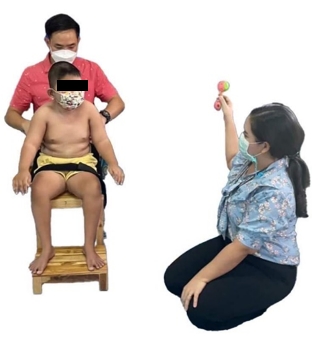
งานวิจัยแบบภาคตัดขวางมีวัตถุประสงค์เพื่อประเมินการควบคุมกล้ามเนื้อลำตัวแบบแยกส่วน และศึกษาความสัมพันธ์ระหว่างระดับการควบคุมกล้ามเนื้อลำตัวแบบแยกส่วน (ไม่สามารถควบคุมกล้ามเนื้อลำตัวได้เลย ควบคุมกล้ามเนื้อลำตัวได้บางส่วน และควบคุมกล้ามเนื้อลำตัวได้ทั้งหมด) กับระดับความสามารถด้านการเคลื่อนไหวเคลื่อนไหวตามเกณฑ์ Gross motor Function Classification System (GMFCS) ในเด็กสมองพิการ อาสาสมัครคือเด็กสมองพิการ จำนวน 30 คน ที่มีระดับความสามารถด้านการเคลื่อนไหวตามเกณฑ์ Gross motor Function Classification System (GMFCS) ระดับ 2-5 อาสาสมัครถูกทดสอบการควบคุมกล้ามเนื้อลำตัวแบบแยกส่วนด้วยแบบประเมิน Segmental Assessment of Trunk Control (SATCo) ใน 3 สภาวะการทดสอบคือ static trunk control, active trunk control, และ reactive trunk control ใช้สถิติ Chi-square เพื่อวิเคราะห์ความสัมพันธ์ โดยกำหนดระดับนัยสำคัญทางสถิตที่ p < 0.05 ผลการศึกษาพบว่า ในสภาวะ static trunk control, active trunk , และ reactive trunk control อาสาสมัครส่วนใหญ่ควบคุมกล้ามเนื้อลำตัวได้ทั้งหมดและไม่สามารถควบคุมกล้ามเนื้อลำตัวได้เลย โดยสภาวะ reactive trunk control มีค่าคะแนนน้อยที่สุด และการควบคุมกล้ามเนื้อลำตัวแบบแยกส่วนมีความสัมพันธ์กับระดับความสามารถด้านการเคลื่อนไหว (ระดับความสัมพันธ์ในสภาวะ static trunk control, active trunk , และ reactive trunk control = 38.77, 38.77, 27.40, p =0.00) ผลการศึกษานี้สามารถใช้วางแผนการรักษาตามความสามารถในการควบคุมกล้ามเนื้อลำตัวของเด็กสมองพิการ
เอกสารอ้างอิง
Liu WY, Zaino CA, Mccoy SW. Anticipatory postural adjustments in children with cerebral palsy and children with typical development. Pediatr Phys Ther. 2007;19(3):188-195.
van der Heide JC, Begeer C, Fock JM, Otten B, Stremmelaar E, van Eykern LA, et al. Postural control during reaching in preterm children with cerebral palsy. Dev Med Child Neurol. 2004;46(4):253-266.
Pavao SL, dos Santos AN, Woollacott MH, Rocha NA. Assessment of postural control in children with cerebral palsy: a review. Res Dev Disabil. 2013;34(5):1367-1375.
de Graaf-Peters VB, Blauw-Hospers CH, Dirks T, Bakker H, Bos AF, Hadders-Algra M. Development of postural control in typically developing children and children with cerebral palsy: Possibilities for intervention? Neurosci Biobehav Rev. 2007;31(8):1191-1200.
Shumway-Cook A, Woollacott MH. Normal postural control. In: Motor control translating research into clinical practice. 3rd ed. Philadephia: Lippincott Williams & Wilkins; 2007. p. 157-186.
Martin S. Balance. In: Teaching motor skills to children with cerebral palsy and similar movement disorders. 1st ed. USA: Woodbine House; 2006. p. 145-158.
Assaiante C, Mallau S, Viel S, Jover M, Schmitz C. Development of postural control in healthy children: a functional approach. Neural Plast. 2005;12(23):109-118.
Saavedra S, Joshi A, Woollacott M, Donkelaar PV. Eye hand coordination in children with cerebral palsy. 2009;192(2):155-165.
Preuss R, Fung J. Musculature and biomechnics of the trunk in the maintenance of upright posture. J Electromyogr Kinesiol. 2008;18(5):815-828.
Butler PB, Saavedra S, Sofranac M, Jarvis SE, Woollacott MH. Refinement, reliability, and validity of the segmental assessment of trunk control.Pediatr Phys Ther. 2010;22(3): 246-257.
Tedla JS, Reddy RS. Evaluation of psychometric properties of the Segmental Assessment of Trunk Control (SATCo) in children with spastic quadriplegic cerebral palsy. Niger J Clin Pract. 2021;24(7):1077-1081.
Hansen L, Erhardsen KT, Bencke J, Magnusson SP, Curtis DJ. The reliability of the Segmental Assessment of Trunk Control (SATCo) in children with cerebral palsy. Phys Occup Ther Pediatr. 2018; 38(3):291-304.
Pin TW, Butler PB, Cheung HM, Shum SL. Segmental Assessment of Trunk Control in infants from 4 to 9 months of age- a psychometric study.BMC pediatrics. 2018;18(1):182-190.
Flores M, Mitchell K, Bickley C, Da Silva CP. Psychometric properties of Segmental Assessment of Trunk Control in infants and toddlers with Down Syndrome. Pediatr Phys Ther. 2020;32(3):250-256.
Sa CD, Fagundes IK, Araujo TB, Oliveira AS, Favero FM. The relevance of trunk evaluation in duchenne muscular dystrophy: the Segmental Assessment of Trunk Control. Arq Neuropsiquiatr. 2016;74(10): 791-795.
Tedla JS, Reddy RS. Evaluation of psychometric properties of the segmental assessment of trunk control (SATCo) in children with spastic quadriplegic cerebral palsy. Niger J Clin Pract. 2022;24(7):1077-1081.
Palisano R, Rosenbaum P, Walter S, Russell D, Wood E, Galuppi B. Development and reliability of a system to classify gross motor function in children with cerebral palsy. Dev Med Child Neurol. 1997; 39(4):214-223.
Saavedra SL, Woollacott MH. Segmental Contributions to Trunk Control in children with moderate-to-severe cerebral palsy. Arch Phys Med Rehabil. 2015;96(6):1088-1097.
Curtis DJ, Butler P, Saavedra S, Bencke J, Kallemose, Sonne-Holm S, Woollacott M. The central role of trunk control in the gross motor function of children with cerebral palsy: a retrospective cross-sectional study. Dev Med Child Neurol. 2015;57:351-357.
Santamaria V, Rachwani J, Saavedra SL, Woollacott MH. The impact of segmental trunk support on posture and reaching in children with cerebral palsy. Pediatr Phys Ther. 2016;28(3):285-293.
Portney LG, Watkins MP. Reliability of measurements. In: Foundations of clinical research applications to practice. 3rd ed. USA: Pearson Prentice Hall; 2009. p. 77-96.
Rachwani J, Santamaria V, Saavedra SL, Woollacott MH. The development of trunk control and its relation to reaching in infancy: a longitudinal study. Front Hum Neurosci. 2015;9:1-12.
Greco ALR, Da Costa CSN, Tudella E. Identifying the level of trunk control of healthy term infants aged from 6 to 9 months. Infant Beh Dev. 2018;50:207-212.
Pin TW. Butler PB, Cheung HM, Shum SLF. Longitudinal development of segmental trunk control in full term and preterm infants – a pilot study: part I. Dev Neurorehabil. 2020;23(3):185-192.
Hadders-Algra M, Carlberg EB. Postural control: a key issue in development disorders. London: Mac Keith Press; 2008.
Heyrman L, Desloovere K, Molenaers G, Verheyden G, Klingels K, Monbaliu, et al. Clinical characteristics of impaired trunk control in children with spastic cerebral palsy. Res Dev Disabil. 2013;34(1):327-334.
Monica S, Nayak A, Joshua AM, Mithra P, Amaravadi SK, Misri Z, et al. Relationship between trunk position sense and trunk control in children with spastic cerebral palsy: a cross-sectional study. Rehabil Res Pract. 2021;19:1-6.
Mendoza SM, Gomez-Conesa A, Montesinos MDH. Association between gross motor function and postural control in sitiing in children with cerebral palsy: a correlation study in spain. BMC Pediatrics. 2015;15(124):1-7.
Cheng HYK, Lien YJ, Yu YC, Ju YY, Pei YC, Cheng CH, Wu DBC. The effect of lower body stabilization and different writing tools n writing biomechanics in children with cerebral palsy. Res Dev Disabil. 2013;34(4):1152-1159.
Van Balen LC, Dijkstra LJ, Hadders-Algra M. Development of postural adjustments during reaching in typically developing infants from 4 to 18 months. Exp Brain Res. 2012;220(2):109-119.
ดาวน์โหลด
เผยแพร่แล้ว
รูปแบบการอ้างอิง
ฉบับ
ประเภทบทความ
สัญญาอนุญาต
ลิขสิทธิ์ (c) 2023 วารสารนเรศวรพะเยา

อนุญาตภายใต้เงื่อนไข Creative Commons Attribution-NonCommercial-NoDerivatives 4.0 International License.
ผู้นิพนธ์ต้องรับผิดชอบข้อความในบทนิพนธ์ของตน มหาวิทยาลัยพะเยา ไม่จำเป็นต้องเห็นด้วยกับบทความที่ตีพิมพ์เสมอไป ผู้สนใจสามารถคัดลอก และนำไปใช้ได้ แต่จะต้องขออนุมัติเจ้าของ และได้รับการอนุมัติเป็นลายลักษณ์อักษรก่อน พร้อมกับมีการอ้างอิงและกล่าวคำขอบคุณให้ถูกต้องด้วย